
ART APPRECIATION
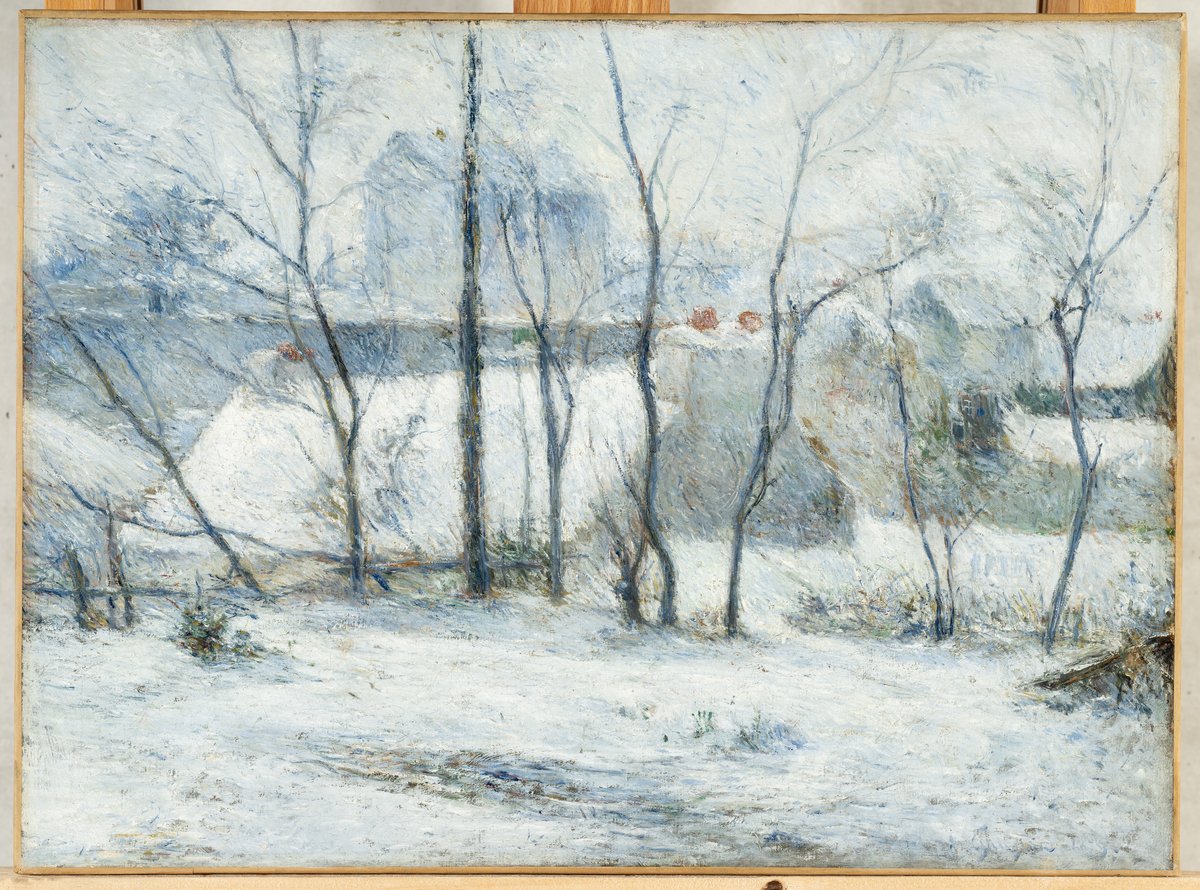
Garden Under Snow (1879) by Paul Gauguin
Garden Under Snow was one of Gauguin’s earliest works. It was completed before he traveled to Tahiti where his style changed dramatically. One of his most famous works from this period is entitled Where Do We Come From? What Are We? Where Are We Going? which displays the originality for which he was later renowned.
1
Paul Gauguin (1848-1903) though born in Paris, moved with his family to Peru, South America, when he was very young, His father died on the journey. When Gauguin was old enough, he sailed the seas as a merchant marine then later as a member of the French Navy. He later got married and had five children. Painting began as a hobby during his stint with the French Navy and continued when he took a job as a stockbroker. After the famous Salon in Paris accepted one of his works to show, he quit his job and made painting his focus. It was during this show that his works were noticed by the Impressionists group of Monet, Pissarro, and Degas who wanted to show his works at their exhibitions. Gauguin became friends with Vincent van Gogh around this time, and, for a period, the two spent a lot of time together. After an argument, Gauguin traveled to Tahiti to get away and to gain creative freedom; he felt the European art world was too constrained. During this trip, Gauguin painted his most original works. However, the art world did not appreciate these pieces, and they didn’t sell very well. Poor and sickly, he moved to a remote island where he later died. It was not until after his death that his paintings became popular. He influenced later artists such as Picasso and Matisse.
2
MUSIC APPRECIATION
| Carmina Burana: I. “O Fortuna” |
Though composed in the 20th century, Carmina Burana uses Latin poems from the 13th century as its lyrics. At the beginning of this piece, the author complains about Fate and Fortuna, the personification of luck in Roman mythology. This is a work written for a very large orchestra and choir and makes heavy use of percussion instruments.
3
Carl Orff (1895-1982) was born and educated in Munich. He became a conductor in various opera houses in the city, as he was developing his unique style of composition. His first major success, Carmina Burana (1937), illustrates his dedication to the expression of text with music, and rhythm with dance. Carmina Burana, along with his operas Der Mond (The Moon, 1938) and Die Kluge (The Clever Woman, 1942) established his international reputation as a composer. Larger stage works, including Antigonae (1947/48) and Oedipus Der Tyrann (1957/58), add a variety of speech effects to the chorus and orchestra for expressive purposes. Orff’s entire musical output is characterized by strong rhythms derived from rich text material and their interplay with melody. 4
- Lange, Krista, and Leigh Lowe. Second Grade Enrichment: Classical Core Curriculum. Teacher Guide. Memoria Press, 2017. ↩︎
- Ibid. ↩︎
- Music Appreciation I. I, Memoria Press.
↩︎ - Orchestra, Atlanta Symphony. “Carl Orff.” Atlanta Symphony Orchestra, http://www.aso.org/artists/detail/carl-orff. Accessed 1 Dec. 2025.
↩︎
 Providence School of Tifton