
ART APPRECIATION
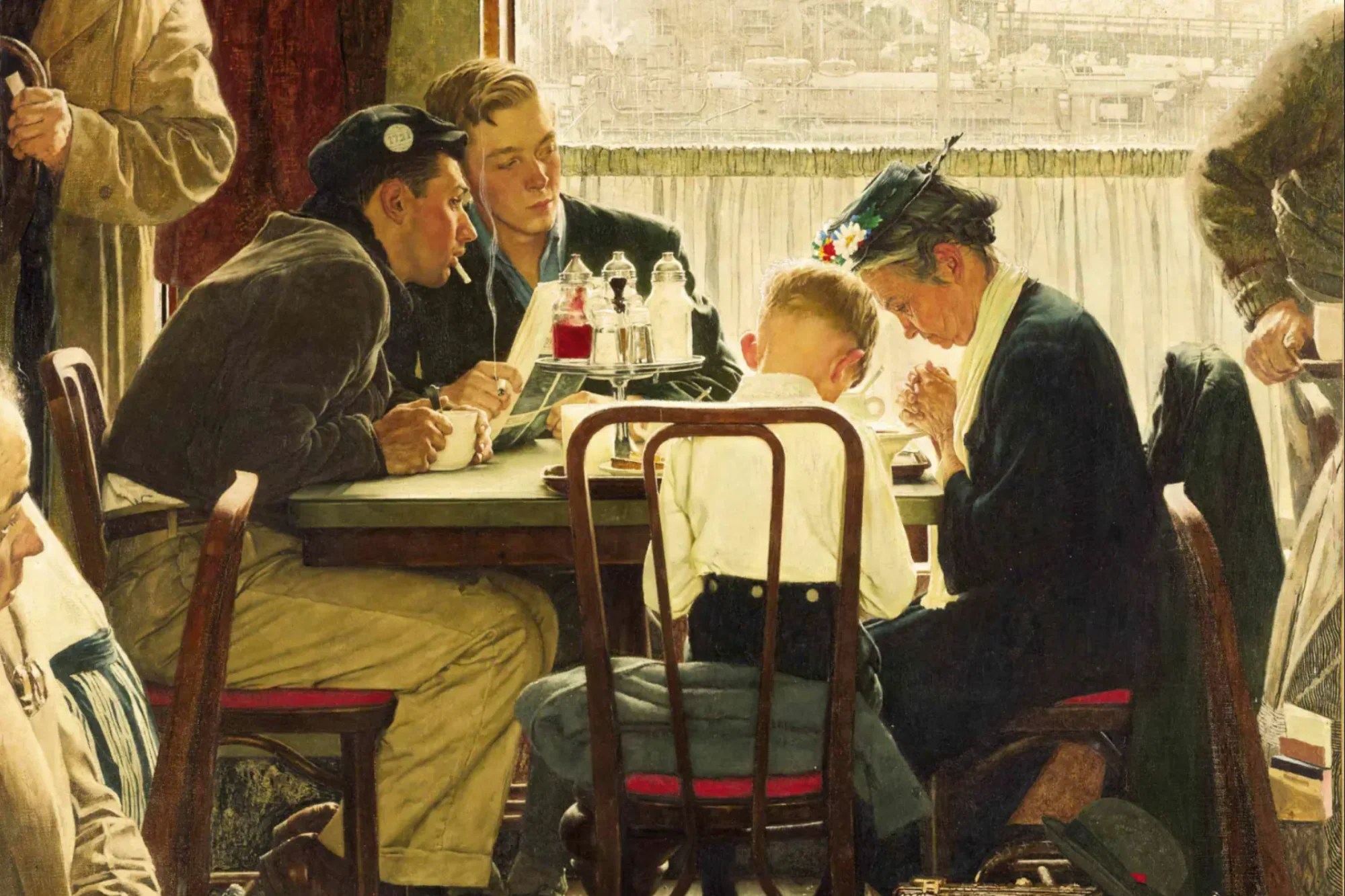
Saying Grace (1951) by Norman Rockwell
Saying Grace was a painting inspired by a letter Rockwell received from a lady who had encountered a similar scene in an Automat in Pennsylvania. She told Rockwell about a lady, whom she presumed to be Polish, with a young boy of five who happily took their food trays to a table in the diner where two other young men were already eating. The lady and boy sat down and prayed over their meal for a couple of minutes while the world around them continued on its frenetic pace. Their posture of gratitude was decidedly different from those around them. This painting sold for a record $46 million in 2013.
1
Norman Rockwell (1894-1978) was born in New York City. Rockwell’s parents allowed him to go to art school when he was 14 after seeing his drawings for Charles Dickens’s book A Christmas Carol. After high school he studied at The New York School of Art and The Art Students League where he learned about illustration. While still a teenager, he became the art director for Boys Life, a publication of the Boy Scouts of America. In 1916, he painted his first cover for The Saturday Evening Post. He eventually illustrated 321 covers for the Post over a 47 year period. Many of his most famous original paintings were covers for the magazine. Rockwell was well-known for staging his covers. He used photos with similar settings when painting. Some of his most well-known paintings are the Four Freedoms: Freedom of Speech, Freedom to Worship, Freedom from Want, and Freedom from Fear. They were inspired by a speech given by President Franklin D. Roosevelt in 1943. These particular paintings toured the United States in partnership with the U.S. Treasury and helped raise over $130 million through the sale of war bonds for the war effort. Rockwell received the highest honor for an American citizen, the Presidential Medal of Freedom, from President Gerald Ford in 1977.
2
MUSIC APPRECIATION
| Lyric Pieces, Book VII, Op. 62: No. 2, “Takk” (“Gratitude”) |
Lyric Pieces was a series of short pieces for solo piano that were written from 1867-1901. Grieg was a Norwegian composer during the Romantic era who was inspired by Norwegian landscapes, folk tales, and traditions. He began his career as a concert pianist in 1861. He is well-known for his piece “In the Hall of the Mountain King” which he wrote for the premiere of Henbrik Ibsen’s play Peer Gynt.
3
Edvard Grieg (1843-1907) was a Norwegian composer and pianist. He is widely considered one of the leading Romantic era composers, and his music is part of the standard classical repertoire worldwide. His use and development of Norwegian folk music in his own compositions put the music of Norway in the international spectrum, as well as helping to develop a national identity, much as Jean Sibelius and Antonín Dvořák did in Finland and Bohemia, respectively. 4
- Julie Rucker. ↩︎
- Ibid. ↩︎
- Ibid.
↩︎ - “Edvard Grieg.” Edvard Grieg – Steinway & Sons, http://www.steinway.com/artists/edvard-grieg. Accessed 25 Nov. 2025.
↩︎
 Providence School of Tifton