
ART APPRECIATION
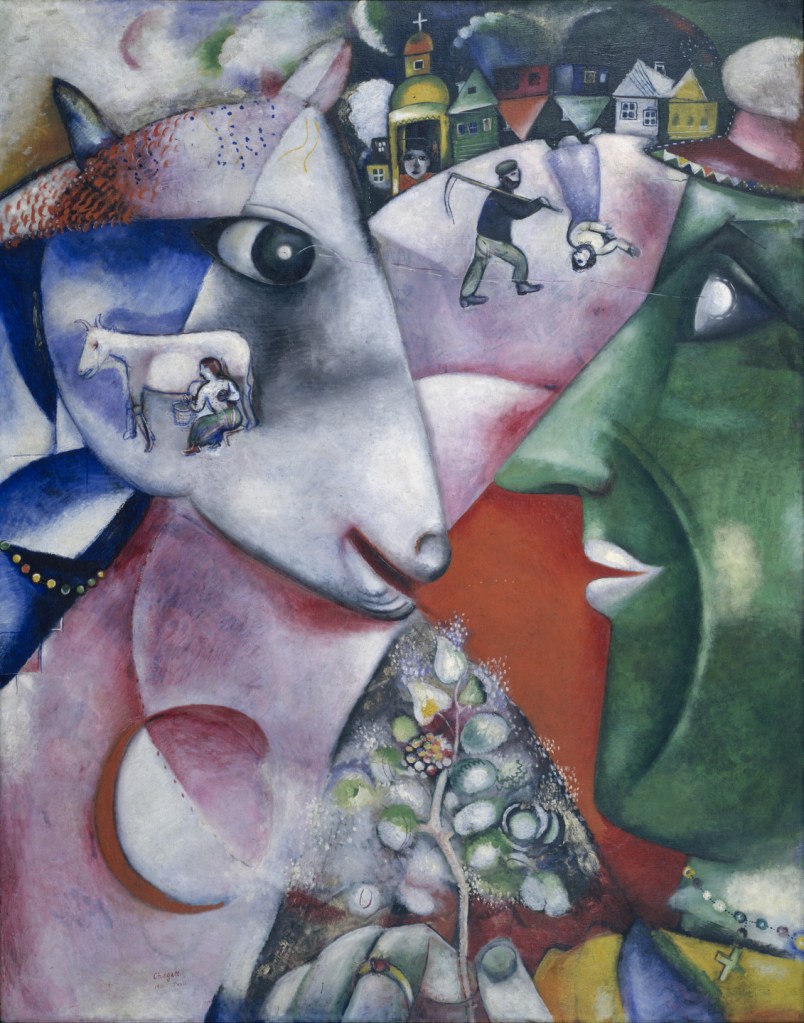
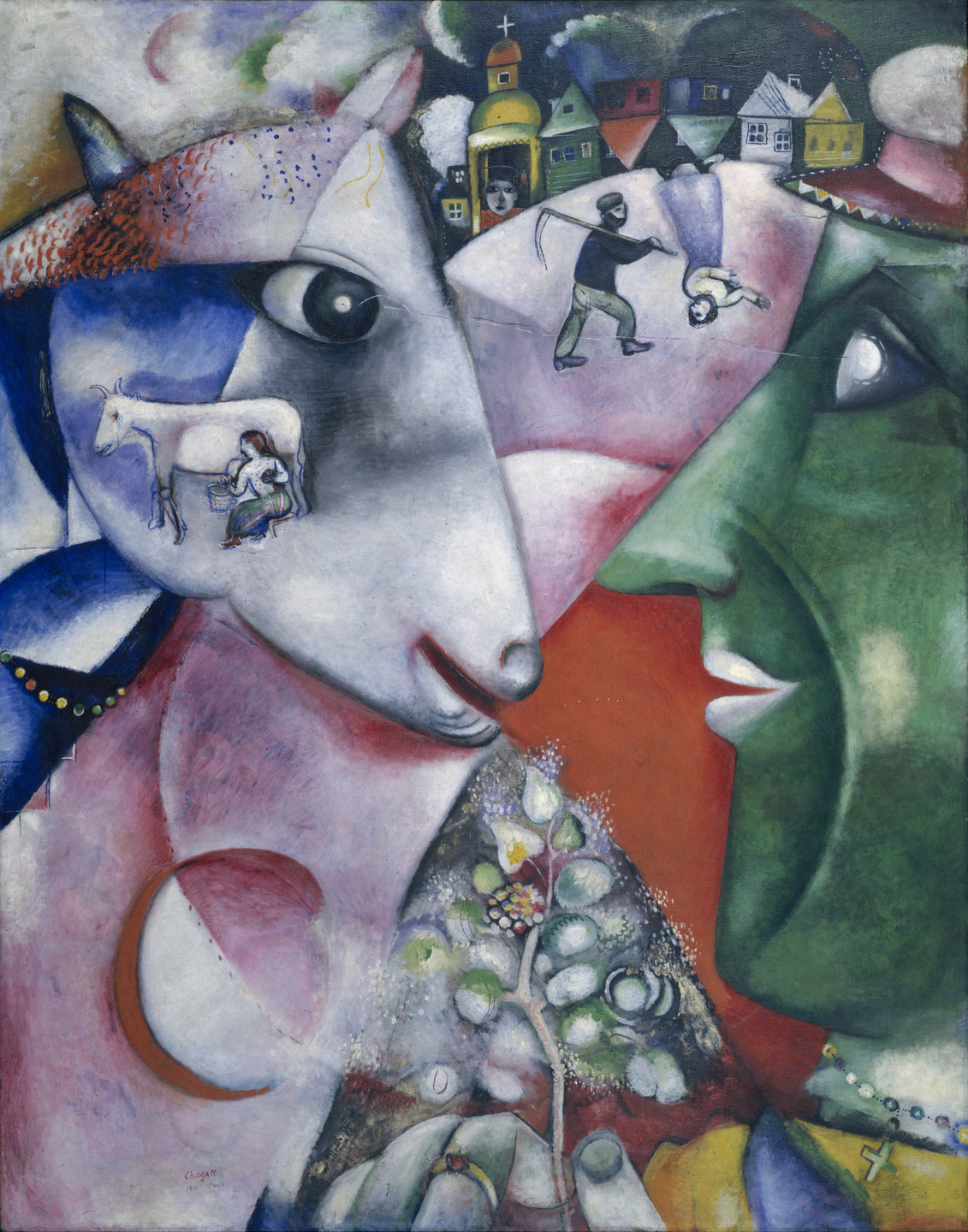
I and the Village (Modern Art – Cubanism) by Marc Chagall
This painting is one of Chagall’s earliest works that has survived. It is a self-portrait containing many memories from his youth. The city at the top is said to be his childhood town; it is also said to be a picture of his dreams evidenced by the lack of gravity and the upside-down houses. The painting is broken up into five different sections. Look closely and you will find Russian symbols and landscape, a horse, a farmer, a girl milking a cow, and upside-down houses.
1
Marc Chagall (1887-1985) was born in Belarus, part of the Russian empire. Raised with his eight siblings by devoutly Jewish parents, he attended a Jewish primary school but later went to a public school where he learned Russian.
At twenty, Chagall studied painting in St. Petersburg before moving to Paris, France. Living in an area of the city known as “the beehive” because several artists and writers lived there, he began to experiment with his style. He was influenced by the Impressionists, Post-Impressionists, Fauvists, and Cubists, whose works he saw there. Chagall created some of his best works, which became part of his first show in Berlin. It was a great success.
Hagall traveled the world extensively once World War I was over, and he spent two months in the Holy Land getting inspiration for his Bible etchings and Biblically-themed plates.
The beginning of WWII forced Chagall to move to far south France to escape the Nazis who had once praised but now feared his works and sought to destroy them. He finally moved to New York in the United States, where he worked once again designing sets and costumes, thai time for ballets. His works were honored in New York and Chicago.
In his later years, he designed several stained-glass windows for synagogues, the United Nations building, and several churches and cathedrals.
2
MUSIC APPRECIATION
| “Sabre Dance” from Gayane (1941-1942) |
Gayane is a fourt-part ballet composed by Khatchaturian, a Soviet-Armenian composer. “Sabre Dance,” one of the four parts. The “Sabre Dance” is a high-energy folk dance that is a part of the final part of the ballet.
3
Aram Khatchaturian (1903-1978) was an Armenian composer whose works were often influenced by Armenian folk music. By synthesizing folk music into formal classical compositions, Aram Khachaturian made a notable contribution to the world of music while preserving the robustness of the Armenian culture. The combination of the songs and rhythms of the Caucasus peoples with Western theoretical stylism created a bridge between the east and the west and made folk music themes very acceptable for classical concert performances. 4
- Lange, Krista, and Leigh Lowe. Second Grade Enrichment: Classical Core Curriculum. Teacher Guide. Memoria Press, 2017. ↩︎
- Ibid. ↩︎
- Music Appreciation I. I, Memoria Press.
↩︎ - Orchestra, Atlanta Symphony. “Aram Khachaturian.” Atlanta Symphony Orchestra, http://www.aso.org/artists/detail/aram-khachaturian. Accessed 16 Oct. 2025.
↩︎
 Providence School of Tifton