“Virtue simply means ‘excellence,’ and it usually refers to moral excellence, or excellence of character. Education is the process of forming excellent character in a student. The ancient Roman educator Quintilian famously stated that the true rhetorician is a good man speaking well. A person who speaks well is persuasive, but if that person lacks character, he or she would be persuading people wrongly. An education that fails to cultivate virtue in students is an education that fails.
For thousands of years, communities of God-honoring people have taught their children to love and fear God, for without a proper awe of God and a desire to please Him, wisdom and understanding are impossible. Classical education, then, recognizes that piety is the first step toward becoming virtuous. Without piety and the grace of God—most fully demonstrated in the life, death, and resurrection of Jesus—it is impossible to live a life that truly pleases Him. However, a righteous Christian life does not happen automatically or haphazardly; virtue formation happens slowly and requires intentional practice. Students need to begin practicing virtuous actions as early as possible so that these practices will become habits before they reach adulthood.
While there are many virtues that students should learn, practice and habituate, there are seven virtues that Christian educators have historically emphasized: Prudence, Justice, Fortitude, and Temperance (the four cardinal virtues), and Faith, Hope, and Love (the three theological virtues). The student who has been trained to practice these virtues and who has begun to habituate them in his or her own daily life will be prepared for adulthood and the manifold complexities and responsibilities of being a spouse, parent, church member, employee, neighbor, and friend.
The primary place of virtue formation in the life of a child is not school: it is the home and the church. It is the responsibility of parents, within the authority of and through participation in the church, to train their children to become godly adults. However, the school, in its secondary role, offers specific support to the family and the church that neither of those typically provide.
First, pragmatically speaking, children spend more of their waking hours at school than they do anywhere else. If the culture and practices of the school are forming the child in a different direction than the family and the church, the latter will have a much more difficult time properly fulfilling their role. However, if the culture and practices of the school are forming the child in the same direction as the family and the church, then they will be supported and encouraged as they carry out the difficult task of training a child to live in a way that pleases God.
The second and more specialized way that the school offers support to the family and church is through its academic training. Classical Christian education provides robust, foundational academic training that follows the liberal arts tradition in cultivating virtue in students for the sake of restoring the glory of God’s image in them.”
— Veritas School (Richmond, VA) on Virtue Formation
ROMANS 12:2
2 Do not be conformed to this world, but be transformed by the renewal of your mind, that by testing you may discern what is the will of God, what is good and acceptable and perfect.
COLLECT FOR PURITY
Almighty God, unto whom all hearts are open, all desires known, and from whom no secrets are hid; cleanse the thoughts of our hearts by the inspiration of your Holy Spirit, that we may perfectly love You, and worthily magnify your holy Name,
through Christ our Lord. Amen.
ART APPRECIATION
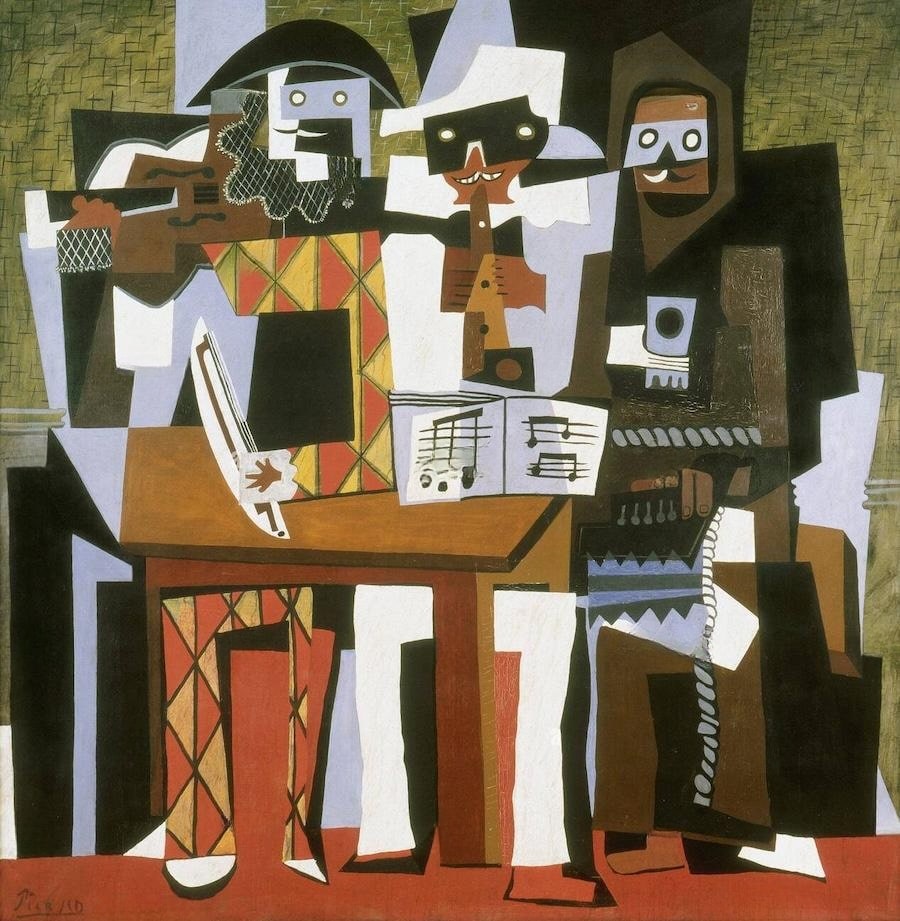
The Three Musicians is a famous example of Picasso’s style of Cubism. The three musicians are transformed into a sequence of two-dimensional planes, lines, and arcs.
1
Pablo Picasso (1811-1973) was born in Malaga, Spain. His name at birth was Pablo Diego Jose Franciso de Paula Juan Nepomunceno Maria de los Remedios Cipriano de la Santisima Trinidad Ruiz y Picasso. His parents gave him many names honoring saints and relatives. His mother claimed Pablo’s first words were “pencil, pencil” (in Spanish, of course). His father was a fine arts teacher at several schools, but legend has it that when he caught his 13-year-old-son finishing one of his paintings, he never painted again. Pablo was enrolled in a prestigious art academy, but soon quit because he didn’t like formal education. Instead, he moved to Paris to learn from the masters there. Picasso was the best-known figure in 20th century art and was more famous for his work during his lifetime than any other artist before him. He was a founder of a new art form called Cubism.
2
MUSIC APPRECIATION
| “O mio babbino caro” from Gianni Schicchi |
Puccini flirted briefly with faintly Wagnerian subjects in his early operas Le villi (1884) and Edgar (1889), though in these operas, the music owes much more to Verdi than to his Teutonic contemporary. Gianni Schicchi is a comparatively late work, comprising the third part of Puccini’s Il trittico (The Triptych), which premiered at the Metropolitan Opera in 1918. The libretto takes an episode from Dante’s Divine Comedy, the damnation of the will-forger Gianni Schicchi, as its starting point. His fraudulent will enriches his clan so that Lauretta, his daughter, can marry Rinuccio. In “O mio babbino caro,” one of Italian opera’s greatest tunes and a number that has become an archetype of late Romanticism’s final flowering in Puccini’s hands, Lauretta begs her father to go with her to buy a ring so she can marry, setting the whole forgery in motion. The tone of the aria is over-the-top in its voluptuousness, almost parodistic, which perfectly fits Lauretta’s melodramatic emotional state.
3
Giacomo Puccini (1858-1924) was an Italian composer, one of the greatest exponents of operatic realism, who virtually brought the history of Italian opera to an end. His mature operas included La Bohème (1896), Tosca (1900), Madama Butterfly (1904), and Turandot (left incomplete). 4
- Lange, Krista, and Leigh Lowe. First Grade Enrichment: Classical Core Curriculum. Teacher Guide. Memoria Press, 2017. ↩︎
- Ibid. ↩︎
- “‘O Mio Babbino Caro’ from Gianni Schicchi, Giacomo Puccini.” LA Phil, http://www.laphil.com/musicdb/pieces/56/o-mio-babbino-caro-from-gianni-schicchi. Accessed 15 Apr. 2025.
↩︎ - “Giuseppe Verdi.” Encyclopædia Britannica, Encyclopædia Britannica, inc., 19 Feb. 2025, http://www.britannica.com/biography/Giuseppe-Verdi.
↩︎
 Providence School of Tifton