
“Perhaps we are not following Christ all the way or in the right spirit. We are likely, for example, to be a little sparing of the palms and hosannas. We are chary of wielding the scourge of small cords, lest we should offend somebody or interfere with trade. We do not furnish up our wits to disentangle knotty questions about Sunday observance and tribute money, nor hasten to sit at the feet of the doctors, both hearing them and asking them questions. We pass hastily over disquieting jests about making friends with the mammon of unrighteousness and alarming observations about bringing not peace but a sword; nor do we distinguish ourselves by the graciousness by which we sit at meat with publicans and sinners. Somehow or other, and with the best intentions, we have shown the world the typical Christian in the likeness of a crashing and rather ill-natured bore—and this in the name of the one who assuredly never bored a soul in those thirty-three years
during which he passed through the world like a flame. Let us, in heaven’s name, drag out the divine drama from under the dreadful accumulation of slipshod thinking and trashy sentiment heaped upon it, and set it on an open stage to startle the world into some sort of vigorous reaction. If the pious are the first to be shocked, so much worse for the pious—others will pass into the kingdom of heaven before them. If all men are offended because of Christ, let them be offended; but where is the sense of their being offended at something that is not Christ and is nothing like him? We do him singularly little honor by watering down his personality till it could not offend a fly. Surely it is not the business of the Church to adapt Christ to men, but to adapt men to Christ.”
― Dorothy L. Sayers, Letters to a Diminished Church
PSALM 112
1 Praise the Lord!
Blessed is the man who fears the Lord,
who greatly delights in his commandments!
2 His offspring will be mighty in the land;
the generation of the upright will be blessed.
3 Wealth and riches are in his house,
and his righteousness endures forever.
4 Light dawns in the darkness for the upright;
he is gracious, merciful, and righteous.
5 It is well with the man who deals generously and lends;
who conducts his affairs with justice.
6 For the righteous will never be moved;
he will be remembered forever.
7 He is not afraid of bad news;
his heart is firm, trusting in the Lord.
8 His heart is steady; he will not be afraid,
until he looks in triumph on his adversaries.
9 He has distributed freely; he has given to the poor;
his righteousness endures forever;
his horn is exalted in honor.
10 The wicked man sees it and is angry;
he gnashes his teeth and melts away;
the desire of the wicked will perish!
ST. THOMAS’S PRAYER BEFORE STUDY
Creator of all things, true source of light and wisdom, origin of all being, graciously let a ray of your light penetrate the darkness of our understanding. Take from us the double darkness in which we have been born, an obscurity of sin and ignorance. Give us keen understanding, retentive memories, and the ability to grasp things correctly and fundamentally. Grant us the talent of being exact in our explanations and the ability to express ourselves with thoroughness and charm. Point out the beginning, direct the progress, and help in the completion. We ask this through Christ our Lord. Amen.
ART APPRECIATION
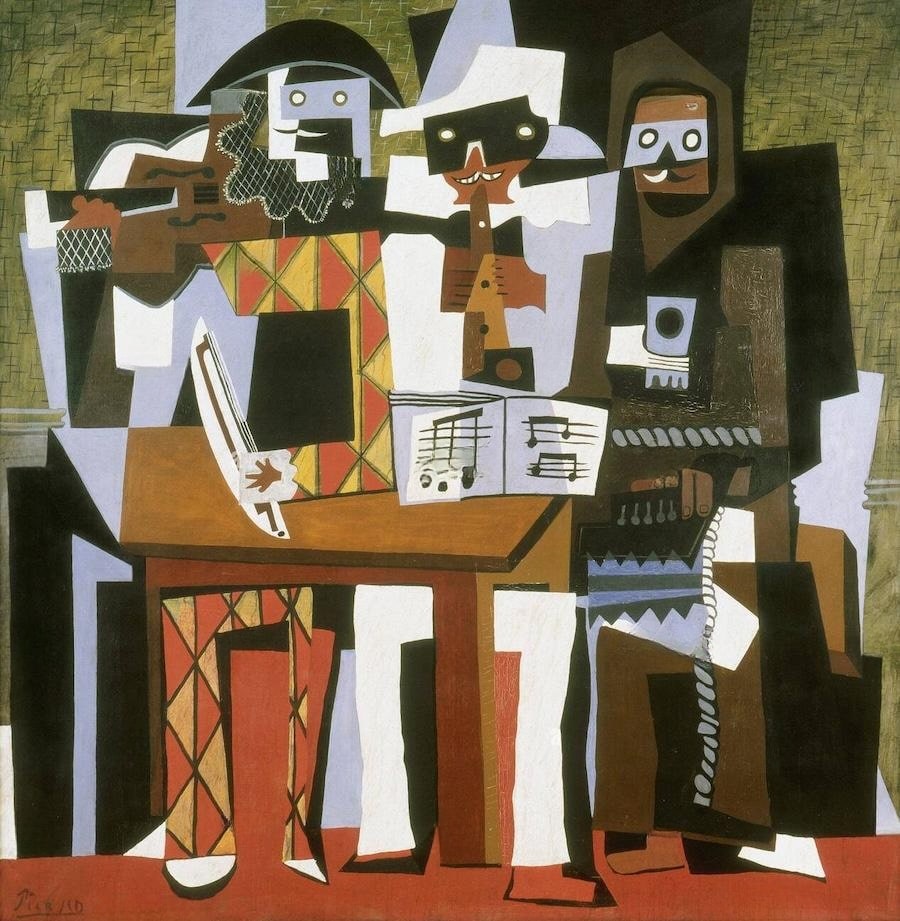
The Three Musicians is a famous example of Picasso’s style of Cubism. The three musicians are transformed into a sequence of two-dimensional planes, lines, and arcs.
1
Pablo Picasso (1811-1973) was born in Malaga, Spain. His name at birth was Pablo Diego Jose Franciso de Paula Juan Nepomunceno Maria de los Remedios Cipriano de la Santisima Trinidad Ruiz y Picasso. His parents gave him many names honoring saints and relatives. His mother claimed Pablo’s first words were “pencil, pencil” (in Spanish, of course). His father was a fine arts teacher at several schools, but legend has it that when he caught his 13-year-old-son finishing one of his paintings, he never painted again. Pablo was enrolled in a prestigious art academy, but soon quit because he didn’t like formal education. Instead, he moved to Paris to learn from the masters there. Picasso was the best-known figure in 20th century art and was more famous for his work during his lifetime than any other artist before him. He was a founder of a new art form called Cubism.
2
MUSIC APPRECIATION
| “O mio babbino caro” from Gianni Schicchi |
Puccini flirted briefly with faintly Wagnerian subjects in his early operas Le villi (1884) and Edgar (1889), though in these operas, the music owes much more to Verdi than to his Teutonic contemporary. Gianni Schicchi is a comparatively late work, comprising the third part of Puccini’s Il trittico (The Triptych), which premiered at the Metropolitan Opera in 1918. The libretto takes an episode from Dante’s Divine Comedy, the damnation of the will-forger Gianni Schicchi, as its starting point. His fraudulent will enriches his clan so that Lauretta, his daughter, can marry Rinuccio. In “O mio babbino caro,” one of Italian opera’s greatest tunes and a number that has become an archetype of late Romanticism’s final flowering in Puccini’s hands, Lauretta begs her father to go with her to buy a ring so she can marry, setting the whole forgery in motion. The tone of the aria is over-the-top in its voluptuousness, almost parodistic, which perfectly fits Lauretta’s melodramatic emotional state.
3
Giacomo Puccini (1858-1924) was an Italian composer, one of the greatest exponents of operatic realism, who virtually brought the history of Italian opera to an end. His mature operas included La Bohème (1896), Tosca (1900), Madama Butterfly (1904), and Turandot (left incomplete). 4
- Lange, Krista, and Leigh Lowe. First Grade Enrichment: Classical Core Curriculum. Teacher Guide. Memoria Press, 2017. ↩︎
- Ibid. ↩︎
- “‘O Mio Babbino Caro’ from Gianni Schicchi, Giacomo Puccini.” LA Phil, http://www.laphil.com/musicdb/pieces/56/o-mio-babbino-caro-from-gianni-schicchi. Accessed 15 Apr. 2025.
↩︎ - “Giuseppe Verdi.” Encyclopædia Britannica, Encyclopædia Britannica, inc., 19 Feb. 2025, http://www.britannica.com/biography/Giuseppe-Verdi.
↩︎
 Providence School of Tifton