“In half a dozen classrooms they gather then,—here to follow the love song of Dido, here to listen to the tale of Troy divine; there to wander among the stars, there to wander among men and nations,—and elsewhere other well-worn ways of knowing this queer world. Nothing new, no time-saving devices, simply old time-glorified methods of delving for Truth, and searching out the hidden beauties of life, and learning the good of living.”
— W.E.B. Du Bois, The Souls of Black Folk
1 PETER 3:18-22
18 For Christ also suffered once for sins, the righteous for the unrighteous, that he might bring us to God, being put to death in the flesh but made alive in the spirit, 19 in which he went and proclaimed to the spirits in prison, 20 because they formerly did not obey, when God’s patience waited in the days of Noah, while the ark was being prepared, in which a few, that is, eight persons, were brought safely through water. 21 Baptism, which corresponds to this, now saves you, not as a removal of dirt from the body but as an appeal to God for a good conscience, through the resurrection of Jesus Christ, 22 who has gone into heaven and is at the right hand of God, with angels, authorities, and powers having been subjected to
him.
ST. THOMAS’S PRAYER BEFORE STUDY
Creator of all things, true source of light and wisdom, origin of all being, graciously let a ray of your light penetrate the darkness of our understanding. Take from us the double darkness in which we have been born, an obscurity of sin and ignorance. Give us keen understanding, retentive memories, and the ability to grasp things correctly and fundamentally. Grant us the talent of being exact in our explanations and the ability to express ourselves with thoroughness and charm. Point out the beginning, direct the progress, and help in the completion. We ask this through Christ our Lord. Amen.
ART APPRECIATION
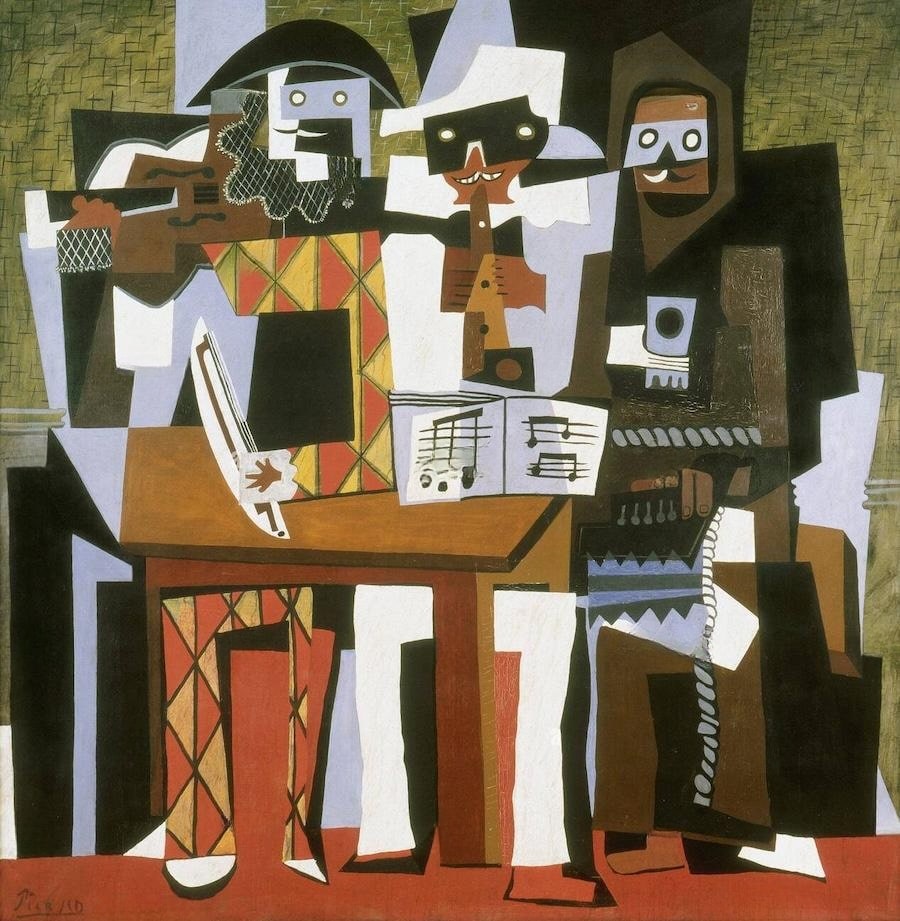
The Three Musicians is a famous example of Picasso’s style of Cubism. The three musicians are transformed into a sequence of two-dimensional planes, lines, and arcs.
1
Pablo Picasso (1811-1973) was born in Malaga, Spain. His name at birth was Pablo Diego Jose Franciso de Paula Juan Nepomunceno Maria de los Remedios Cipriano de la Santisima Trinidad Ruiz y Picasso. His parents gave him many names honoring saints and relatives. His mother claimed Pablo’s first words were “pencil, pencil” (in Spanish, of course). His father was a fine arts teacher at several schools, but legend has it that when he caught his 13-year-old-son finishing one of his paintings, he never painted again. Pablo was enrolled in a prestigious art academy, but soon quit because he didn’t like formal education. Instead, he moved to Paris to learn from the masters there. Picasso was the best-known figure in 20th century art and was more famous for his work during his lifetime than any other artist before him. He was a founder of a new art form called Cubism.
2
MUSIC APPRECIATION
| “O mio babbino caro” from Gianni Schicchi |
Puccini flirted briefly with faintly Wagnerian subjects in his early operas Le villi (1884) and Edgar (1889), though in these operas, the music owes much more to Verdi than to his Teutonic contemporary. Gianni Schicchi is a comparatively late work, comprising the third part of Puccini’s Il trittico (The Triptych), which premiered at the Metropolitan Opera in 1918. The libretto takes an episode from Dante’s Divine Comedy, the damnation of the will-forger Gianni Schicchi, as its starting point. His fraudulent will enriches his clan so that Lauretta, his daughter, can marry Rinuccio. In “O mio babbino caro,” one of Italian opera’s greatest tunes and a number that has become an archetype of late Romanticism’s final flowering in Puccini’s hands, Lauretta begs her father to go with her to buy a ring so she can marry, setting the whole forgery in motion. The tone of the aria is over-the-top in its voluptuousness, almost parodistic, which perfectly fits Lauretta’s melodramatic emotional state.
3
Giacomo Puccini (1858-1924) was an Italian composer, one of the greatest exponents of operatic realism, who virtually brought the history of Italian opera to an end. His mature operas included La Bohème (1896), Tosca (1900), Madama Butterfly (1904), and Turandot (left incomplete). 4
- Lange, Krista, and Leigh Lowe. First Grade Enrichment: Classical Core Curriculum. Teacher Guide. Memoria Press, 2017. ↩︎
- Ibid. ↩︎
- “‘O Mio Babbino Caro’ from Gianni Schicchi, Giacomo Puccini.” LA Phil, http://www.laphil.com/musicdb/pieces/56/o-mio-babbino-caro-from-gianni-schicchi. Accessed 15 Apr. 2025.
↩︎ - “Giuseppe Verdi.” Encyclopædia Britannica, Encyclopædia Britannica, inc., 19 Feb. 2025, http://www.britannica.com/biography/Giuseppe-Verdi.
↩︎
 Providence School of Tifton