
“This life therefore is not righteousness, but growth in righteousness, not health, but healing, not being but becoming, not rest but exercise. We are not yet what we shall be, but we are growing toward it, the process is not yet finished, but it is
going on, this is not the end, but it is the road. All does not yet gleam in glory, but all is being purified.”
— Martin Luther, Defense of all the Articles
GALATIANS 1:6-10
6 I am astonished that you are so quickly deserting him who called you in the grace of Christ and are turning to a different gospel— 7 not that there is another one, but there are some who trouble you and want to distort the gospel of Christ. 8 But even if we or an angel from heaven should preach to you a gospel contrary to the one we preached to you, let him be accursed. 9 As we have said before, so now I say again: If anyone is preaching to you a gospel contrary to the one you received, let him be accursed. 10 For am I now seeking the approval of man, or of God? Or am I trying to please man? If I were still trying to please man, I would not be a servant of Christ.
THE PRAYER OF GENERAL CONFESSION
Almighty and most merciful Father; we have erred, and strayed from thy ways like lost sheep. We have followed too much the devices and desires of our hearts. We have of ended against thy holy laws. We have left undone those things which we ought to have done; and we have done those things which we ought not to have done’ and there is no health in us. But thou, O Lord, have mercy upon us, miserable of enders. Spare thou them, O God which confess their faults. Restore thou them that are penitent; according thy promises declared unto mankind in Christ Jesus our Lord. And grant, O most merciful Father, for his sake; that we may hereafter live a godly, righteous, and sober life, to the glory of thy holy Name.
Amen.
ART APPRECIATION
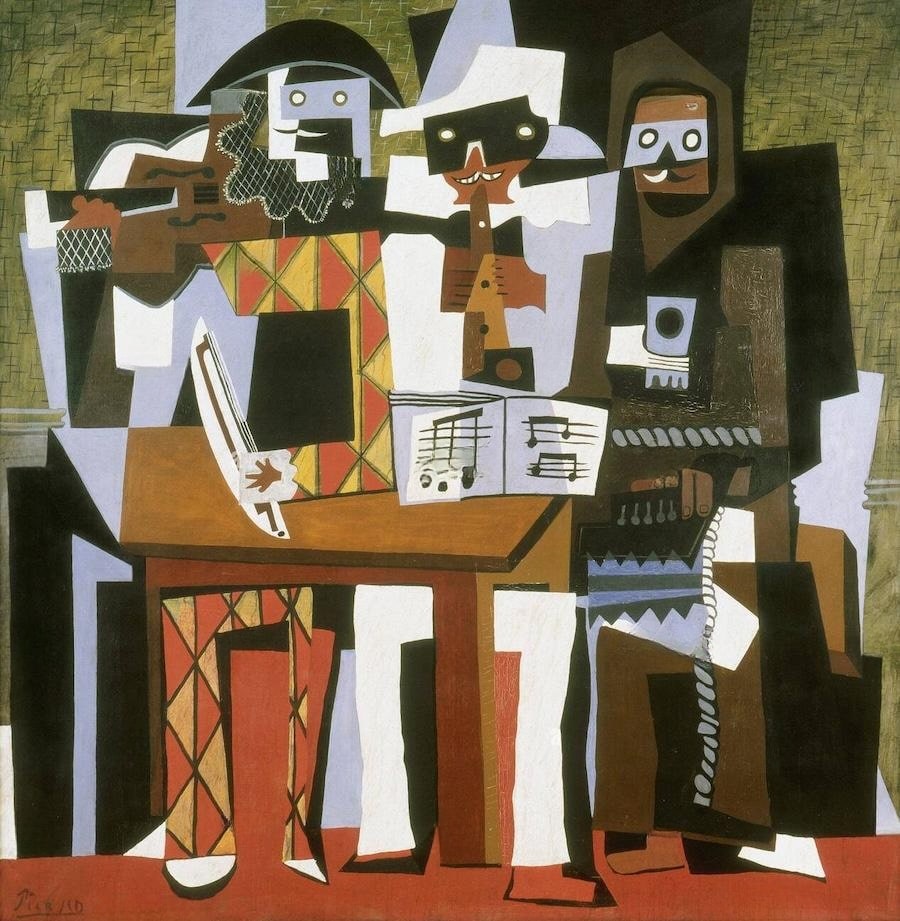
The Three Musicians is a famous example of Picasso’s style of Cubism. The three musicians are transformed into a sequence of two-dimensional planes, lines, and arcs.
1
Pablo Picasso (1811-1973) was born in Malaga, Spain. His name at birth was Pablo Diego Jose Franciso de Paula Juan Nepomunceno Maria de los Remedios Cipriano de la Santisima Trinidad Ruiz y Picasso. His parents gave him many names honoring saints and relatives. His mother claimed Pablo’s first words were “pencil, pencil” (in Spanish, of course). His father was a fine arts teacher at several schools, but legend has it that when he caught his 13-year-old-son finishing one of his paintings, he never painted again. Pablo was enrolled in a prestigious art academy, but soon quit because he didn’t like formal education. Instead, he moved to Paris to learn from the masters there. Picasso was the best-known figure in 20th century art and was more famous for his work during his lifetime than any other artist before him. He was a founder of a new art form called Cubism.
2
MUSIC APPRECIATION
| “O mio babbino caro” from Gianni Schicchi |
Puccini flirted briefly with faintly Wagnerian subjects in his early operas Le villi (1884) and Edgar (1889), though in these operas, the music owes much more to Verdi than to his Teutonic contemporary. Gianni Schicchi is a comparatively late work, comprising the third part of Puccini’s Il trittico (The Triptych), which premiered at the Metropolitan Opera in 1918. The libretto takes an episode from Dante’s Divine Comedy, the damnation of the will-forger Gianni Schicchi, as its starting point. His fraudulent will enriches his clan so that Lauretta, his daughter, can marry Rinuccio. In “O mio babbino caro,” one of Italian opera’s greatest tunes and a number that has become an archetype of late Romanticism’s final flowering in Puccini’s hands, Lauretta begs her father to go with her to buy a ring so she can marry, setting the whole forgery in motion. The tone of the aria is over-the-top in its voluptuousness, almost parodistic, which perfectly fits Lauretta’s melodramatic emotional state.
3
Giacomo Puccini (1858-1924) was an Italian composer, one of the greatest exponents of operatic realism, who virtually brought the history of Italian opera to an end. His mature operas included La Bohème (1896), Tosca (1900), Madama Butterfly (1904), and Turandot (left incomplete). 4
- Lange, Krista, and Leigh Lowe. First Grade Enrichment: Classical Core Curriculum. Teacher Guide. Memoria Press, 2017. ↩︎
- Ibid. ↩︎
- “‘O Mio Babbino Caro’ from Gianni Schicchi, Giacomo Puccini.” LA Phil, http://www.laphil.com/musicdb/pieces/56/o-mio-babbino-caro-from-gianni-schicchi. Accessed 15 Apr. 2025.
↩︎ - “Giuseppe Verdi.” Encyclopædia Britannica, Encyclopædia Britannica, inc., 19 Feb. 2025, http://www.britannica.com/biography/Giuseppe-Verdi.
↩︎
 Providence School of Tifton