“The catechism is, quite simply, other people’s words, the words of wise men, sage women, saints, and authors of Scripture. Class opens with the recitation of wise men’s words because their words matter more than ours. We have not convened to judge the ancients, but to be judged by them; we have not gathered to speak our minds, but to have our minds formed by the Western canon.”
— Joshua Gibbs, Something They Will Not Forget: A Handbook for Classical Teachers
2 CORINTHIANS 10:13-18
13 But we will not boast beyond limits, but will boast only with regard to the area of influence God assigned to us, to reach even to you. 14 For we are not overextending ourselves, as though we did not reach you. For we were the first to come all the way to you with the gospel of Christ. 15 We do not boast beyond limit in the labors of others. But our hope is that as your faith increases, our area of influence among you may be greatly enlarged, 16 so that we may preach the gospel in lands beyond you, without boasting of work already done in another’s area of influence. 17 “Let the one who boasts, boast in the Lord.” 18 For it is not the one who commends himself who is approved, but the one whom the Lord commends.
ST. FRANCIS’S PRAYER OF DESIRE
Therefore, let us desire nothing else, let us want nothing else, let nothing else please us and cause us delight except you our Creator, Redeemer and Savior, the only true God, Who is the fullness of good, all good, every good, the true and supreme good, Who alone is good, merciful, gentle, delightful, and sweet, Who alone is holy, just, true, holy, and upright, Who alone is kind, innocent, clean, from Whom, through Whom and in Whom is all pardon, all grace, all glory of all penitents and just ones, of all the blessed rejoicing together in heaven. Amen.
ART APPRECIATION
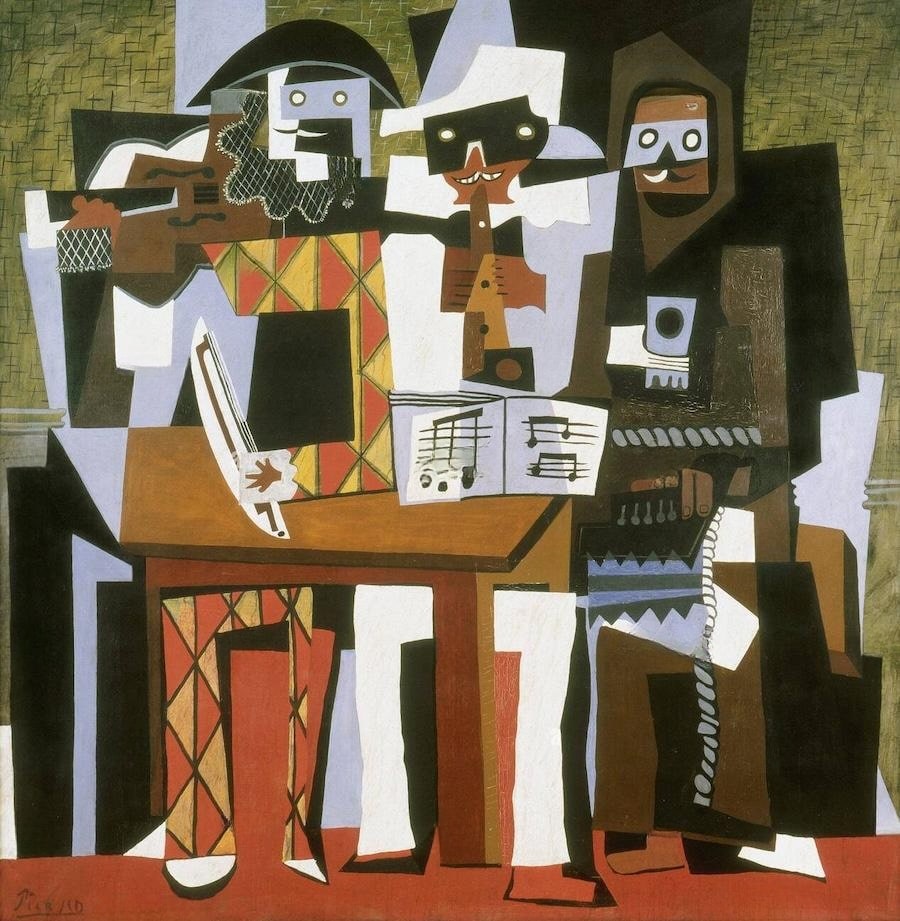
The Three Musicians is a famous example of Picasso’s style of Cubism. The three musicians are transformed into a sequence of two-dimensional planes, lines, and arcs.
1
Pablo Picasso (1811-1973) was born in Malaga, Spain. His name at birth was Pablo Diego Jose Franciso de Paula Juan Nepomunceno Maria de los Remedios Cipriano de la Santisima Trinidad Ruiz y Picasso. His parents gave him many names honoring saints and relatives. His mother claimed Pablo’s first words were “pencil, pencil” (in Spanish, of course). His father was a fine arts teacher at several schools, but legend has it that when he caught his 13-year-old-son finishing one of his paintings, he never painted again. Pablo was enrolled in a prestigious art academy, but soon quit because he didn’t like formal education. Instead, he moved to Paris to learn from the masters there. Picasso was the best-known figure in 20th century art and was more famous for his work during his lifetime than any other artist before him. He was a founder of a new art form called Cubism.
2
MUSIC APPRECIATION
| “O mio babbino caro” from Gianni Schicchi |
Puccini flirted briefly with faintly Wagnerian subjects in his early operas Le villi (1884) and Edgar (1889), though in these operas, the music owes much more to Verdi than to his Teutonic contemporary. Gianni Schicchi is a comparatively late work, comprising the third part of Puccini’s Il trittico (The Triptych), which premiered at the Metropolitan Opera in 1918. The libretto takes an episode from Dante’s Divine Comedy, the damnation of the will-forger Gianni Schicchi, as its starting point. His fraudulent will enriches his clan so that Lauretta, his daughter, can marry Rinuccio. In “O mio babbino caro,” one of Italian opera’s greatest tunes and a number that has become an archetype of late Romanticism’s final flowering in Puccini’s hands, Lauretta begs her father to go with her to buy a ring so she can marry, setting the whole forgery in motion. The tone of the aria is over-the-top in its voluptuousness, almost parodistic, which perfectly fits Lauretta’s melodramatic emotional state.
3
Giacomo Puccini (1858-1924) was an Italian composer, one of the greatest exponents of operatic realism, who virtually brought the history of Italian opera to an end. His mature operas included La Bohème (1896), Tosca (1900), Madama Butterfly (1904), and Turandot (left incomplete). 4
- Lange, Krista, and Leigh Lowe. First Grade Enrichment: Classical Core Curriculum. Teacher Guide. Memoria Press, 2017. ↩︎
- Ibid. ↩︎
- “‘O Mio Babbino Caro’ from Gianni Schicchi, Giacomo Puccini.” LA Phil, http://www.laphil.com/musicdb/pieces/56/o-mio-babbino-caro-from-gianni-schicchi. Accessed 15 Apr. 2025.
↩︎ - “Giuseppe Verdi.” Encyclopædia Britannica, Encyclopædia Britannica, inc., 19 Feb. 2025, http://www.britannica.com/biography/Giuseppe-Verdi.
↩︎
 Providence School of Tifton