
Providence School of Tifton Student Vision
Providence strives to graduate young men and women that live a life which glorifies their Creator by:
⎼ loving God with all their heart, soul mind, and strength;
⎼ equipping them to elevate Truth above all else;
⎼ evaluating all human knowledge and experience in light of Scripture;
⎼ participating in “The Great Conversation” by listening carefully and responding with eloquence, precision, and sound reason;
⎼ create a life-long passion for learning and continuing to apply the tools of learning throughout their life;
⎼ serving their community with humility, gratitude, and grace.
ROMANS 5:1-5
1 Therefore, since we have been justified by faith, we have peace with God through our Lord Jesus Christ. 2 Through him we have also obtained access by faith into this grace in which we stand, and we rejoice in hope of the glory of God. 3 Not only that, but we rejoice in our sufferings, knowing that suffering produces endurance, 4 and endurance produces character, and character produces hope 5 and hope does not put us to shame, because God’s love has been poured into our hearts through the Holy Spirit who has been given to us.
COLLECT FOR PURITY
Almighty God, unto whom all hearts are open, all desires known, and from whom no secrets are hid; cleanse the thoughts of our hearts by the inspiration of your Holy Spirit, that we may perfectly love You, and worthily magnify your holy Name,
through Christ our Lord. Amen.
ART APPRECIATION
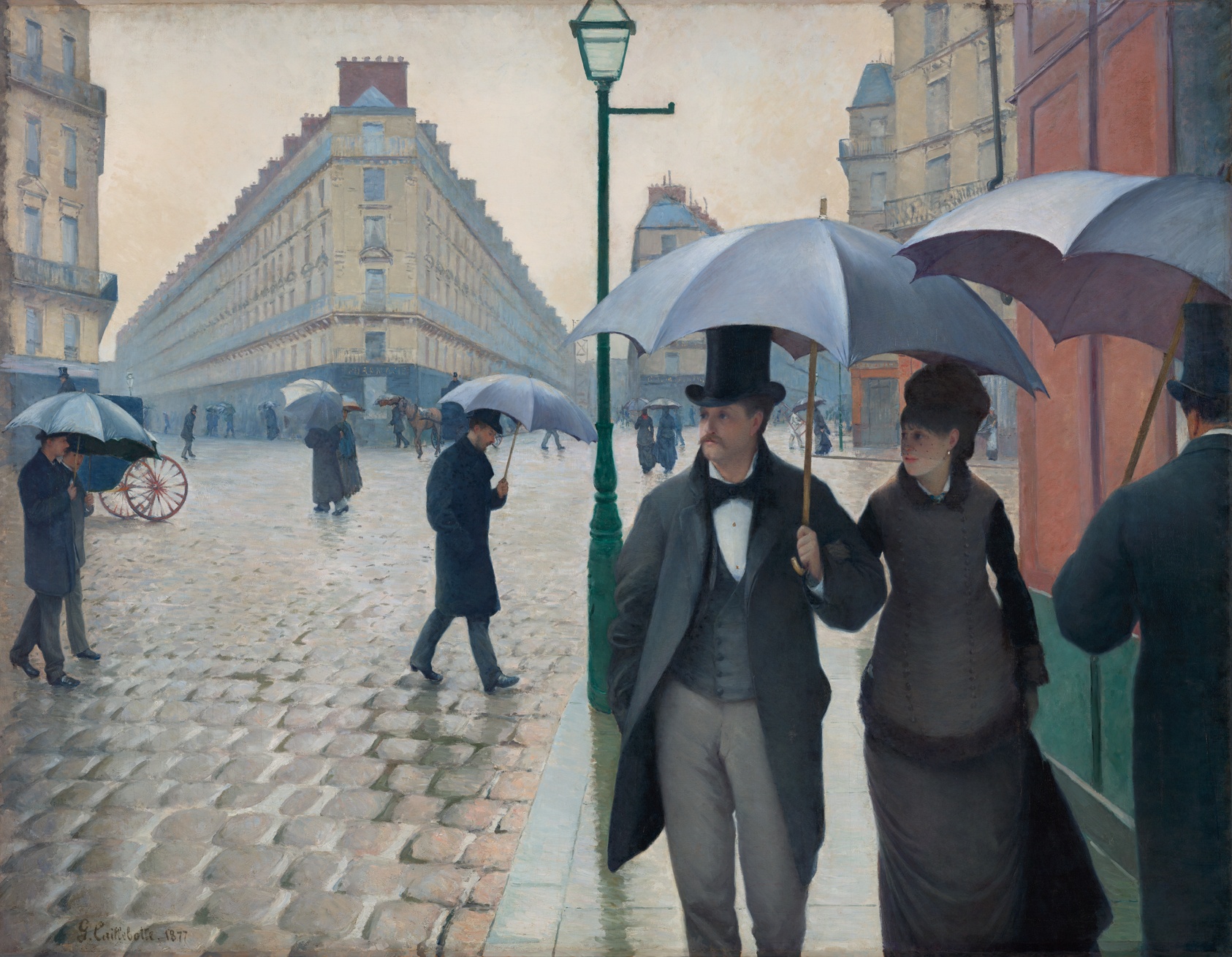
Caillebotte painted many scenes of the city, especially the broad boulevards of Paris. At the time of this painting (1877), this was a picture of a very modern Paris. We see people of different classes going about their business and the huge apartment buildings in the background. We see shadows and light reflecting off the cobblestones. Although this masterpiece looks like a snapshot, it is well-balanced. Caillebotte’s paintings often looked more realistic than those of his contemporaries.
1
Gustave Caillebotte (1848-1894) trained to be an engineer but became interested in painting and attended the Ecole des Beaux-Arts in Paris. He met Edgar Degas, Claude Monet, and Auguste Renior in 1874 and became the chief organizer, promoter, and financial backer of the Impressionist exhibitions for several years. Although Caillebotte was a remarkable artist, he is lesser known because many of his works remained in his family and his works were not reproduced until the later 1900s. Caillebotte was one of the first Impressionist artists to be influenced by photography in his paintings.
2
MUSIC APPRECIATION
| Piano Concerto No. 2 in C Minor, op. 18: I. “Moderato” |
Piano Concerto No. 2 in C Minor, Op. 18, composition for piano and orchestra by Sergei Rachmaninoff. It premiered on November 9, 1901, and contains themes that, throughout the 20th century, would be reborn as the melodies of several popular songs, including Frank Sinatra’s 1945 “Full Moon and Empty Arms” and Eric Carmen’s 1975 “All by Myself”; Carmen, trained as a classical pianist, shared songwriting credit with the long-dead Rachmaninoff. It was made most famous when a portion of the second movement was set as the haunting motif of David Lean’s 1945 film Brief Encounter.
3
Sergei Rachmaninoff (1873-1943) was a composer who was the last great figure of the tradition of Russian Romanticism and a leading piano virtuoso of his time. He is especially known for his piano concerti and the piece for piano and orchestra titled Rhapsody on a Theme of Paganini (1934). 4
- Lange, Krista, and Leigh Lowe. First Grade Enrichment: Classical Core Curriculum. Teacher Guide. Memoria Press, 2017. ↩︎
- Ibid. ↩︎
- “Piano Concerto No. 2 in C Minor, Op. 18.” Encyclopædia Britannica, Encyclopædia Britannica, inc., http://www.britannica.com/topic/Piano-Concerto-No-2-Rachmaninoff. Accessed 28 Mar. 2025.
↩︎ - “Sergey Rachmaninoff.” Encyclopædia Britannica, Encyclopædia Britannica, inc., 28 Mar. 2025, http://www.britannica.com/biography/Sergey-Rachmaninoff.
↩︎
 Providence School of Tifton