
“I would rather be what God chose to make me than the most glorious creature that I could think of; for to have been thought about, born in God’s thought, and then made by God, is the dearest, grandest and most precious thing in all
thinking.”
― George MacDonald, Davin Elinbord
REVELATION 4:1-11
1 After this I looked, and behold, a door standing open in heaven! And the first voice, which I had heard speaking to me like a trumpet, said, “Come up here, and I will show you what must take place after this.” 2 At once I was in the Spirit, and behold, a throne stood in heaven, with one seated on the throne. 3 And he who sat there had the appearance of jasper and carnelian, and around the throne was a rainbow that had the appearance of an emerald. 4 Around the throne were twenty-four thrones, and seated on the thrones were twenty-four elders, clothed in white garments, with golden crowns on their heads. 5 From the throne came flashes of lightning, and rumblings and peals of thunder, and before the throne were burning seven torches of fire, which are the seven spirits of God, 6 and before the throne there was as it were a sea of glass, like crystal. And around the throne, on each side of the throne, are four living creatures, full of eyes in front and behind: 7 the first living creature like a lion, the second living creature like an ox, the third living creature with the face of a man, and the fourth living creature like an eagle in flight. 8 And the four living creatures, each of them with six wings, are full of eyes all around and within, and day and night they never cease to say, “Holy, holy, holy, is the Lord God Almighty, who was and is and is to come!” 9 And whenever the living creatures give glory and honor and thanks to him who is seated on the throne, who lives forever and ever, 10 the twenty-four elders fall down before him who is seated on the throne and worship him who lives forever and ever. They cast their crowns before the throne, saying, 11 “Worthy are you, our Lord and God, to receive glory and honor and power, for you created all things, and by your will they existed
and were created.”
ST. FRANCIS’S PRAYER OF DESIRE
Therefore, let us desire nothing else, let us want nothing else, let nothing else please us and cause us delight except you our Creator, Redeemer and Savior, the only true God, Who is the fullness of good, all good, every good, the true and supreme good, Who alone is good, merciful, gentle, delightful, and sweet, Who alone is holy, just, true, holy, and upright, Who alone is kind, innocent, clean, from Whom, through Whom and in Whom is all pardon, all grace, all glory of all penitents and just ones, of all the blessed rejoicing together in heaven. Amen.
ART APPRECIATION
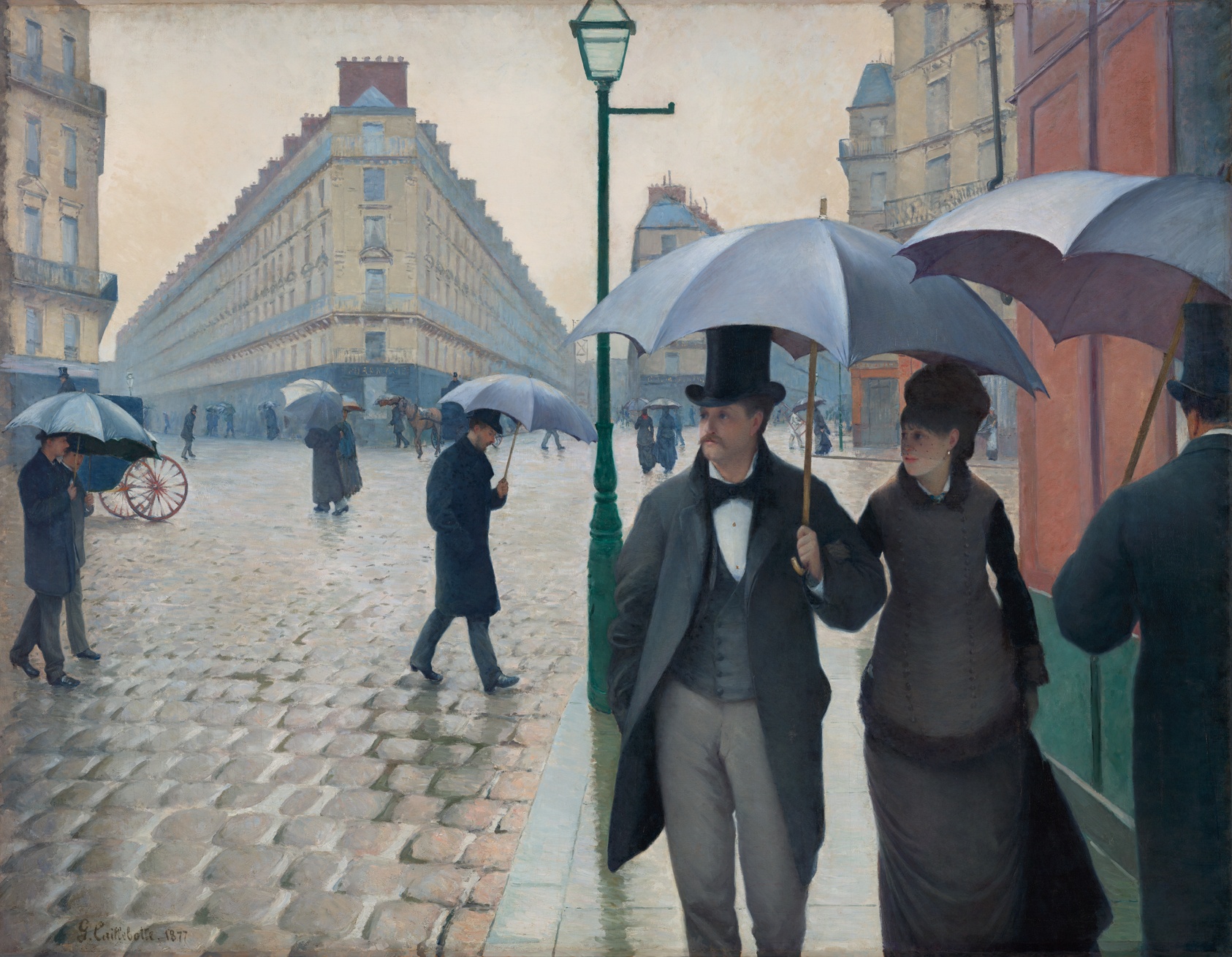
Caillebotte painted many scenes of the city, especially the broad boulevards of Paris. At the time of this painting (1877), this was a picture of a very modern Paris. We see people of different classes going about their business and the huge apartment buildings in the background. We see shadows and light reflecting off the cobblestones. Although this masterpiece looks like a snapshot, it is well-balanced. Caillebotte’s paintings often looked more realistic than those of his contemporaries.
1
Gustave Caillebotte (1848-1894) trained to be an engineer but became interested in painting and attended the Ecole des Beaux-Arts in Paris. He met Edgar Degas, Claude Monet, and Auguste Renior in 1874 and became the chief organizer, promoter, and financial backer of the Impressionist exhibitions for several years. Although Caillebotte was a remarkable artist, he is lesser known because many of his works remained in his family and his works were not reproduced until the later 1900s. Caillebotte was one of the first Impressionist artists to be influenced by photography in his paintings.
2
MUSIC APPRECIATION
| Piano Concerto No. 2 in C Minor, op. 18: I. “Moderato” |
Piano Concerto No. 2 in C Minor, Op. 18, composition for piano and orchestra by Sergei Rachmaninoff. It premiered on November 9, 1901, and contains themes that, throughout the 20th century, would be reborn as the melodies of several popular songs, including Frank Sinatra’s 1945 “Full Moon and Empty Arms” and Eric Carmen’s 1975 “All by Myself”; Carmen, trained as a classical pianist, shared songwriting credit with the long-dead Rachmaninoff. It was made most famous when a portion of the second movement was set as the haunting motif of David Lean’s 1945 film Brief Encounter.
3
Sergei Rachmaninoff (1873-1943) was a composer who was the last great figure of the tradition of Russian Romanticism and a leading piano virtuoso of his time. He is especially known for his piano concerti and the piece for piano and orchestra titled Rhapsody on a Theme of Paganini (1934). 4
- Lange, Krista, and Leigh Lowe. First Grade Enrichment: Classical Core Curriculum. Teacher Guide. Memoria Press, 2017. ↩︎
- Ibid. ↩︎
- “Piano Concerto No. 2 in C Minor, Op. 18.” Encyclopædia Britannica, Encyclopædia Britannica, inc., http://www.britannica.com/topic/Piano-Concerto-No-2-Rachmaninoff. Accessed 28 Mar. 2025.
↩︎ - “Sergey Rachmaninoff.” Encyclopædia Britannica, Encyclopædia Britannica, inc., 28 Mar. 2025, http://www.britannica.com/biography/Sergey-Rachmaninoff.
↩︎
 Providence School of Tifton