
“Jesus literally sang as He was preparing to go to the cross. So, the sacrifices you will make for your children should be something you can sing over. If there is not a song in it, it is not a biblical sacrifice.”
― Douglas Wilson, Why Children Matter
GENESIS 3:16-19
16 To the woman he said, “I will surely multiply your pain in childbearing; in pain you shall bring forth children. Your desire shall be contrary to your husband, but he shall rule over you.” 17 And to Adam he said, “Because you have listened
to the voice of your wife and have eaten of the tree of which I commanded you, ‘You shall not eat of it,’ cursed is the ground because of you; in pain you shall eat of it all the days of your life; 18 thorns and thistles it shall bring forth for you; and you shall eat the plants of the field. 19 By the sweat of your face you shall eat bread, till you return to the ground, for out of it you were taken; for you are dust, and to dust you shall return.”
ST. THOMAS’S PRAYER BEFORE STUDY
Creator of all things, true source of light and wisdom, origin of all being, graciously let a ray of your light penetrate the darkness of our understanding. Take from us the double darkness in which we have been born, an obscurity of sin and ignorance. Give us keen understanding, retentive memories, and the ability to grasp things correctly and fundamentally. Grant us the talent of being exact in our explanations and the ability to express ourselves with thoroughness and charm. Point out the beginning, direct the progress, and help in the completion. We ask this through Christ our Lord. Amen.
ART APPRECIATION
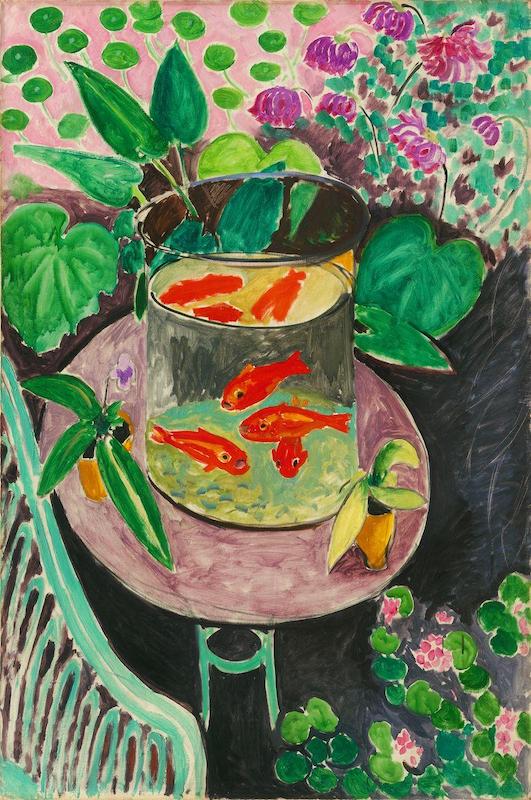
There are four goldfish. The red shapes at the top of the bowl are reflections of the fish. Our eyes are drawn to the goldfish because they are very bright and in the center of the painting. Notice that some of the leaves and the fish have very similar shapes.
1
Henri Matisse (1869-1954) is one of the best-known artists of the twentieth century. Born in France, Matisse studied law in Paris and worked as a court administrator. When he was recovering from appendicitis, his mother brought him some art supplies. He found his true calling and decided to study art, much to his father’s disappointment. He studied art in Paris, initially painting landscapes and still-lifes in the traditional style of the day. Later, he was introduced to the work of the Postimpressionists, and his style changed completely. Influenced by the Postimpressionists and Japanese art, Matisse made color a crucial element in his paintings.
2
MUSIC APPRECIATION
| “Fantaisie-Impromptu in C-sharp Minor,” op.posth. 66 |
Since its publication, “Fantaisie-Impromptu” has become one of Chopin’s most popular and recognizable compositions. The piece is widely performed by classical pianists around the world, and it has been featured in numerous films, television shows, and other media. Its popularity and enduring appeal are testament to Chopin’s exceptional talent as a composer and his enduring influence on classical music.
3
Frédéric Chopin (1810-1849) was a Polish French composer and pianist of the Romantic period, best known for his solo pieces for piano and his piano concerti. Although he wrote little but piano works, many of them brief, Chopin ranks as one of music’s greatest tone poets by reason of his superfine imagination and fastidious craftsmanship. 4
- Lange, Krista, and Leigh Lowe. First Grade Enrichment: Classical Core Curriculum. Teacher Guide. Memoria Press, 2017. ↩︎
- Ibid. ↩︎
- Team, Serenade. “Chopin’s Hidden Gem: The Story of ‘Fantaisie-Impromptu’ – Serenade.” Serenade Magazine, Serenade Magazine, 13 Feb. 2023, serenademagazine.com/chopins-hidden-gem-the-story-of-fantaisie-impromptu/.
↩︎ - “Frédéric Chopin.” Encyclopædia Britannica, Encyclopædia Britannica, inc., 13 Jan. 2025, http://www.britannica.com/biography/Frederic-Chopin. ↩︎
 Providence School of Tifton