
“Write quickly and you will never write well; write well, and you will soon write quickly.”
― Quintillian, Institutes of Oratory
JEREMIAH 31:33-34
33 For this is the covenant that I will make with the house of Israel after those days, declares the LORD: I will put my law within them, and I will write it on their hearts. And I will be their God, and they shall be my people. 34 And no longer shall each one teach his neighbor and each his brother, saying, ‘Know the LORD,’ for they shall all know me, from the least of them to the greatest, declares the LORD. For I will forgive their iniquity, and I will remember their sin no more.”
THE LORD’S PRAYER
Our Father, who art in heaven, Hallowed be thy Name; Thy kingdom come; Thy will be done on earth, as it is in heaven: Give us this day our daily bread; And forgive us our trespasses, as we forgive those that trespass against us; And lead us not into temptation, But deliver us from evil: For thine is the kingdom, the power, and the glory, For ever and ever. Amen.
ART APPRECIATION
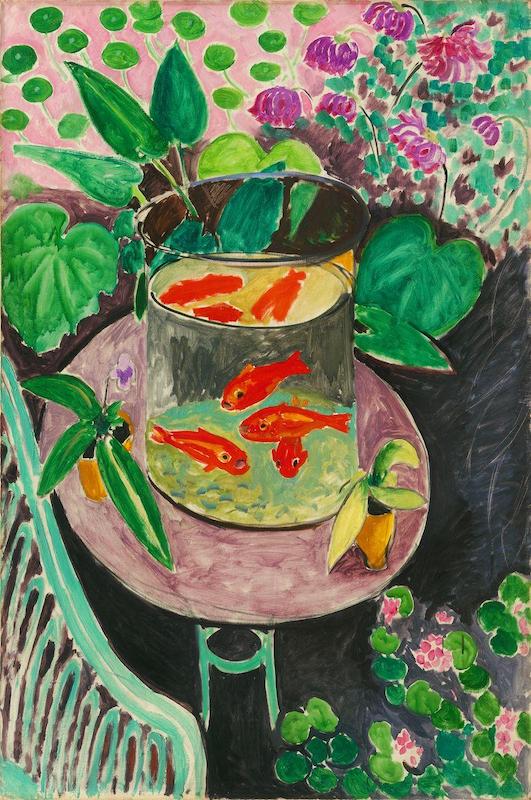
There are four goldfish. The red shapes at the top of the bowl are reflections of the fish. Our eyes are drawn to the goldfish because they are very bright and in the center of the painting. Notice that some of the leaves and the fish have very similar shapes.
1
Henri Matisse (1869-1954) is one of the best-known artists of the twentieth century. Born in France, Matisse studied law in Paris and worked as a court administrator. When he was recovering from appendicitis, his mother brought him some art supplies. He found his true calling and decided to study art, much to his father’s disappointment. He studied art in Paris, initially painting landscapes and still-lifes in the traditional style of the day. Later, he was introduced to the work of the Postimpressionists, and his style changed completely. Influenced by the Postimpressionists and Japanese art, Matisse made color a crucial element in his paintings.
2
MUSIC APPRECIATION
| “Fantaisie-Impromptu in C-sharp Minor,” op.posth. 66 |
Since its publication, “Fantaisie-Impromptu” has become one of Chopin’s most popular and recognizable compositions. The piece is widely performed by classical pianists around the world, and it has been featured in numerous films, television shows, and other media. Its popularity and enduring appeal are testament to Chopin’s exceptional talent as a composer and his enduring influence on classical music.
3
Frédéric Chopin (1810-1849) was a Polish French composer and pianist of the Romantic period, best known for his solo pieces for piano and his piano concerti. Although he wrote little but piano works, many of them brief, Chopin ranks as one of music’s greatest tone poets by reason of his superfine imagination and fastidious craftsmanship. 4
- Lange, Krista, and Leigh Lowe. First Grade Enrichment: Classical Core Curriculum. Teacher Guide. Memoria Press, 2017. ↩︎
- Ibid. ↩︎
- Team, Serenade. “Chopin’s Hidden Gem: The Story of ‘Fantaisie-Impromptu’ – Serenade.” Serenade Magazine, Serenade Magazine, 13 Feb. 2023, serenademagazine.com/chopins-hidden-gem-the-story-of-fantaisie-impromptu/.
↩︎ - “Frédéric Chopin.” Encyclopædia Britannica, Encyclopædia Britannica, inc., 13 Jan. 2025, http://www.britannica.com/biography/Frederic-Chopin. ↩︎
 Providence School of Tifton