
“A vision of the good has far greater power to move men and women to do the right thing than all the horrible images we may conjure up to terrify them into doing it.”
―Vigen Gurion, Rallying the Really Human Things
JUDE 1:17-23
17 But you must remember, beloved, the predictions of the apostles of our Lord Jesus Christ. 18 They said to you, “In the last time there will be scoffers, following their own ungodly passions.” 19 It is these who cause divisions, worldly people, devoid of the Spirit. 20 But you, beloved, building yourselves up in your most holy faith and praying in the Holy Spirit, 21 keep yourselves in the love of God, waiting for the mercy of our Lord Jesus Christ that leads to eternal life. 22 And have mercy on those who doubt; 23 save others by snatching them out of the fire; to others show mercy with fear, hating even the garment stained by the flesh.
ST. THOMAS’ PRAYER BEFORE STUDY
Creator of all things, true source of light and wisdom, origin of all being, graciously let a ray of your light penetrate the darkness of our understanding. Take from us the double darkness in which we have been born, an obscurity of sin and ignorance. Give us keen understanding, retentive memories, and the ability to grasp things correctly and fundamentally. Grant us the talent of being exact in our explanations and the ability to express ourselves with thoroughness and charm. Point out the beginning, direct the progress, and help in the completion. We ask this through Christ our Lord. Amen.
ART APPRECIATION
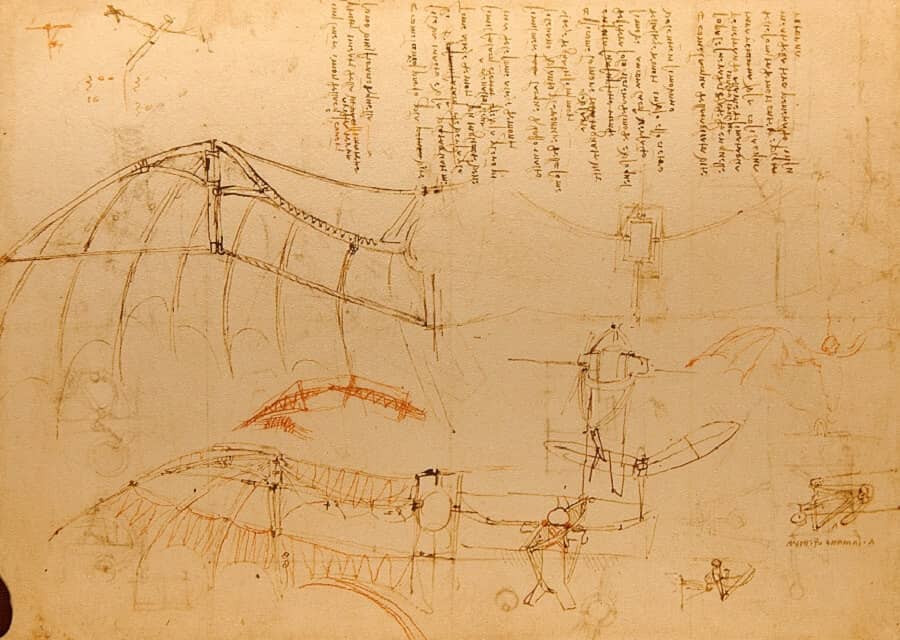
Leonardo da Vinci was truly excited by the possibility of human flight. He was inspired in his inventions by the flight of winged animals, especially birds and bats. The flying machine was quite large (the wingspan exceeded 33 feet), and the frame was to be built with pine. The flying machine was covered with silk so that it would be light but sturdy. The pilot was to face down and turn cranks with both feet and hands that would flap the wings. As da Vinci probably found out, the flying machine (an ornithopter) may have been able to fly once in the air, but a human could not produce enough power in this machine to get off the ground.
1
Leonardo da Vinci (1452-1519) was accomplished in art, music, science, mathematics, and engineering. Da Vinci was considered to be exceptionally smart. He designed weapons, buildings, machinery, churches, and fortresses He also drew very detailed anatomical studies that scientists respect to this day.
Da Vinci was left handed and often wrote backwards, though this was easily deciphered using a mirror. He drew sketches of submarines, a parachute, flying machines–things that weren’t invented until centuries later. The famous de’ Medici family were patrons who supported da Vinci’s work. Later, he met King Francis of France for whom he worked until his death in 1519.
2
MUSIC APPRECIATION
| “L’amour est un oiseau rebelle” (Habanera) from Carmen |
With a plot based on the 1845 novella of the same name by Prosper Mérimée, Bizet’s Carmen was groundbreaking in its realism, and it rapidly became one of the most popular Western operas of all time. It is the source of many memorable and widely recognized songs, notably those known by the popular names “Toréador Song” and “Habanera.” Carmen also is the best-known example of opéra-comique, a genre of French opera not necessarily comic but featuring both spoken dialogue and sung portions. Despite its current reputation, however, it was condemned by the earliest critics, who were unaccustomed to seeing the lives of the common folk, much less the world of gypsies (in Mérimée they are specifically identified with the Roma), smugglers, deserters, factory workers, and various ne’er-do-wells given centre stage.
Tchaikovsky, Pyotr Ilyich: Piano Concerto No. 1 in B-flat Minor, Op. 23. The second movement, “Andantino,” of Pyotr Ilyich Tchaikovsky’s Piano Concerto No. 1 in B-flat Minor, Op. 23.
Possessing limited piano skills, Tchaikovsky wrote the concerto intending to persuade a colleague to give the premiere performance. He first approached Nikolay Rubinstein, a pianist and the director of the Moscow Conservatory at which Tchaikovsky taught. Rubinstein condemned the work as badly written and refused to play it unless substantial changes were made. Tchaikovsky declined to revise the piece and offered it instead to the German virtuoso Hans von Bülow, who, finding more to admire than had Rubinstein, agreed to perform it. The premiere, given during an American tour, was an immediate success, and the piece soon became equally popular in Europe. In the face of the new concerto’s undeniable success, Rubinstein withdrew his earlier criticism. He agreed to conduct the Moscow premiere and even made the concerto part of his own repertory.
3
Georges Bizet (1838-1875) was a French composer best remembered for his opera Carmen (1875). His realistic approach influenced the verismo school of opera at the end of the 19th century. 4
- Lange, Krista, and Leigh Lowe. First Grade Enrichment: Classical Core Curriculum. Teacher Guide. Memoria Press, 2017. ↩︎
- Ibid. ↩︎
- “Carmen.” Encyclopædia Britannica, Encyclopædia Britannica, inc., http://www.britannica.com/topic/Carmen-opera-by-Bizet. Accessed 27 Feb. 2025.
↩︎ - “Pyotr Ilyich Tchaikovsky.” Encyclopædia Britannica, Encyclopædia Britannica, inc., 18 Feb. 2025, http://www.britannica.com/biography/Pyotr-Ilyich-Tchaikovsky. ↩︎
 Providence School of Tifton