
“In a very real sense not one of us is qualified, but it seems that God continually chooses the most unqualified to do his work, to bear his glory. If we are qualified, we tend to think that we have done the job ourselves. If we are forced to accept our evident lack of qualification, then there’s no danger that we will confuse God’s work with our own, or God’s glory with our own.”
― Madeleine L’Engle, Walking on Water
MATTHEW 17:20
20 He said to them, “Because of your little faith. For truly, I say to you, if you have faith like a grain of mustard seed, you will say to this mountain, ‘Move from here to there,’ and it will move, and nothing will be impossible for you.”
ST. THOMAS’S PRAYER BEFORE STUDY
Creator of all things, true source of light and wisdom, origin of all being, graciously let a ray of your light penetrate the darkness of our understanding. Take from us the double darkness in which we have been born, an obscurity of sin and ignorance. Give us keen understanding, retentive memories, and the ability to grasp things correctly and fundamentally. Grant us the talent of being exact in our explanations and the ability to express ourselves with thoroughness and charm. Point out the beginning, direct the progress, and help in the completion. We ask this through Christ our Lord. Amen.
ART APPRECIATION
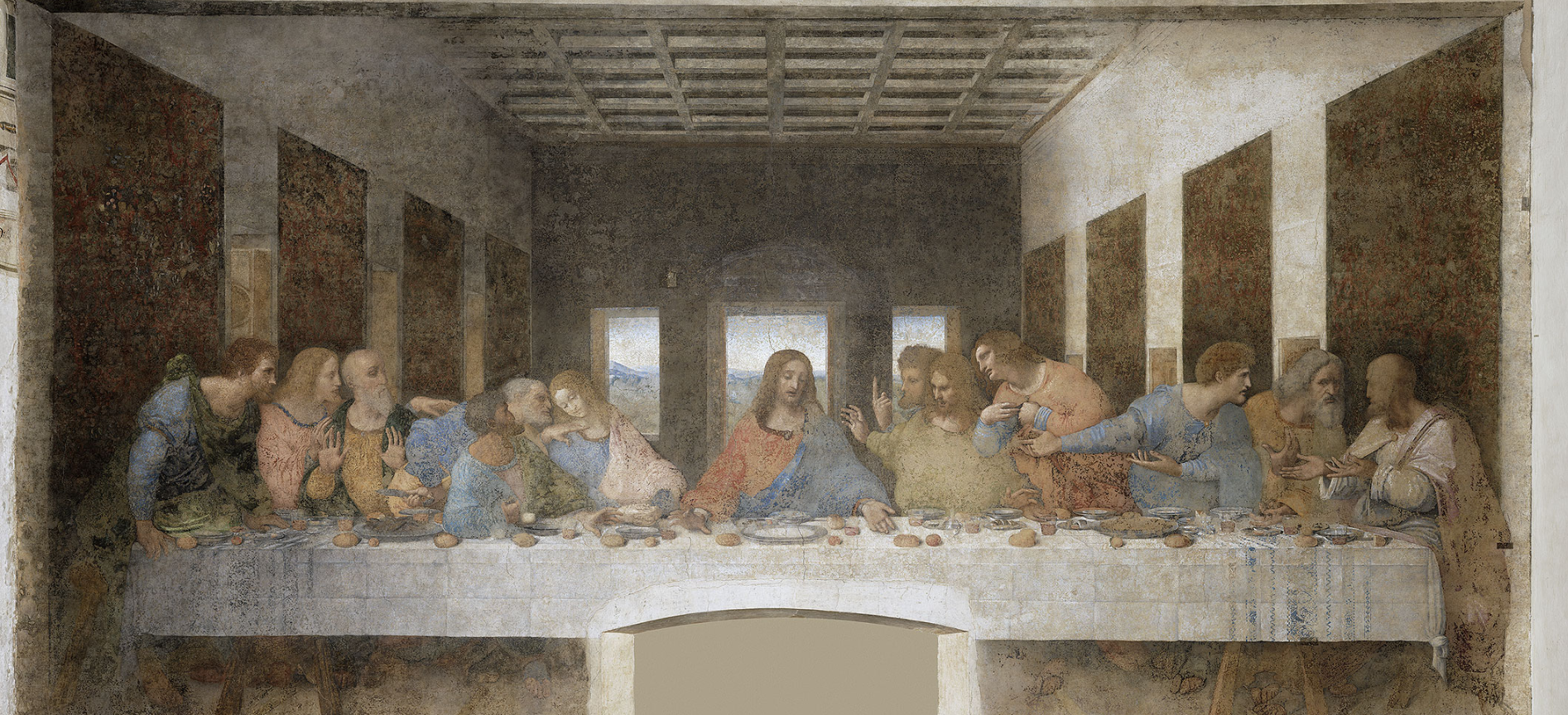
The Last Supper, a mural painting at the end of a dining hall at a monastery in Milan, is one of the greatest and well-known works of the Renaissance. Because da Vinci did not paint on wet plaster, this work is not considered a fresco. The original mural deteriorated within a few years of its completion, but The Last Supper underwent a twenty-year restoration from 1978-1998.
The Last Supper portrays that reaction given by each apostle when Jesus told them that one in the room would betray him. From left to right, the apostles are identified thanks to a notebook of da Vinci’s found in the nineteenth century. Not all the apostles may be seen in our copy of the artwork. Bartholomew, James the Less, and Andrew form a group of three. They looked surprised. Judas Iscariot, Peter, and John form another group of three. Judas clutches a bag and looks taken aback, Peter looks angry and clutches a knife, and John, the youngest apostle, looks as if he will faint. Jesus is in the middle of the picture looking calm and accepting of the suffering he will endure. Thomas, James, and Philip are the next group of three. They look upset and request an explanation from Jesus. Matthew, Jude, and Simon are the final group. We can see them talking among themselves, trying to understand what Jesus has said.
1
Leonardo da Vinci (1452-1519) was accomplished in art, music, science, mathematics, and engineering. Da Vinci was considered to be exceptionally smart. He designed weapons, buildings, machinery, churches, and fortresses He also drew very detailed anatomical studies that scientists respect to this day.
Da Vinci was left handed and often wrote backwards, though this was easily deciphered using a mirror. He drew sketches of submarines, a parachute, flying machines–things that weren’t invented until centuries later. The famous de’ Medici family were patrons who supported da Vinci’s work. Later, he met King Francis of France for whom he worked until his death in 1519.
2
MUSIC APPRECIATION
| Piano Concerto No. 1 in B-flat minor, Op. 23: I. “Allegro non troppo e molto maestoso – Allegro con spirito” |
Piano Concerto No. 1 in B-flat Minor, Op. 23, concerto for piano and orchestra by Pyotr Ilyich Tchaikovsky. The work is particularly famed for the sequence of pounding chords with which the soloist’s part launches the first movement. The piece premiered in Boston, Massachusetts, on October 25, 1875.
Tchaikovsky, Pyotr Ilyich: Piano Concerto No. 1 in B-flat Minor, Op. 23. The second movement, “Andantino,” of Pyotr Ilyich Tchaikovsky’s Piano Concerto No. 1 in B-flat Minor, Op. 23.
Possessing limited piano skills, Tchaikovsky wrote the concerto intending to persuade a colleague to give the premiere performance. He first approached Nikolay Rubinstein, a pianist and the director of the Moscow Conservatory at which Tchaikovsky taught. Rubinstein condemned the work as badly written and refused to play it unless substantial changes were made. Tchaikovsky declined to revise the piece and offered it instead to the German virtuoso Hans von Bülow, who, finding more to admire than had Rubinstein, agreed to perform it. The premiere, given during an American tour, was an immediate success, and the piece soon became equally popular in Europe. In the face of the new concerto’s undeniable success, Rubinstein withdrew his earlier criticism. He agreed to conduct the Moscow premiere and even made the concerto part of his own repertory.
3
Pyotr Ilyich Tchaikovsky (1840-1893) was was the most popular Russian composer of all time. His music has always had great appeal for the general public in virtue of its tuneful, open-hearted melodies, impressive harmonies, and colorful, picturesque orchestration, all of which evoke a profound emotional response. His oeuvre includes 7 symphonies, 11 operas, 3 ballets, 5 suites, 3 piano concertos, a violin concerto, 11 overtures (strictly speaking, 3 overtures and 8 single movement programmatic orchestral works), 4 cantatas, 20 choral works, 3 string quartets, a string sextet, and more than 100 songs and piano pieces.4
- Lange, Krista, and Leigh Lowe. First Grade Enrichment: Classical Core Curriculum. Teacher Guide. Memoria Press, 2017. ↩︎
- Ibid. ↩︎
- “Piano Concerto No. 1 in B-Flat Minor, Op. 23.” Encyclopædia Britannica, Encyclopædia Britannica, inc., http://www.britannica.com/topic/Piano-Concerto-No-1-in-B-flat-Minor. Accessed 21 Feb. 2025.
↩︎ - “Pyotr Ilyich Tchaikovsky.” Encyclopædia Britannica, Encyclopædia Britannica, inc., 18 Feb. 2025, http://www.britannica.com/biography/Pyotr-Ilyich-Tchaikovsky. ↩︎
 Providence School of Tifton