
“Unlike in the business world, the idea of strategically planning the educational process is foreign to modern educators. But planning the curriculum and pedagogy from the top down is, in our opinion, the only way to ensure the outcomes we
intend for our graduates.” ― Robert Littlejohn, Wisdom and Eloquence: A Christian Paradigm for Classical Learning
1 PETER 1:13-21
13 Therefore, preparing your minds for action, and being sober-minded, set your hope fully on the grace that will be brought to you at the revelation of Jesus Christ. 14 As obedient children, do not be conformed to the passions of your former ignorance, 15 but as he who called you is holy, you also be holy in all your conduct, 16 since it is written, “You shall be holy, for I am holy.” 17 And if you call on him as Father who judges impartially according to each one’s deeds, conduct yourselves with fear throughout the time of your exile, 18 knowing that you were ransomed from the futile ways inherited from your forefathers, not with perishable things such as silver or gold, 19 but with the precious blood of Christ, like that of a lamb without blemish or spot. 20 He was foreknown before the foundation of the world but was made manifest in the last times for the sake of you 21 who through him are believers in God, who raised him from the dead and gave him glory, so that your faith and hope are in God.
PRAYER OF GENERAL CONFESSION
Almighty and most merciful Father; we have erred, and strayed from thy ways like lost sheep. We have followed too much the devices and desires of our hearts. We have of ended against thy holy laws. We have left undone those things which we ought to have done; and we have done those things which we ought not to have done’ and there is no health in us. But thou, O Lord, have mercy upon us, miserable of enders. Spare thou them, O God which confess their faults. Restore thou them that are penitent; according thy promises declared unto mankind in Christ Jesus our Lord. And grant, O most merciful Father, for his sake; that we may hereafter live a godly, righteous, and sober life, to the glory of thy holy Name. Amen.
ART APPRECIATION
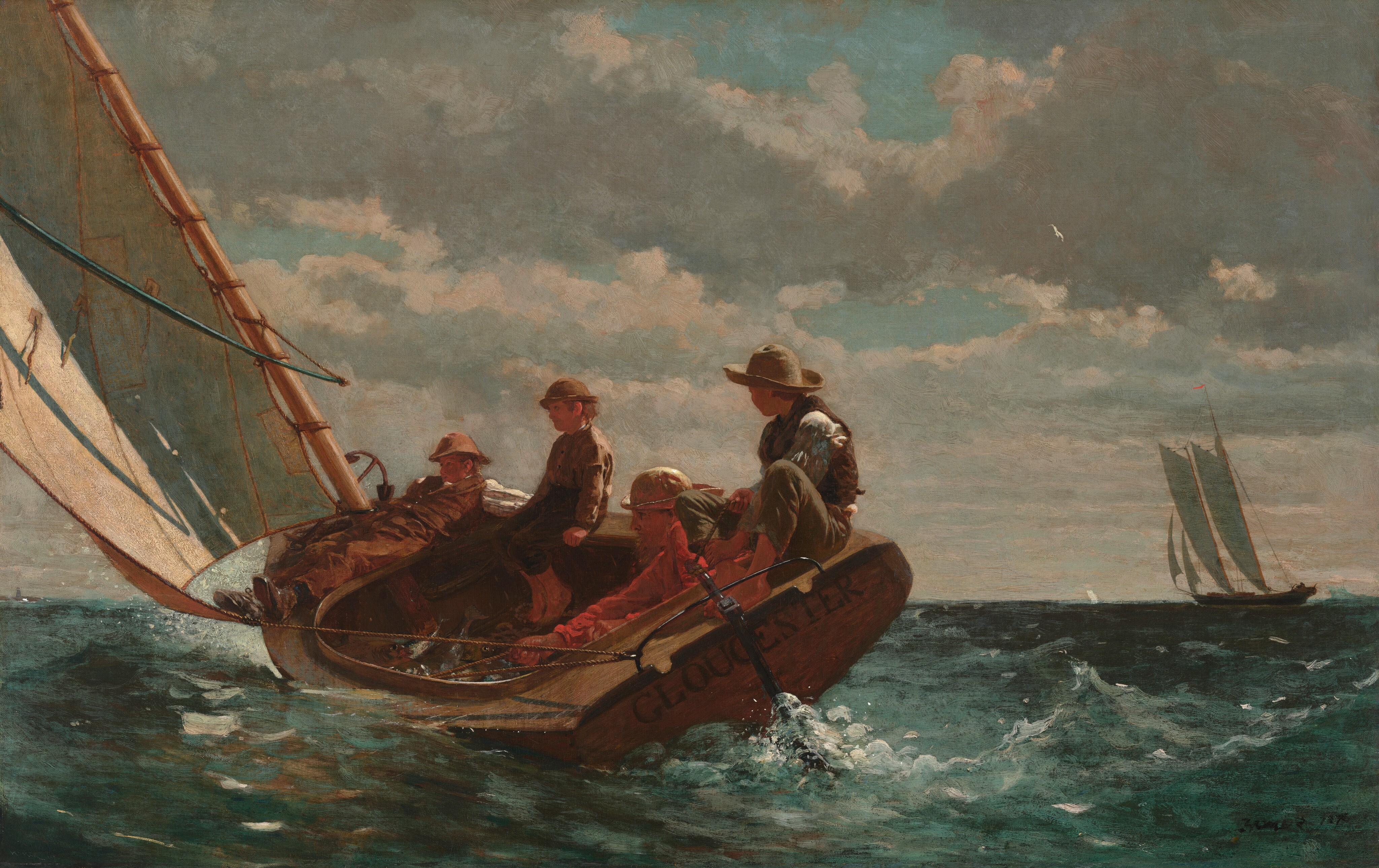
In Breezing Up (A Fair Wind), we see a man and three boys returning to shore with their catch of fish. The painting seems to have a positive message. Even though the waters are choppy, the people look relaxed. Through the clouds we can see sunlight on the backs of the sailors. The boy holding the tiller is looking toward the horizon. This has been interpreted to be a statement of optimism about his future and the future of a young United States.
1
Winslow Homer (1836-1910) was born in Boston, Massachusetts. Though he was an average student, he always had an exceptional talent in art. His mother was a gifted watercolorist and was his first art teacher until he was an adult. Homer never had any formal art instruction because he claimed he wanted his style to be original, not a copy of other artists. His main job was as an illustrator for Harper’s Magazine where he drew mostly Boston life and other New England scenes. After opening a studio in New York City, he took a course in the basics of oil painting, but he taught himself in only one year’s time. Harper’s sent him to the front lines during the Civil War, where he painted the loneliness of the soldiers and the horrors of the war. Home Sweet Home and Prisoners from the Front were examples of this time on the front. When Homer returned and moved to New York, the focus of the paintings were landscapes and children. These were very popular. Snap the Whip and The Morning Bell were done during this period. Later in life, he moved to Maine, where his most popular marine paintings were done. In Eight Bells and Sunlight on the Coast, his focus changed to that of peace and serenity. Though HOmer never taught other artists, he was influential to many other American painters such as N.C. Wyeth and Howard Pyle.
2
MUSIC APPRECIATION
| Violin Concerto in E minor, Op. 64: I. “Allegro molto appassionato” |
Violin Concerto in E Minor, Op. 64, concerto for violin and orchestra by Felix Mendelssohn, one of the most lyrical and flowing works of its type and one of the most frequently performed of all violin concerti. It premiered in Leipzig on March 13, 1845.
Mendelssohn, then conductor of the Leipzig Gewandhaus Orchestra, composed his concerto with violinist Ferdinand David, his concertmaster, in mind. The men had been good friends since they were teenagers. Although Mendelssohn had first mentioned writing a violin concerto in 1838, it was not completed until 1844. On the day of the premiere, David was the soloist, but Mendelssohn, who was ill, could not conduct his new work, so the orchestra was led instead by Mendelssohn’s assistant, Danish conductor and composer Niels Gade.
Mendelssohn used the standard classical structures for the piece, but he made adaptations to better suit both his own tastes and the changing times. These changes include an almost instant introduction of the solo instrument and, until then unusual, a written-out solo cadenza; these were usually improvised by the soloist.
3
Felix Mendelssohn (1809-1847) was a German composer, pianist, musical conductor, and teacher, one of the most-celebrated figures of the early Romantic period. In his music, Mendelssohn largely observed Classical models and practices while initiating key aspects of Romanticism—the artistic movement that exalted feeling and the imagination above rigid forms and traditions. Among his most famous works are Overture to A Midsummer Night’s Dream (1826), Italian Symphony (1833), a violin concerto (1844), two piano concerti (1831, 1837), the oratorio Elijah (1846), and several pieces of chamber music. He was a grandson of the philosopher Moses Mendelssohn.4
- Lange, Krista, and Leigh Lowe. First Grade Enrichment: Classical Core Curriculum. Teacher Guide. Memoria Press, 2017. ↩︎
- Ibid. ↩︎
- “Violin Concerto in E Minor, Op. 64.” Encyclopædia Britannica, Encyclopædia Britannica, inc., http://www.britannica.com/topic/Violin-Concerto-in-E-Minor-Op-64. Accessed 11 Feb. 2025.
↩︎ - “Felix Mendelssohn.” Encyclopædia Britannica, Encyclopædia Britannica, inc., 30 Jan. 2025, http://www.britannica.com/biography/Felix-Mendelssohn. ↩︎
 Providence School of Tifton