
When I consider how my light is spent,
Ere half my days, in this dark world and wide,
And that one Talent which is death to hide
Lodged with me useless, though my Soul more bent
To serve therewith my Maker, and present
My true account, lest he returning chide;
“Doth God exact day-labour, light denied?”
I fondly ask. But patience, to prevent
That murmur, soon replies, “God doth not need
Either man’s work or his own gifts; who best
Bear his mild yoke, they serve him best. His state
Is Kingly. Thousands at his bidding speed
And post o’er Land and Ocean without rest:
They also serve who only stand and wait.”
―John Milton, Sonnet 19
COLOSSIANS 2:6-15
6 Therefore, as you received Christ Jesus the Lord, so walk in him, 7 rooted and built up in him and established in the faith, just as you were taught, abounding in thanksgiving. 8 See to it that no one takes you captive by philosophy and empty deceit, according to human tradition, according to the elemental spirits of the world, and not according to Christ. 9 For in him the whole fullness of deity dwells bodily, 10 and you have been filled in him, who is the head of all rule and authority. 11 In him also you were circumcised with a circumcision made without hands, by putting off the body of the flesh, by the circumcision of Christ, 12 having been buried with him in baptism, in which you were also raised with him through faith in the powerful working of God, who raised him from the dead. 13 And you, who were dead in your trespasses and the uncircumcision of your flesh, God made alive together with him, having forgiven us all our trespasses, 14 by canceling the record of debt that stood against us with its legal demands. This he set aside, nailing it to the cross. 15 He disarmed the rulers and authorities and put them to open shame, by triumphing over them in him.
ST. THOMAS’S PRAYER BEFORE STUDY
Creator of all things, true source of light and wisdom, origin of all being, graciously let a ray of your light penetrate the darkness of our understanding. Take from us the double darkness in which we have been born, an obscurity of sin and ignorance. Give us keen understanding, retentive memories, and the ability to grasp things correctly and fundamentally. Grant us the talent of being exact in our explanations and the ability to express ourselves with thoroughness and charm. Point out the beginning, direct the progress, and help in the completion. We ask this through Christ our Lord. Amen.
ART APPRECIATION
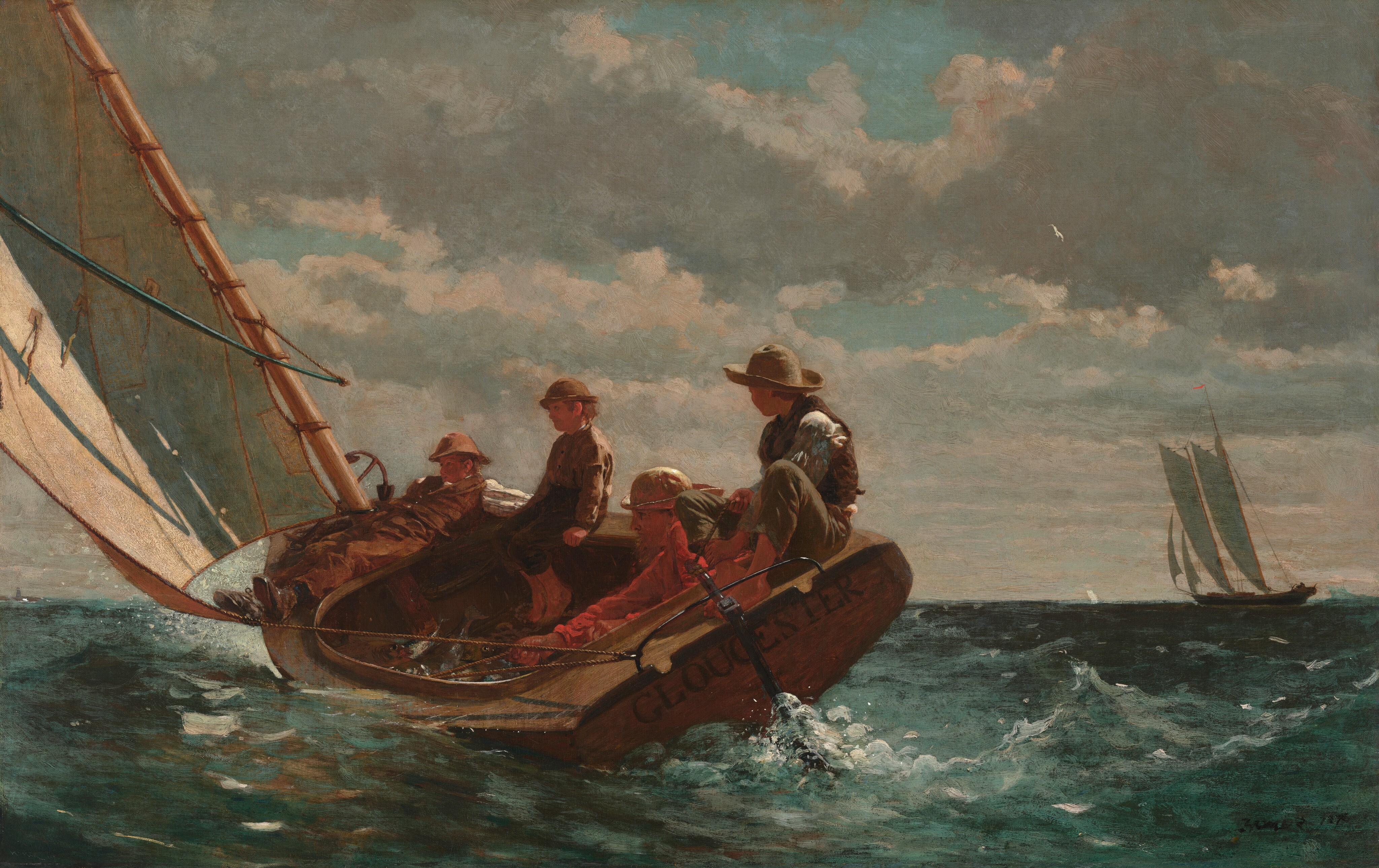
In Breezing Up (A Fair Wind), we see a man and three boys returning to shore with their catch of fish. The painting seems to have a positive message. Even though the waters are choppy, the people look relaxed. Through the clouds we can see sunlight on the backs of the sailors. The boy holding the tiller is looking toward the horizon. This has been interpreted to be a statement of optimism about his future and the future of a young United States.
1
Winslow Homer (1836-1910) was born in Boston, Massachusetts. Though he was an average student, he always had an exceptional talent in art. His mother was a gifted watercolorist and was his first art teacher until he was an adult. Homer never had any formal art instruction because he claimed he wanted his style to be original, not a copy of other artists. His main job was as an illustrator for Harper’s Magazine where he drew mostly Boston life and other New England scenes. After opening a studio in New York City, he took a course in the basics of oil painting, but he taught himself in only one year’s time. Harper’s sent him to the front lines during the Civil War, where he painted the loneliness of the soldiers and the horrors of the war. Home Sweet Home and Prisoners from the Front were examples of this time on the front. When Homer returned and moved to New York, the focus of the paintings were landscapes and children. These were very popular. Snap the Whip and The Morning Bell were done during this period. Later in life, he moved to Maine, where his most popular marine paintings were done. In Eight Bells and Sunlight on the Coast, his focus changed to that of peace and serenity. Though HOmer never taught other artists, he was influential to many other American painters such as N.C. Wyeth and Howard Pyle.
2
MUSIC APPRECIATION
| Violin Concerto in E minor, Op. 64: I. “Allegro molto appassionato” |
Violin Concerto in E Minor, Op. 64, concerto for violin and orchestra by Felix Mendelssohn, one of the most lyrical and flowing works of its type and one of the most frequently performed of all violin concerti. It premiered in Leipzig on March 13, 1845.
Mendelssohn, then conductor of the Leipzig Gewandhaus Orchestra, composed his concerto with violinist Ferdinand David, his concertmaster, in mind. The men had been good friends since they were teenagers. Although Mendelssohn had first mentioned writing a violin concerto in 1838, it was not completed until 1844. On the day of the premiere, David was the soloist, but Mendelssohn, who was ill, could not conduct his new work, so the orchestra was led instead by Mendelssohn’s assistant, Danish conductor and composer Niels Gade.
Mendelssohn used the standard classical structures for the piece, but he made adaptations to better suit both his own tastes and the changing times. These changes include an almost instant introduction of the solo instrument and, until then unusual, a written-out solo cadenza; these were usually improvised by the soloist.
3
Felix Mendelssohn (1809-1847) was a German composer, pianist, musical conductor, and teacher, one of the most-celebrated figures of the early Romantic period. In his music, Mendelssohn largely observed Classical models and practices while initiating key aspects of Romanticism—the artistic movement that exalted feeling and the imagination above rigid forms and traditions. Among his most famous works are Overture to A Midsummer Night’s Dream (1826), Italian Symphony (1833), a violin concerto (1844), two piano concerti (1831, 1837), the oratorio Elijah (1846), and several pieces of chamber music. He was a grandson of the philosopher Moses Mendelssohn.4
- Lange, Krista, and Leigh Lowe. First Grade Enrichment: Classical Core Curriculum. Teacher Guide. Memoria Press, 2017. ↩︎
- Ibid. ↩︎
- “Violin Concerto in E Minor, Op. 64.” Encyclopædia Britannica, Encyclopædia Britannica, inc., http://www.britannica.com/topic/Violin-Concerto-in-E-Minor-Op-64. Accessed 11 Feb. 2025.
↩︎ - “Felix Mendelssohn.” Encyclopædia Britannica, Encyclopædia Britannica, inc., 30 Jan. 2025, http://www.britannica.com/biography/Felix-Mendelssohn. ↩︎
 Providence School of Tifton