
“It is a truism that the medieval vision of human life was profoundly otherworldly. To the medieval, this physical world in which we find ourselves and of which we ourselves our part is not our home. We are aliens here, just traveling through. It is a reality ultimately Unworthy of us, the inferior of another reality to which we have access — the world of the eternal, the immutable, The incorruptible, the imperishable. Our true happiness lies in becoming united with that supreme reality, God. Intellectual contemplation is the means for doing so some there are who are privileged already in this present existence seriously to begin the life of contemplation, doing their best to remove, by ascetic discipline, all hindrances. The rest of us must await our entrance into heaven for the serious beginning of that life. In the meanwhile we perform our religious duties so that we can be assured of eventual beatitude, and we perform the tasks of ordinary society — growing
cabbages, building roads, running the affairs of government — not because such tasks have any religious significance, but because they are necessary to the maintenance of our earthly existence. We also enjoy such sensory delights as come our way, for this present material existence of ours, though inferior, is not evil; yet all the while we long for the day when our eyes will feast solely on God. Earthly life, though for some it already provides incidents and episodes of true beatitude, consists of waiting in the anteroom of our ultimate destiny. The true Christian, said the enormously influential Augustine in The City of God, should keep his gaze fixed on “the everlasting blessings that are promised for the future, using like one in a strange land any earthly and temporal things, not letting them entrap him or divert him from the path that leads to God.”
― Nicholas Wolterstorff, Until Justice and Peace Embrace
JEREMIAH 17:5-8
5 Thus says the Lord: “Cursed is the man who trusts in man and makes flesh his strength, whose heart turns away from the Lord. 6 He is like a shrub in the desert, and shall not see any good come. He shall dwell in the parched places of the wilderness, in an uninhabited salt land. 7 “Blessed is the man who trusts in the Lord, whose trust is the Lord. 8 He is like a tree planted by water, that sends out its roots by the stream, and does not fear when heat comes, for its leaves remain green, and is not anxious in the year of drought, for it does not cease to bear fruit.”
ST. FRANCIS’S PRAYER OF DESIRE
Therefore, let us desire nothing else, let us want nothing else, let nothing else please us and cause us delight except you our Creator, Redeemer and Savior, the only true God, Who is the fullness of good, all good, every good, the true and supreme good, Who alone is good, merciful, gentle, delightful, and sweet, Who alone is holy, just, true, holy, and upright, Who alone is kind, innocent, clean, from Whom, through Whom and in Whom is all pardon, all grace, all glory of all penitents and just ones, of all the blessed rejoicing together in heaven. Amen.
ART APPRECIATION
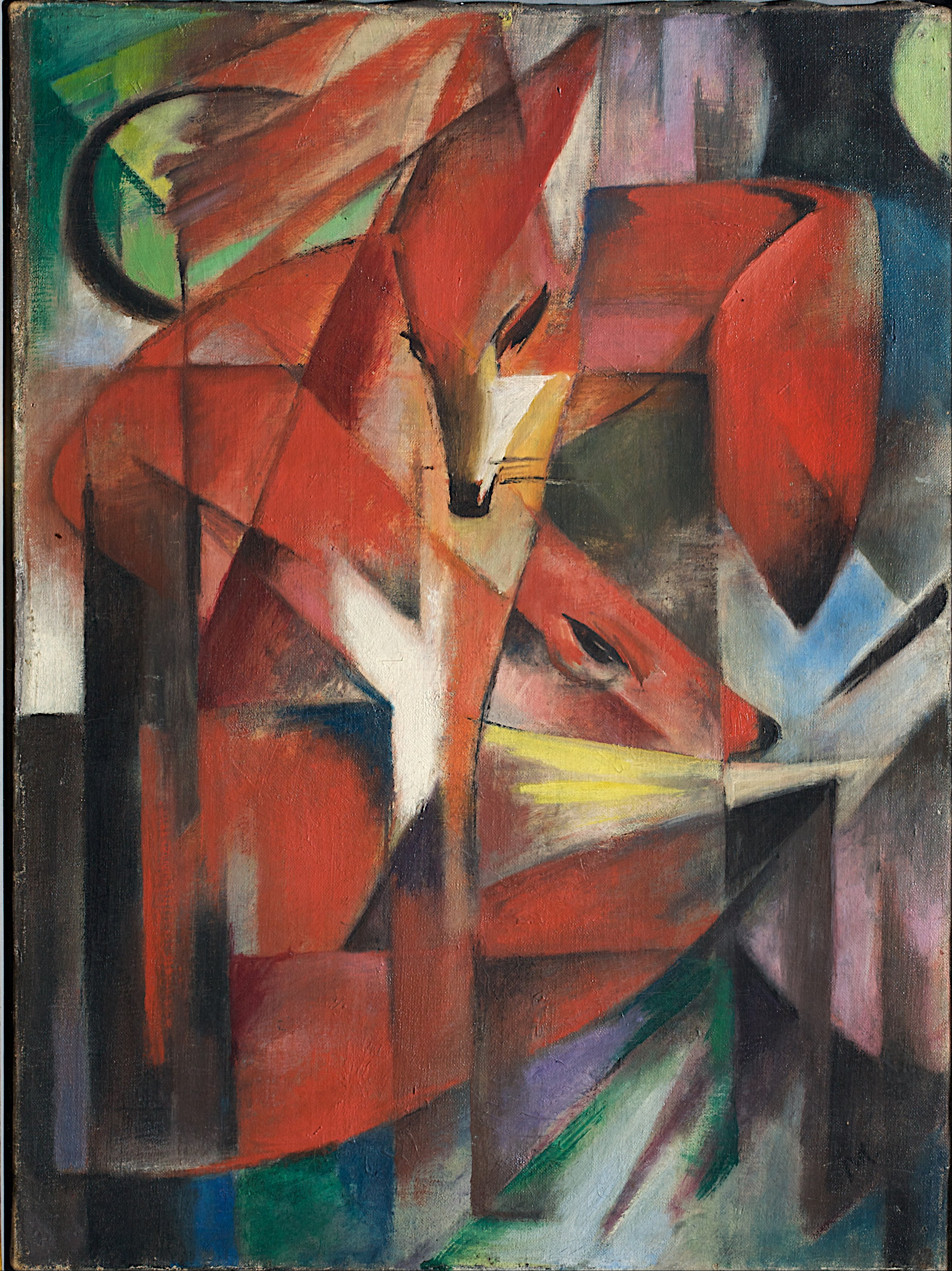
Franz Marc
Marc painted many animals, and his style of The Fox is another form of abstract art called Cubism. It is almost like looking at the fox through a broken mirror. One can see different parts of a three-dimensional fox on a two-dimensional surface.
1
Franz Marc (1880-1916) was a leader in the abstract art movement. Born in Munich, Germany, he studied at the Munich Art Academy. He traveled to Paris, where he saw Impressionist works. Although Marc revered the Impressionists, he would develop his own style of art. With fellow artist Kandinsky, he organized art exhibitions in Germany at the beginning of the 20th century. Marc is known for his works of bright color and for basing his work on intense emotion. His style of art is known today as Expressionism, where an artist portrays the world from a distorted view to evoke certain moods or ideas. Sadly, Marc was killed during service in World War I at the age of 36.
2
MUSIC APPRECIATION
| “Sacrificial Dance” from The Rite of Spring by Igor Stravinsky |
The Rite of Spring, ballet by Russian modernist composer Igor Stravinsky that premiered at the Théâtre des Champs-Elysées in Paris on May 29, 1913. It is considered one of the first examples of Modernism in music and is noted for its brutality, its barbaric rhythms, and its dissonance. Its opening performance provided one of the most scandalous premieres in history, with pro and con members of the audience arguing so volubly that the dancers were unable to take their cues from the orchestra. The Rite of Spring still strikes many contemporary listeners as a startlingly modern work.
3
Igor Stravinsky (1882-1971) was born in Oranienbaum (now Lomonosov), a Baltic resort near St Petersburg, the third son of Feodor Stravinsky, one of the principal basses at the Maryinsky (later Kirov) Theatre in St Petersburg. Stravinsky’s musical education began with piano lessons at home when he was ten; he later studied law at St Petersburg University and music theory with Fyodor Akimenko and Vassily Kalafati. His most important teacher, though, was Nikolay Rimsky-Korsakov, with whom he studied informally from the age of twenty, taking regular lessons from 1905 until 1908.
Although Stravinsky’s first substantial composition was a Symphony in E flat, written in 1906 under the tutelage of Rimsky-Korsakov, it was The Firebird, a ballet commissioned by Sergei Diaghilev and premiered by his Ballets Russes in Paris in 1910, that brought Stravinsky into sudden international prominence. In the next year he consolidated his reputation with Petrushka, like The Firebird a transformation of something essentially Russian into a work of surprising modernity. Stravinsky’s next major score – a third ballet commission from Diaghilev – is one of the major landmarks in the history of music: the blend of melodic primitivism and rhythmic complexity in The Rite of Spring marked the coming of modernism in music and was met with a mixture of astonishment and hostility. Stravinsky became established as the most radical composer of his age.4
- Lange, Krista, and Leigh Lowe. First Grade Enrichment: Classical Core Curriculum. Teacher Guide. Memoria Press, 2017. ↩︎
- Ibid. ↩︎
- “The Rite of Spring.” Encyclopædia Britannica, Encyclopædia Britannica, inc., 9 Jan. 2025, http://www.britannica.com/topic/The-Rite-of-Spring.
↩︎ - “Igor Stravinsky: Composer: Pacific Northwest Ballet.” Composer | Pacific Northwest Ballet, 1 Aug. 2024, http://www.pnb.org/repertory/igor-stravinsky/. ↩︎
 Providence School of Tifton