
“We want to avoid suffering, death, sin, ashes. But we live in a world crushed and broken and torn, a world God Himself visited to redeem. We receive his poured-out life, and being allowed the high privilege of suffering with Him, may then pour ourselves out for others.”
― Elisabeth Elliot
JOEL 2:12-27
12 “Yet even now,” declares the Lord, “return to me with all your heart, with fasting, with weeping, and with mourning; 13 and rend your hearts and not your garments.” Return to the Lord your God, for he is gracious and merciful, slow to anger, and abounding in steadfast love; and he relents over disaster. 14 Who knows whether he will not turn and relent, and leave a blessing behind him, a grain offering and a drink offering for the Lord your God? 15 Blow the trumpet in Zion; consecrate a fast; call a solemn assembly; 16 gather the people. Consecrate the congregation; assemble the elders; gather the children, even nursing infants. Let the bridegroom leave his room, and the bride her chamber. 17 Between the vestibule and the altar let the priests, the ministers of the Lord, weep and say, “Spare your people, O Lord, and make not your heritage a reproach, a byword among the nations. Why should they say among the peoples, ‘Where is their God?’” 18 Then the Lord became jealous for his land and had pity on his people. 19 The Lord answered and said to his people, “Behold, I am sending to you grain, wine, and oil, and you will be satisfied; and I will no more make you a reproach among the nations. 20 “I will remove the northerner far from you, and drive him into a parched and desolate land, his vanguard into the eastern sea, and his rear guard into the western sea; the stench and foul smell of him will rise, for he has done great things. 21 “Fear not, O land; be glad and rejoice, for the Lord has done great things! 22 Fear not, you beasts of the field, for the pastures of the wilderness are green; the tree bears its fruit; the fig tree and vine give their full yield. 23 “Be glad, O children of Zion, and rejoice in the Lord your God, for he has given the early rain for your vindication; he has poured down for you abundant rain, the early and the latter rain, as before. 24 “The threshing floors shall be full of grain; the vats shall overflow with wine and oil. 25 I will restore to you the years that the swarming locust has eaten, the hopper, the destroyer, and the cutter, my great army, which I sent among you. 26 “You shall eat in plenty and be satisfied, and praise the name of the Lord your God, who has dealt wondrously with you. And my people shall never again be put to shame.
27 You shall know that I am in the midst of Israel, and that I am the Lord your God and there is none else. And my people shall never again be put to shame.”
THE ST. THOMAS’S PRAYER BEFORE STUDY
Creator of all things, true source of light and wisdom, origin of all being, graciously let a ray of your light penetrate the darkness of our understanding. Take from us the double darkness in which we have been born, an obscurity of sin and ignorance. Give us keen understanding, retentive memories, and the ability to grasp things correctly and fundamentally. Grant us the talent of being exact in our explanations and the ability to express ourselves with thoroughness and charm. Point out the beginning, direct the progress, and help in the completion. We ask this through Christ our Lord. Amen.
ART APPRECIATION
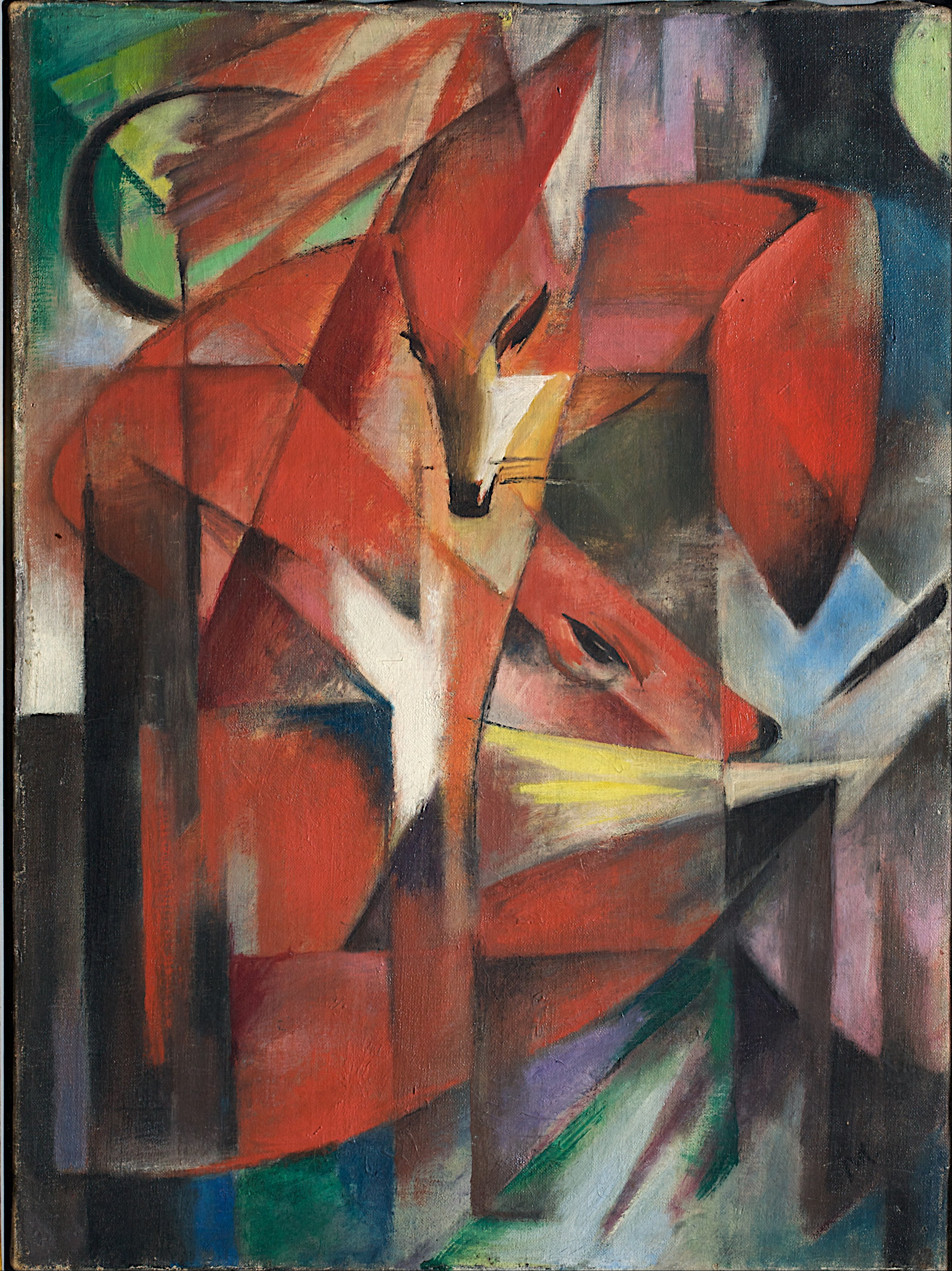
Franz Marc
Marc painted many animals, and his style of The Fox is another form of abstract art called Cubism. It is almost like looking at the fox through a broken mirror. One can see different parts of a three-dimensional fox on a two-dimensional surface.
1
Franz Marc (1880-1916) was a leader in the abstract art movement. Born in Munich, Germany, he studied at the Munich Art Academy. He traveled to Paris, where he saw Impressionist works. Although Marc revered the Impressionists, he would develop his own style of art. With fellow artist Kandinsky, he organized art exhibitions in Germany at the beginning of the 20th century. Marc is known for his works of bright color and for basing his work on intense emotion. His style of art is known today as Expressionism, where an artist portrays the world from a distorted view to evoke certain moods or ideas. Sadly, Marc was killed during service in World War I at the age of 36.
2
MUSIC APPRECIATION
| “Sacrificial Dance” from The Rite of Spring by Igor Stravinsky |
The Rite of Spring, ballet by Russian modernist composer Igor Stravinsky that premiered at the Théâtre des Champs-Elysées in Paris on May 29, 1913. It is considered one of the first examples of Modernism in music and is noted for its brutality, its barbaric rhythms, and its dissonance. Its opening performance provided one of the most scandalous premieres in history, with pro and con members of the audience arguing so volubly that the dancers were unable to take their cues from the orchestra. The Rite of Spring still strikes many contemporary listeners as a startlingly modern work.
3
Igor Stravinsky (1882-1971) was born in Oranienbaum (now Lomonosov), a Baltic resort near St Petersburg, the third son of Feodor Stravinsky, one of the principal basses at the Maryinsky (later Kirov) Theatre in St Petersburg. Stravinsky’s musical education began with piano lessons at home when he was ten; he later studied law at St Petersburg University and music theory with Fyodor Akimenko and Vassily Kalafati. His most important teacher, though, was Nikolay Rimsky-Korsakov, with whom he studied informally from the age of twenty, taking regular lessons from 1905 until 1908.
Although Stravinsky’s first substantial composition was a Symphony in E flat, written in 1906 under the tutelage of Rimsky-Korsakov, it was The Firebird, a ballet commissioned by Sergei Diaghilev and premiered by his Ballets Russes in Paris in 1910, that brought Stravinsky into sudden international prominence. In the next year he consolidated his reputation with Petrushka, like The Firebird a transformation of something essentially Russian into a work of surprising modernity. Stravinsky’s next major score – a third ballet commission from Diaghilev – is one of the major landmarks in the history of music: the blend of melodic primitivism and rhythmic complexity in The Rite of Spring marked the coming of modernism in music and was met with a mixture of astonishment and hostility. Stravinsky became established as the most radical composer of his age.4
- Lange, Krista, and Leigh Lowe. First Grade Enrichment: Classical Core Curriculum. Teacher Guide. Memoria Press, 2017. ↩︎
- Ibid. ↩︎
- “The Rite of Spring.” Encyclopædia Britannica, Encyclopædia Britannica, inc., 9 Jan. 2025, http://www.britannica.com/topic/The-Rite-of-Spring.
↩︎ - “Igor Stravinsky: Composer: Pacific Northwest Ballet.” Composer | Pacific Northwest Ballet, 1 Aug. 2024, http://www.pnb.org/repertory/igor-stravinsky/. ↩︎
 Providence School of Tifton