
“But since a deed done is more prized the more it manifests within itself the mark of the loving heart and goodness of the doer, the Everlasting Love, whose seal is plain on all the wax of the world, was pleased to move in all His ways to raise you up again. For God, in giving Himself that man might be able to raise himself, gave even more than if He had forgiven him in mercy.”
― Dante, Paradisio
1 PETER 1:3-9
3 Blessed be the God and Father of our Lord Jesus Christ! According to his great mercy, he has caused us to be born again to a living hope through the resurrection of Jesus Christ from the dead, 4 to an inheritance that is imperishable, undefiled, and unfading, kept in heaven for you, 5 who by God’s power are being guarded through faith for a salvation ready to be revealed in the last time. 6 In this you rejoice, though now for a little while, if necessary, you have been grieved by various trials, 7 so that the tested genuineness of your faith—more precious than gold that perishes though it is tested by fire—may be found to result in praise and glory and honor at the revelation of Jesus Christ. 8 Though you have not seen him, you love him. Though you do not now see him, you believe in him and rejoice with joy that is inexpressible and filled with glory, 9 obtaining the outcome of your faith, the salvation of your souls.
THE LORD’S PRAYER
Our Father, who art in heaven, Hallowed be thy Name; Thy kingdom come; Thy will be done on earth, as it is in heaven: Give us this day our daily bread; And forgive us our trespasses, as we forgive those that trespass against us; And lead us not into temptation, But deliver us from evil: For thine is the kingdom, the power, and the glory, For ever and ever. Amen.
ART APPRECIATION
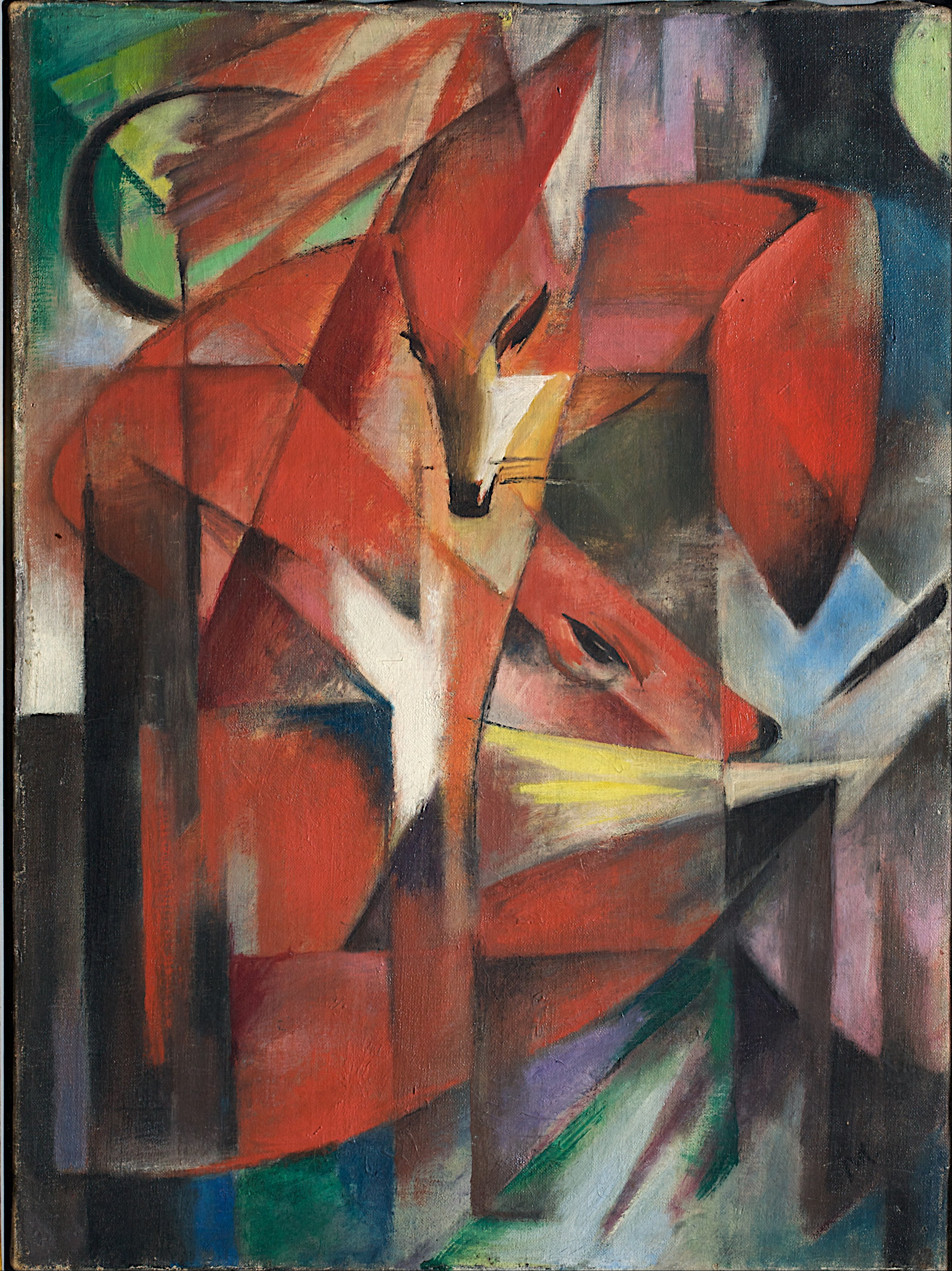
Franz Marc
Marc painted many animals, and his style of The Fox is another form of abstract art called Cubism. It is almost like looking at the fox through a broken mirror. One can see different parts of a three-dimensional fox on a two-dimensional surface.
1
Franz Marc (1880-1916) was a leader in the abstract art movement. Born in Munich, Germany, he studied at the Munich Art Academy. He traveled to Paris, where he saw Impressionist works. Although Marc revered the Impressionists, he would develop his own style of art. With fellow artist Kandinsky, he organized art exhibitions in Germany at the beginning of the 20th century. Marc is known for his works of bright color and for basing his work on intense emotion. His style of art is known today as Expressionism, where an artist portrays the world from a distorted view to evoke certain moods or ideas. Sadly, Marc was killed during service in World War I at the age of 36.
2
MUSIC APPRECIATION
| “Sacrificial Dance” from The Rite of Spring by Igor Stravinsky |
The Rite of Spring, ballet by Russian modernist composer Igor Stravinsky that premiered at the Théâtre des Champs-Elysées in Paris on May 29, 1913. It is considered one of the first examples of Modernism in music and is noted for its brutality, its barbaric rhythms, and its dissonance. Its opening performance provided one of the most scandalous premieres in history, with pro and con members of the audience arguing so volubly that the dancers were unable to take their cues from the orchestra. The Rite of Spring still strikes many contemporary listeners as a startlingly modern work.
3
Igor Stravinsky (1882-1971) was born in Oranienbaum (now Lomonosov), a Baltic resort near St Petersburg, the third son of Feodor Stravinsky, one of the principal basses at the Maryinsky (later Kirov) Theatre in St Petersburg. Stravinsky’s musical education began with piano lessons at home when he was ten; he later studied law at St Petersburg University and music theory with Fyodor Akimenko and Vassily Kalafati. His most important teacher, though, was Nikolay Rimsky-Korsakov, with whom he studied informally from the age of twenty, taking regular lessons from 1905 until 1908.
Although Stravinsky’s first substantial composition was a Symphony in E flat, written in 1906 under the tutelage of Rimsky-Korsakov, it was The Firebird, a ballet commissioned by Sergei Diaghilev and premiered by his Ballets Russes in Paris in 1910, that brought Stravinsky into sudden international prominence. In the next year he consolidated his reputation with Petrushka, like The Firebird a transformation of something essentially Russian into a work of surprising modernity. Stravinsky’s next major score – a third ballet commission from Diaghilev – is one of the major landmarks in the history of music: the blend of melodic primitivism and rhythmic complexity in The Rite of Spring marked the coming of modernism in music and was met with a mixture of astonishment and hostility. Stravinsky became established as the most radical composer of his age.4
- Lange, Krista, and Leigh Lowe. First Grade Enrichment: Classical Core Curriculum. Teacher Guide. Memoria Press, 2017. ↩︎
- Ibid. ↩︎
- “The Rite of Spring.” Encyclopædia Britannica, Encyclopædia Britannica, inc., 9 Jan. 2025, http://www.britannica.com/topic/The-Rite-of-Spring.
↩︎ - “Igor Stravinsky: Composer: Pacific Northwest Ballet.” Composer | Pacific Northwest Ballet, 1 Aug. 2024, http://www.pnb.org/repertory/igor-stravinsky/. ↩︎
 Providence School of Tifton