
“Rats and roaches live by competition under the law of supply and demand; it is the privilege of human beings to live under the laws of justice and mercy.”
― Wendell Berry, What Are People For?
PSALM 85
1 Lord, you were favorable to your land;
you restored the fortunes of Jacob.
2 You forgave the iniquity of your people;
you covered all their sin. Selah
3 You withdrew all your wrath;
you turned from your hot anger.
4 Restore us again, O God of our salvation,
and put away your indignation toward us!
5 Will you be angry with us forever?
Will you prolong your anger to all generations?
6 Will you not revive us again,
that your people may rejoice in you?
7 Show us your steadfast love, O Lord,
and grant us your salvation.
8 Let me hear what God the Lord will speak,
for he will speak peace to his people, to his saints;
but let them not turn back to folly.
9 Surely his salvation is near to those who fear him,
that glory may dwell in our land.
10 Steadfast love and faithfulness meet;
righteousness and peace kiss each other.
11 Faithfulness springs up from the ground,
and righteousness looks down from the sky.
12 Yes, the Lord will give what is good,
and our land will yield its increase.
13 Righteousness will go before him
and make his footsteps a way.
A PRAYER OF THANKSGIVING
Therefore, let us desire nothing else, let us want nothing else, let nothing else please us and cause us delight except you our Creator, Redeemer and Savior, the only true God, Who is the fullness of good, all good, every good, the true and supreme good, Who alone is good, merciful, gentle, delightful, and sweet, Who alone is holy, just, true, holy, and upright, Who alone is kind, innocent, clean, from Whom, through Whom and in Whom is all pardon, all grace, all glory of all penitents and just ones, of all the blessed rejoicing together in heaven. Amen.
ART APPRECIATION
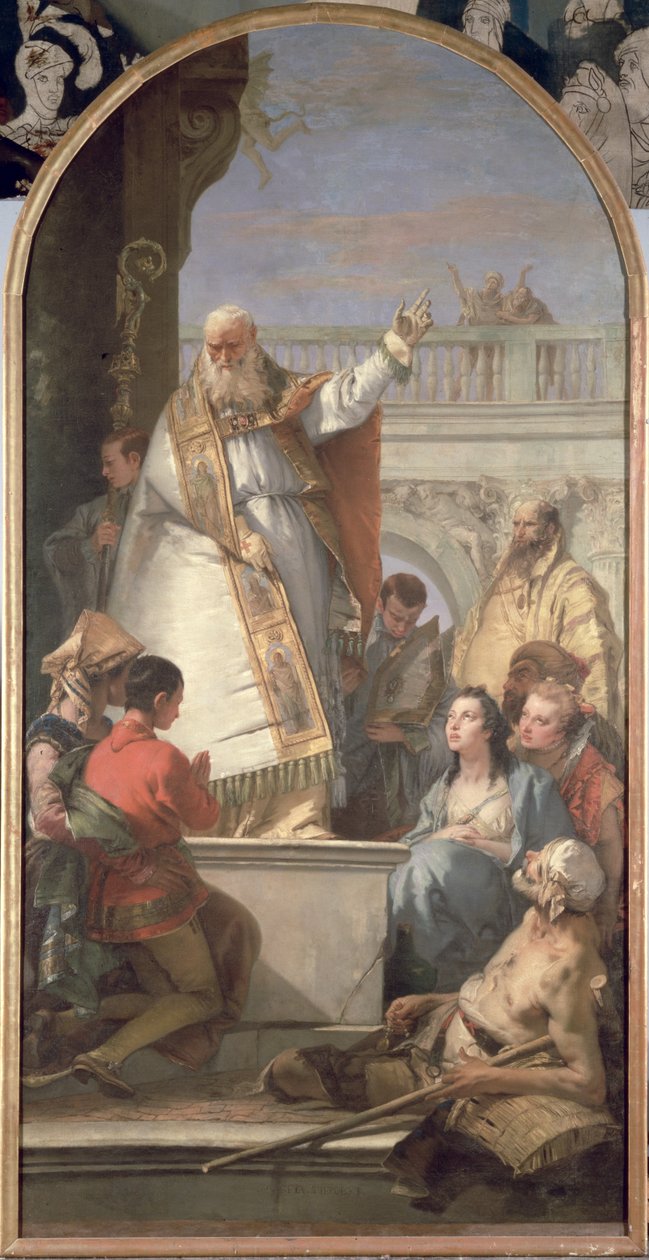
Giovanni Battista Tiepolo
Tiepolo painted this as an altarpiece for a church in Padua, Italy.
1
Giovanni Battista Tiepolo (1696-1770) is considered one of the greatest painters in eighteenth-century Europe. His art celebrates the imagination by taking history, myths, and Scripture and transposing them into a grand, theatrical scene. His greatest works are considered to be the frescoed ceilings he painted for churches and palaces throughout Europe.
2
MUSIC APPRECIATION
| Requiem in D minor, Op. 48: IV. “Pie Jesu” |
At its simplest, ‘Pie Jesu’ is just two lines of text from the final couplet of the Latin hymn ‘Dies irae’: Pie Jesu Domine, Dona eis requiem (sempiternam). Which translates as: Merciful Jesus Grant them rest (everlasting).
When Gabriel Fauré fell in love with the couplet and used it in his Requiem (1887 – 1890), his friend Camille Saint-Saëns said: “Just as Mozart’s is the only ‘Ave verum corpus’, this is the only ‘Pie Jesu’”. Fauré might have composed one of the most famous settings of the couplet, but composers have been setting ‘Pie Jesu’ to music ever since.
3
Gabriel Fauré (1845-1924) was a composer whose refined and gentle music influenced the course of modern French music. Although he had deep respect for the traditional forms of music, Fauré delighted in infusing those forms with a mélange of harmonic daring and a freshness of invention. One of the most striking features of his style was his fondness for daring harmonic progressions and sudden modulations, invariably carried out with supreme elegance and a deceptive air of simplicity. His quiet and unspectacular revolution prepared the way for more sensational innovations by the modern French school. 4
- Lange, Krista, and Leigh Lowe. First Grade Enrichment: Classical Core Curriculum. Teacher Guide. Memoria Press, 2017. ↩︎
- Ibid. ↩︎
- “What Are the Lyrics to ‘Pie Jesu’?” Classic FM, Classic FM, 18 Sept. 2023, http://www.classicfm.com/discover-music/pie-jesu-lyrics-facts/.
↩︎ - “Gabriel Fauré.” Encyclopædia Britannica, Encyclopædia Britannica, inc., http://www.britannica.com/biography/Gabriel-Faure. Accessed 27 Jan. 2025. ↩︎
 Providence School of Tifton