
“The sweetest thing in all my life has been the longing — to reach the Mountain, to find the place where all the beauty came from — my country, the place where I ought to have been born. Do you think it all meant nothing, all the longing? The longing for home? For indeed it now feels not like going, but like going back.”
― C. S. Lewis, Till We Have Faces
PSALM 51
1 Have mercy on me, O God,
according to your steadfast love;
according to your abundant mercy
blot out my transgressions.
2 Wash me thoroughly from my iniquity,
and cleanse me from my sin!
3 For I know my transgressions,
and my sin is ever before me.
4 Against you, you only, have I sinned
and done what is evil in your sight,
so that you may be justified in your words
and blameless in your judgment.
5 Behold, I was brought forth in iniquity,
and in sin did my mother conceive me.
6 Behold, you delight in truth in the inward being,
and you teach me wisdom in the secret heart.
7 Purge me with hyssop, and I shall be clean;
wash me, and I shall be whiter than snow.
8 Let me hear joy and gladness;
let the bones that you have broken rejoice.
9 Hide your face from my sins,
and blot out all my iniquities.
10 Create in me a clean heart, O God,
and renew a right spirit within me.
11 Cast me not away from your presence,
and take not your Holy Spirit from me.
12 Restore to me the joy of your salvation,
and uphold me with a willing spirit.
13 Then I will teach transgressors your ways,
and sinners will return to you.
14 Deliver me from blood guiltiness, O God,
O God of my salvation,
and my tongue will sing aloud of your
righteousness.
15 O Lord, open my lips,
and my mouth will declare your praise.
16 For you will not delight in sacrifice, or I would give
it; you will not be pleased with a burnt offering.
17 The sacrifices of God are a broken spirit;
a broken and contrite heart, O God, you will not
despise.
18 Do good to Zion in your good pleasure;
build up the walls of Jerusalem;
19 then will you delight in right sacrifices,
in burnt offerings and whole burnt offerings;
then bulls will be offered on your altar.
THE LORD’S PRAYER
Our Father, who art in heaven, Hallowed be thy Name; Thy kingdom come; Thy will be done on earth, as it is in heaven: Give us this day our daily bread; And forgive us our trespasses, as we forgive those that trespass against us; And lead us not into temptation, But deliver us from evil: For thine is the kingdom, the power, and the glory, For ever and ever. Amen.
ART APPRECIATION
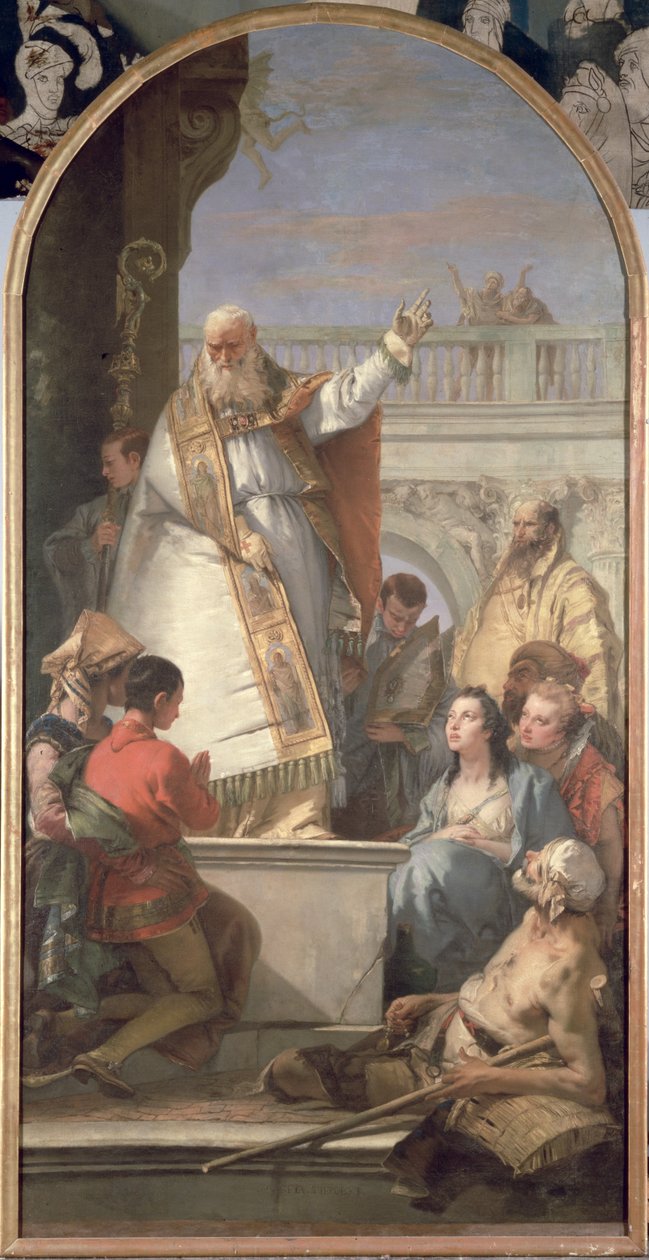
Giovanni Battista Tiepolo
Tiepolo painted this as an altarpiece for a church in Padua, Italy.
1
Giovanni Battista Tiepolo (1696-1770) is considered one of the greatest painters in eighteenth-century Europe. His art celebrates the imagination by taking history, myths, and Scripture and transposing them into a grand, theatrical scene. His greatest works are considered to be the frescoed ceilings he painted for churches and palaces throughout Europe.
2
MUSIC APPRECIATION
| Requiem in D minor, Op. 48: IV. “Pie Jesu” |
At its simplest, ‘Pie Jesu’ is just two lines of text from the final couplet of the Latin hymn ‘Dies irae’: Pie Jesu Domine, Dona eis requiem (sempiternam). Which translates as: Merciful Jesus Grant them rest (everlasting).
When Gabriel Fauré fell in love with the couplet and used it in his Requiem (1887 – 1890), his friend Camille Saint-Saëns said: “Just as Mozart’s is the only ‘Ave verum corpus’, this is the only ‘Pie Jesu’”. Fauré might have composed one of the most famous settings of the couplet, but composers have been setting ‘Pie Jesu’ to music ever since.
3
Gabriel Fauré (1845-1924) was a composer whose refined and gentle music influenced the course of modern French music. Although he had deep respect for the traditional forms of music, Fauré delighted in infusing those forms with a mélange of harmonic daring and a freshness of invention. One of the most striking features of his style was his fondness for daring harmonic progressions and sudden modulations, invariably carried out with supreme elegance and a deceptive air of simplicity. His quiet and unspectacular revolution prepared the way for more sensational innovations by the modern French school. 4
- Lange, Krista, and Leigh Lowe. First Grade Enrichment: Classical Core Curriculum. Teacher Guide. Memoria Press, 2017. ↩︎
- Ibid. ↩︎
- “What Are the Lyrics to ‘Pie Jesu’?” Classic FM, Classic FM, 18 Sept. 2023, http://www.classicfm.com/discover-music/pie-jesu-lyrics-facts/.
↩︎ - “Gabriel Fauré.” Encyclopædia Britannica, Encyclopædia Britannica, inc., http://www.britannica.com/biography/Gabriel-Faure. Accessed 27 Jan. 2025. ↩︎
 Providence School of Tifton