
“I wanted you to see what real courage is, instead of getting the idea that courage is a man with a gun in his hand. It’s when you know you’re licked before you begin, but you begin anyway and see it through no matter what.”
― Harper Lee, To Kill a Mockingbird
2 TIMOTHY 4:1-5
1 I charge you in the presence of God and of Christ Jesus, who is to judge the living and the dead, and by his appearing and his kingdom: 2 preach the word; be ready in season and out of season; reprove, rebuke, and exhort, with complete patience and teaching. 3 For the time is coming when people will not endure sound teaching, but having itching ears they will accumulate for themselves teachers to suit their own passions, 4 and will turn away from listening to the truth and wander off into myths. 5 As for you, always be sober-minded, endure suffering, do the work of an evangelist, fulfill your ministry.
A PRAYER OF THANKSGIVING
Almighty God, Father of all mercies, we your unworthy servants give you humble thanks for all your goodness and loving-kindness to us and to all whom you have made. We bless you for our creation, preservation, and all the blessings of this life; but above all for your immeasurable love in the redemption of the world by our Lord Jesus Christ; for the means of grace, and for the hope of glory. And, we pray, give us such an awareness of your mercies, that with truly thankful hearts we may show forth your praise, not only with our lips, but in our lives, by giving up ourselves to your service, and by walking before you in holiness and righteousness all our days; through Jesus Christ our Lord, to whom, with you and the Holy Spirit, be honor and glory throughout all ages. Amen.
ART APPRECIATION
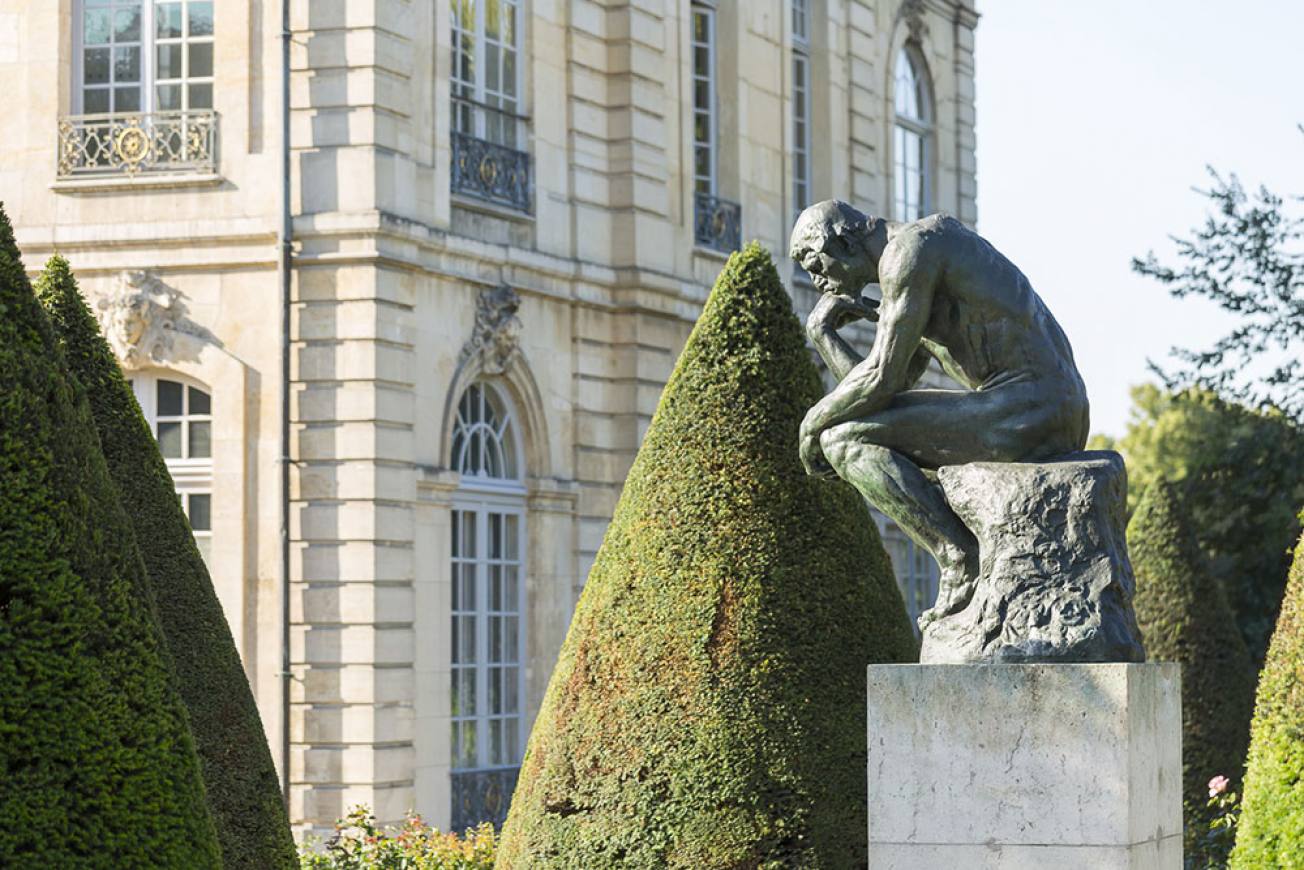
The Thinker was originally intended to represent the poet Dante as he contemplated writing his Divine Comedy. Rodin also paid tribute to Michelangelo in his sculpture by making his figure muscular and valiant. The Thinker has become known all over the world as a symbol of philosophy and knowledge.
1
Auguste Rodin (1840-1970) was born in Paris and studied drawing and painting at the Petite Ecole, a school that specialized in art and mathematics. When he was seventeen, Rodin submitted a sculpture to the Grand Ecole, a renowned art school, but he was not accepted into the school even after several attempts. Rodin earned a living as a craftsman, ornamentor, and art director of a porcelain factory until he gained prominence as an artist. Rodin was accused of taking a cast from a living model. He was later cleared of this charge. Although Rodin is often considered a leader in modern sculpture, he was schooled traditionally and took a craftsmanlike approach to his work.
2
MUSIC APPRECIATION
| Gone with the Wind Soundtrack Suite |
The score for Gone With the Wind, by Max Steiner (1888 – 1971), is one of the greatest and best-known of all film music and is the highest and most immediate representation of music of Hollywood’s pre-World War II Golden Age.
David O. Selznick was halfway through shooting the immense Southern epic when, in March 1939, he sent a memo to the general manager of his studios that it was time to engage a composer and suggested Max Steiner. The Viennese-born Steiner was already a ten-year veteran of scoring sound pictures. Steiner, who had lived in the U.S. since 1915, working primarily in theatrical music, is credited as being the first to use non-source music (i.e., the audience does not see where the music comes from and, as Steiner realized, does not care) and the first to use music under dialogue. In King Kong (1933), he pioneered the use of leading motives, themes associated with characters or dramatic symbols that can be developed in parallel with the dramatic development in films.
3
Max Steiner (1888-1971) was more so than any other iconic Hollywood film composer, a difficult sell for contemporary audiences. On the one hand, in Hollywood he was and remains universally acknowledged as the “father of film music.” As a composer, Steiner’s music had extraordinary influence on the techniques, approaches, and conventions that remain the foundation of film music in the Western world. It was Steiner who established the Wagnerian leitmotif convention for cinema, Steiner who pioneered the click track, Steiner who gave us the concept of “Mickey Mousing” (though that certainly isn’t what he called it), Steiner who made people realize the role that music can play in establishing a picture’s sense of spectacle, and Steiner who established the defining cultural music idioms in nearly every genre he touched.4
- Lange, Krista, and Leigh Lowe. First Grade Enrichment: Classical Core Curriculum. Teacher Guide. Memoria Press, 2017. ↩︎
- Ibid. ↩︎
- Stevenson , Joseph. “Gone with the Wind, Film Score: Details.” AllMusic, http://www.allmusic.com/composition/gone-with-the-wind-film-score-mc0002372144. Accessed 14 Jan. 2025.
↩︎ - Cote, Paul. “Max Steiner.” IFMCA: International Film Music Critics Association, 10 June 2012, filmmusiccritics.org/ifmca-legends/max-steiner/#:~:text=Max%20Steiner%2C%20perhaps%20more%20so,difficult%20sell%20for%20contemporary%20audiences.
↩︎
 Providence School of Tifton