
“Can a lie be taken as communication? I tend to deny it. A lie is the opposite of communication. It means specifically to withhold the other’s share and portion of reality, to prevent his participation in reality. Whoever speaks to another person–not simply, we presume, in spontaneous conversation but using well-considered
words, and whoever in so doing is explicitly not committed to the truth–whoever, in other words, is in this guided by something other than the truth–such a person, from that moment on, no longer considers the other as partner, as equal. In fact, he no longer respects the other as a human person. From that moment on, to be precise, all conversation ceases; all dialogue and all communication come to an end.”
―Josef Pieper, Abuse of Language— Abuse of Power
EPHESIANS 4:17-32
17 Now this I say and testify in the Lord, that you must no longer walk as the Gentiles do, in the futility of their minds. 18 They are darkened in their understanding, alienated from the life of God because of the ignorance that is in them, due to their hardness of heart. 19 They have become callous and have given themselves up to sensuality, greedy to practice every kind of impurity. 20 But that is not the way you learned Christ!— 21 assuming that you have heard about him and were taught in him, as the truth is in Jesus, 22 to put off your old self, which belongs to your former manner of life and is corrupt through deceitful desires, 23 and to be renewed in the spirit of your minds, 24 and to put on the new self, created after the likeness of God in true righteousness and holiness. 25 Therefore, having put away falsehood, let each one of you speak the truth with his neighbor, for we are members one of another. 26 Be angry and do not sin; do not let the sun go down on your anger, 27 and give no opportunity to the devil. 28 Let the thief no longer steal, but rather let him labor, doing honest work with his own hands, so that he may have something to share with anyone in need. 29 Let no corrupting talk come out of your mouths, but only such as is good for building up, as fits the occasion, that it may give grace to those who hear. 30 And do not grieve the Holy Spirit of God, by whom you were sealed for the day of redemption. 31 Let all bitterness and wrath and anger and clamor and slander be put away from you, along with all malice. 32 Be kind to one another, tenderhearted, forgiving one another, as God in Christ forgave you.
COLLECT FOR ADVENT
Blessed Lord, who has caused all Holy Scriptures to be written for our learning; grant that we may in such wise hear them, read, mark, learn, and inwardly digest them, that by patience, and comfort of the holy word, we may embrace, and ever hold fast the Blessed hope of everlasting life, which thou Hast given us in our Savior Jesus Christ. Amen.
ART APPRECIATION
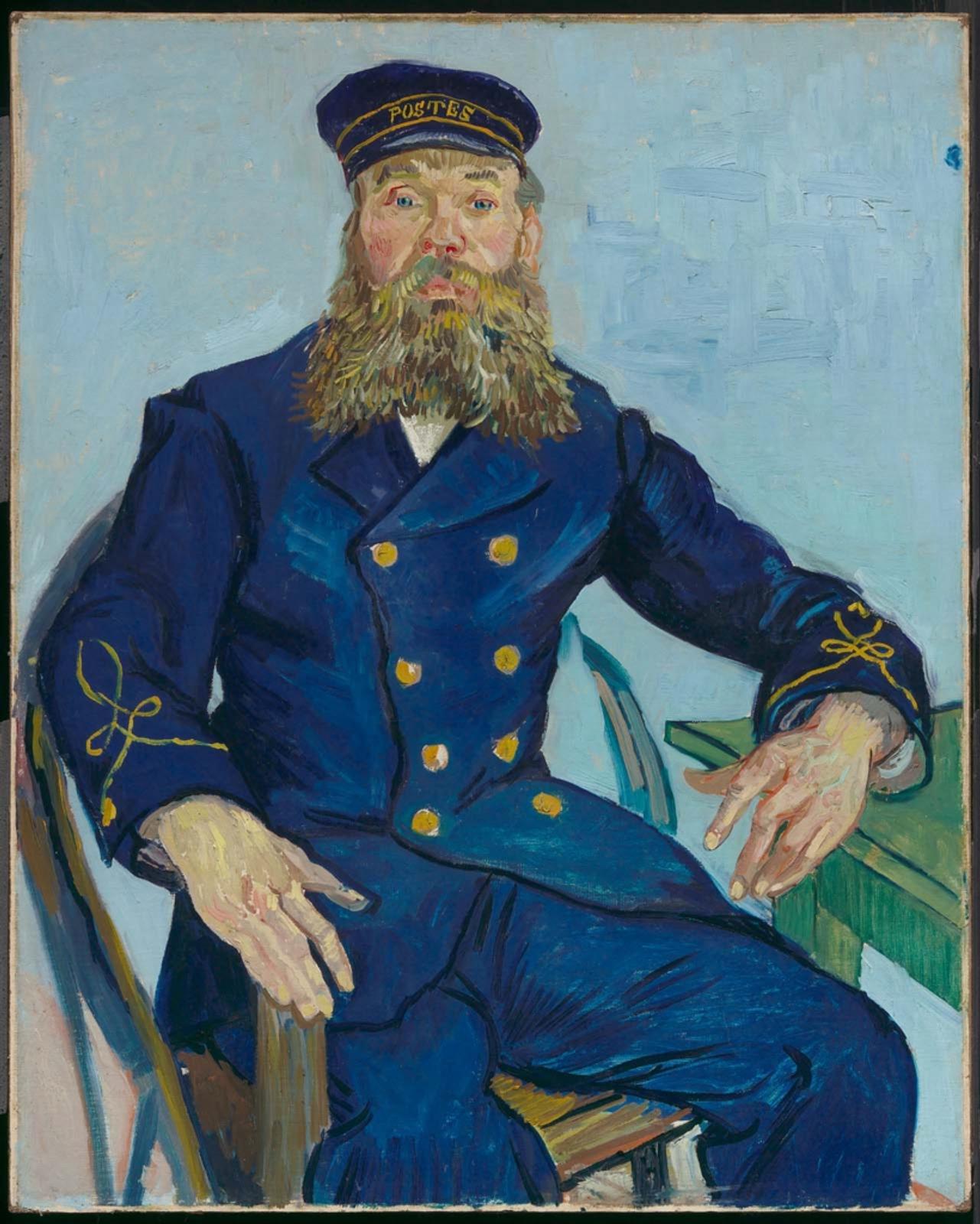
Van Gogh was born the son of a preacher in 1853 in Holland. He pursued a career in art for most of his life; he was never considered successful, though he worked tirelessly for days, sometimes without stopping to eat! Even though he painted over 800 works, only one painting sold during his lifetime. Van Gogh’s works are characterized by large, sweeping brush strokes using paints in a VERY THICK amount. Sometimes he would store the paint on with a knife, almost like working with clay. Van Gogh also painted still lifes of fruits (lemons and pears) and of flowers (irises and sunflowers). Today, several of his paintings rank among the most expensive in the world! Other painters that lived during van Gogh’s lifetime were Jean-Francois Millet, Paul Gaugin, Camille Pissarro, and Claude Monet.
1
Vincent van Gogh (1853-1890) painted several portraits of his good friend Joseph Roulin while he lived in Arles toward the end of his life. Roulin worked at the railroad station, probably sorting mail. Van Gogh also painted portraits of Roulin’s wife and three children.
2
MUSIC APPRECIATION
| “Toy Symphony” (Cassation in G Major for Toys, 2 Oboes, Strings and Continuo) by Leopold Mozart |
This fun piece of music, which calls for toys, a trumpet, ratchet, nightingale, cukoo, and drum, is traditionally played at Christmas time.
3
Leopold Motzart (1719-1787) matriculated at the Salzburg Benedictine University in 1737 but was expelled in September 1739 for poor attendance and a failure to show proper deference to his professors and the university establishment. He then became a valet and musician to Johann Baptist, Count of Thurn-Valsassina and Taxis, Salzburg canon and president of the consistory. In 1743, Leopold joined the Salzburg court orchestra as fourth violinist; by 1758 he had advanced to the post of second violinist and in 1763 he was promoted to deputy Kapellmeister. During these years he composed prolifically; a contemporaneous account of the Salzburg court music, possibly written by Leopold himself ‘(Nachricht von dem gegenwärtigen Zustande der Musik Sr. Hochfürstl. Gnaden des Erzbischoffs zu Salzburg’), mentions a large number of symphonies, more than serenades, concertos for flute, oboe, bassoon, horn and trumpet, ‘countless’ trios and divertimentos for various instruments, ‘hundreds’ of minuets, opera dances and similar works, a dozen oratorios and ‘many contrapuntal and other church items’. References in the family letters show that Leopold Mozart considered himself a ‘modern’ composer and his extant works, both early and late, bear this out. 4
- Lange, Krista, and Leigh Lowe. First Grade Enrichment: Classical Core Curriculum. Teacher Guide. Memoria Press, 2017. ↩︎
- Ibid. ↩︎
- “Music Appreciation I: Memoria Press – Classical Christian Curriculum.” Memoria Press: Classical Education, 12 Aug. 2024, http://www.memoriapress.com/curriculum/art-and-music/music-appreciation-book/.
↩︎ - “Mozart &Material Culture.” Mozart, Leopold (1719-1787) | Mozart & Material Culture, mmc.kdl.kcl.ac.uk/entities/person/mozart-leopold/. Accessed 24 Nov. 2024. ↩︎
 Providence School of Tifton