
“For somehow, beneath this gorgeous paradigm of unnecessary being, lies the Act by which it exists. You have just now reduced it to its parts, shivered it into echoes, and pressed it to a memory, but you have also caught the hint that a thing is more than the sum of all the insubstantialities that comprise it. Hopefully, you will never again argue that the solidities of the world are mere matters of accident, creatures of air and darkness, temporary and meaningless shapes out of nothing. Perhaps now you have seen at least dimly that the uniquenesses of creation are the result of continuous creative support, of effective regard by no mean lover. He likes onions, therefore they are. The fit, the colors, the smell, the tensions, the tastes, the textures, the likes, the shapes are a response, not to some forgotten decree that there may as well be onions as turnips, but to His present delight- His intimate and immediate joy in all you have seen, and in the thousand other wonders you do not even suspect.”
―Robert Farrar Capon, The Supper of the Lamb
JOHN 2:1-11
1 On the third day there was a wedding at Cana in Galilee, and the mother of Jesus was there. 2 Jesus also was invited to the wedding with his disciples. 3 When the wine ran out, the mother of Jesus said to him, “They have no wine.” 4 And Jesus said to her, “Woman, what does this have to do with me? My hour has not yet come.” 5 His mother said to the servants, “Do whatever he tells you.” 6 Now there were six stone water jars there for the Jewish rites of purification, each holding twenty or thirty gallons. 7 Jesus said to the servants, “Fill the jars with water.” And they filled them up to the brim. 8 And he said to them, “Now draw some out and take it to the master of the feast.” So they took it. 9 When the master of the feast tasted the water now become wine, and did not know where it came from (though the servants who had drawn the water knew), the master of the feast called the bridegroom 10 and said to him, “Everyone serves the good wine first, and when people have drunk freely, then the poor wine. But you have kept the good wine until now.” 11 This, the first of his signs, Jesus did at Cana in Galilee, and manifested his glory. And his disciples believed in him.
COLLECT FOR ADVENT
Blessed Lord, who has caused all Holy Scriptures to be written for our learning; grant that we may in such wise hear them, read, mark, learn, and inwardly digest them, that by patience, and comfort of the holy word, we may embrace, and ever hold fast the Blessed hope of everlasting life, which thou Hast given us in our Savior Jesus Christ. Amen.
ART APPRECIATION
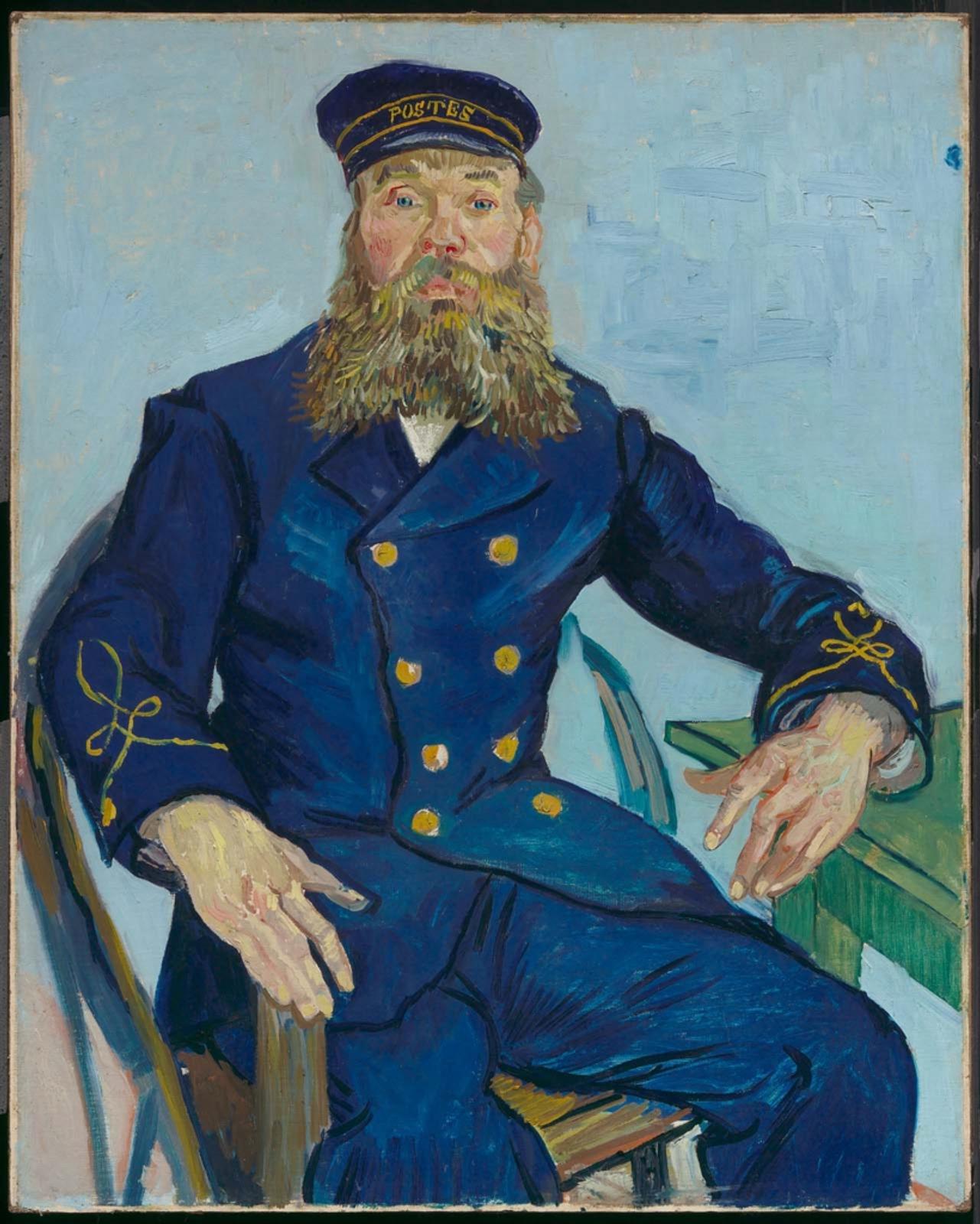
Van Gogh was born the son of a preacher in 1853 in Holland. He pursued a career in art for most of his life; he was never considered successful, though he worked tirelessly for days, sometimes without stopping to eat! Even though he painted over 800 works, only one painting sold during his lifetime. Van Gogh’s works are characterized by large, sweeping brush strokes using paints in a VERY THICK amount. Sometimes he would store the paint on with a knife, almost like working with clay. Van Gogh also painted still lifes of fruits (lemons and pears) and of flowers (irises and sunflowers). Today, several of his paintings rank among the most expensive in the world! Other painters that lived during van Gogh’s lifetime were Jean-Francois Millet, Paul Gaugin, Camille Pissarro, and Claude Monet.
1
Vincent van Gogh (1853-1890) painted several portraits of his good friend Joseph Roulin while he lived in Arles toward the end of his life. Roulin worked at the railroad station, probably sorting mail. Van Gogh also painted portraits of Roulin’s wife and three children.
2
MUSIC APPRECIATION
| “Toy Symphony” (Cassation in G Major for Toys, 2 Oboes, Strings and Continuo) by Leopold Mozart |
This fun piece of music, which calls for toys, a trumpet, ratchet, nightingale, cukoo, and drum, is traditionally played at Christmas time.
3
Leopold Motzart (1719-1787) matriculated at the Salzburg Benedictine University in 1737 but was expelled in September 1739 for poor attendance and a failure to show proper deference to his professors and the university establishment. He then became a valet and musician to Johann Baptist, Count of Thurn-Valsassina and Taxis, Salzburg canon and president of the consistory. In 1743, Leopold joined the Salzburg court orchestra as fourth violinist; by 1758 he had advanced to the post of second violinist and in 1763 he was promoted to deputy Kapellmeister. During these years he composed prolifically; a contemporaneous account of the Salzburg court music, possibly written by Leopold himself ‘(Nachricht von dem gegenwärtigen Zustande der Musik Sr. Hochfürstl. Gnaden des Erzbischoffs zu Salzburg’), mentions a large number of symphonies, more than serenades, concertos for flute, oboe, bassoon, horn and trumpet, ‘countless’ trios and divertimentos for various instruments, ‘hundreds’ of minuets, opera dances and similar works, a dozen oratorios and ‘many contrapuntal and other church items’. References in the family letters show that Leopold Mozart considered himself a ‘modern’ composer and his extant works, both early and late, bear this out. 4
- Lange, Krista, and Leigh Lowe. First Grade Enrichment: Classical Core Curriculum. Teacher Guide. Memoria Press, 2017. ↩︎
- Ibid. ↩︎
- “Music Appreciation I: Memoria Press – Classical Christian Curriculum.” Memoria Press: Classical Education, 12 Aug. 2024, http://www.memoriapress.com/curriculum/art-and-music/music-appreciation-book/.
↩︎ - “Mozart &Material Culture.” Mozart, Leopold (1719-1787) | Mozart & Material Culture, mmc.kdl.kcl.ac.uk/entities/person/mozart-leopold/. Accessed 24 Nov. 2024. ↩︎
 Providence School of Tifton