
“Thus it was up to God, to Him alone
in His own ways – by one or both, I say –
to give man back his whole life and perfection.
But since a deed done is more prized the more
it manifests within itself the mark
of the loving heart and goodness of the doer,
the Everlasting Love, whose seal is plain
on all the wax of the world was pleased to move
in all His ways to raise you up again.
There was not, nor will be, from the first day
to the last night, an act so glorious
and so magnificent, on either way.
For God, in giving Himself that man might be
able to raise himself, gave even more
than if he had forgiven him in mercy.
All other means would have been short, I say,
of perfect justice, but that God’s own Son
humbled Himself to take on mortal clay.”
― Dante, The Divine Comedy
JOHN 1:19-28
19 And this is the testimony of John, when the Jews sent priests and Levites from Jerusalem to ask him, “Who are you?” 20 He confessed, and did not deny, but confessed, “I am not the Christ.” 21 And they asked him, “What then? Are you Elijah?” He said, “I am not.” “Are you the Prophet?” And he answered, “No.” 22 So they said to him, “Who are you? We need to give an answer to those who sent us. What do you say about yourself?” 23 He said, “I am the voice of one crying out in the wilderness, ‘Make straight the way of the Lord,’ as the prophet Isaiah said.” 24 (Now they had been sent from the Pharisees.) 25 They asked him, “Then why are you baptizing, if you are neither the Christ, nor Elijah, nor the Prophet?” 26 John answered them, “I baptize with water, but among you stands one you do not know, 27 even he who comes after me, the strap of whose sandal I am not worthy to untie.” 28 These things took place in Bethany across the Jordan, where John was baptizing.
COLLECT FOR ADVENT
Blessed Lord, who has caused all Holy Scriptures to be written for our learning; grant that we may in such wise hear them, read, mark, learn, and inwardly digest them, that by patience, and comfort of the holy word, we may embrace, and ever hold fast the Blessed hope of everlasting life, which thou Hast given us in our Savior Jesus Christ. Amen.
ART APPRECIATION
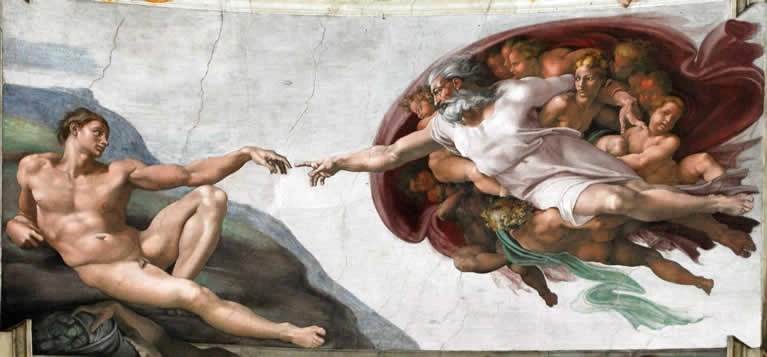
Michelangelo painted the ceiling of the Sistine Chapel from 1508-1512. His work in the Sistine Chapel is a cornerstone of the High Renaissance. The middle of the ceiling contains nine scenes from the book of Genesis of which The Creation of Adam is the most famous. In this portion of the painting, we see God’s right arm outstretched to give the spark of life from his finger to Adam’s finger. Adam’s left arm is extended in a pose mirroring God’s, a reminder that man is created in the image and likeness of God (Genesis 1:26). Notice that Adam’s finger and God’s finger are not touching. This gives the appearance that God, the giver of life, is reaching out to Adam and Adam is receiving.
1
Michelangelo (1475-1569) was born in March, 1475, in Caprese, Italy. His family moved to Florence shortly after his birth. It was Florence that Michelangelo always considered his home, which was fortuitous because Florence was considered the center of the arts during the Renaissance. Michelangelo was surrounded by great artists in many different media. His talent was soon recognized by Lorenzo di Medici, a well-known and very rich art patron who took Michelangelo under his wing and gave him a place to live in his palace. Though Michelangelo was famous for his mural painting in the Sistine Chapel, he considered himself a sculptor foremost. His sculpture of David is considered technically perfect and has been viewed by millions who visit Florence.
2
MUSIC APPRECIATION
“Hallelujah” (Chorus) from Messiah from George Frideric Handel
Handel composed Messiah without getting much sleep or even eating much food. When his assistants brought him his meals, they were often left uneaten. His servants would often find him in tears as he composed. When he completed “Hallelujah,” he reportedly told his servant, “I did think I did see all Heaven before me, and the great God Himself seated on His throne, with His company of Angels.”
3
George Frideric Handel (1685-1759) was a German-born English composer of the late Baroque era, noted particularly for his operas, oratorios, and instrumental compositions. He wrote the most famous of all oratorios, Messiah (1741), and is also known for such occasional pieces as Water Music (1717) and Music for the Royal Fireworks (1749). 4
- Lange, Krista, and Leigh Lowe. First Grade Enrichment: Classical Core Curriculum. Teacher Guide. Memoria Press, 2017. ↩︎
- Ibid. ↩︎
- “The History of ‘Hallelujah’ Chorus from Handel’s Messiah.” Tabernacle Choir, Tabernacle Choir, 10 Nov. 2023, http://www.thetabernaclechoir.org/articles/history-of-handels-hallelujah-chorus.html?lang=eng.
↩︎ - “George Frideric Handel.” Encyclopædia Britannica, Encyclopædia Britannica, inc., 5 Nov. 2024, http://www.britannica.com/biography/George-Frideric-Handel. ↩︎
 Providence School of Tifton