
“Peter, Adam’s Son,” said Father Christmas.
“Here, sir,” said Peter.
“These are your presents,” was the answer, “and they are tools, not toys. The time to use them is perhaps near at hand. Bear them well.” With these words he handed to Peter a shield and a sword. The shield was the color of silver and across it there ramped a red lion, as bright as a ripe strawberry at the moment when you pick it. The hilt of the sword was of gold and it had a sheath and a sword belt and everything it needed, and it was just the right size and weight for Peter to use. Peter was silent and solemn as he received these gifts, for he felt they were a very serious kind of present.
“Susan, Eve’s Daughter,” said Father Christmas. “These are for you,” and he handed her a bow and a quiver full of arrows and a little ivory horn. “You must use the bow only in great need,” he said, “for I do not mean you to fight in the battle. It does not easily miss. And when you put this horn to your lips and blow it, then, wherever you are, I think help of some kind will come to you.” Last of all he said, “Lucy, Eve’s Daughter,” and Lucy came forward. He gave her a little bottle of what looked like glass (but people said afterwards that it was made of diamond) and a small dagger. “In this bottle,” he said, “there is a cordial made of the juice of one of the fire-flowers that grow on the mountains of the sun. If you or any of your friends is hurt, a few drops of this will restore them. And the dagger is to defend yourself at great need.”
― C.S. Lewis, The Lion, the Witch, and the Wardrobe
LUKE 1:39-45
39 In those days Mary arose and went with haste into the hill country, to a town in Judah, 40 and she entered the house of Zechariah and greeted Elizabeth. 41 And when Elizabeth heard the greeting of Mary, the baby leaped in her womb. And Elizabeth was filled with the Holy Spirit, 42 and she exclaimed with a loud cry, “Blessed are you among women, and blessed is the fruit of your womb! 43 And why is this granted to me that the mother of my Lord should come to me? 44 For behold, when the sound of your greeting came to my ears, the baby in my womb leaped for joy. 45 And blessed is she who believed that there would be a fulfillment of what was spoken to her from the Lord.”
COLLECT FOR ADVENT
Blessed Lord, who has caused all Holy Scriptures to be written for our learning; grant that we may in such wise hear them, read, mark, learn, and inwardly digest them, that by patience, and comfort of the holy word, we may embrace, and ever hold fast the Blessed hope of everlasting life, which thou Hast given us in our Savior Jesus Christ. Amen.
ART APPRECIATION
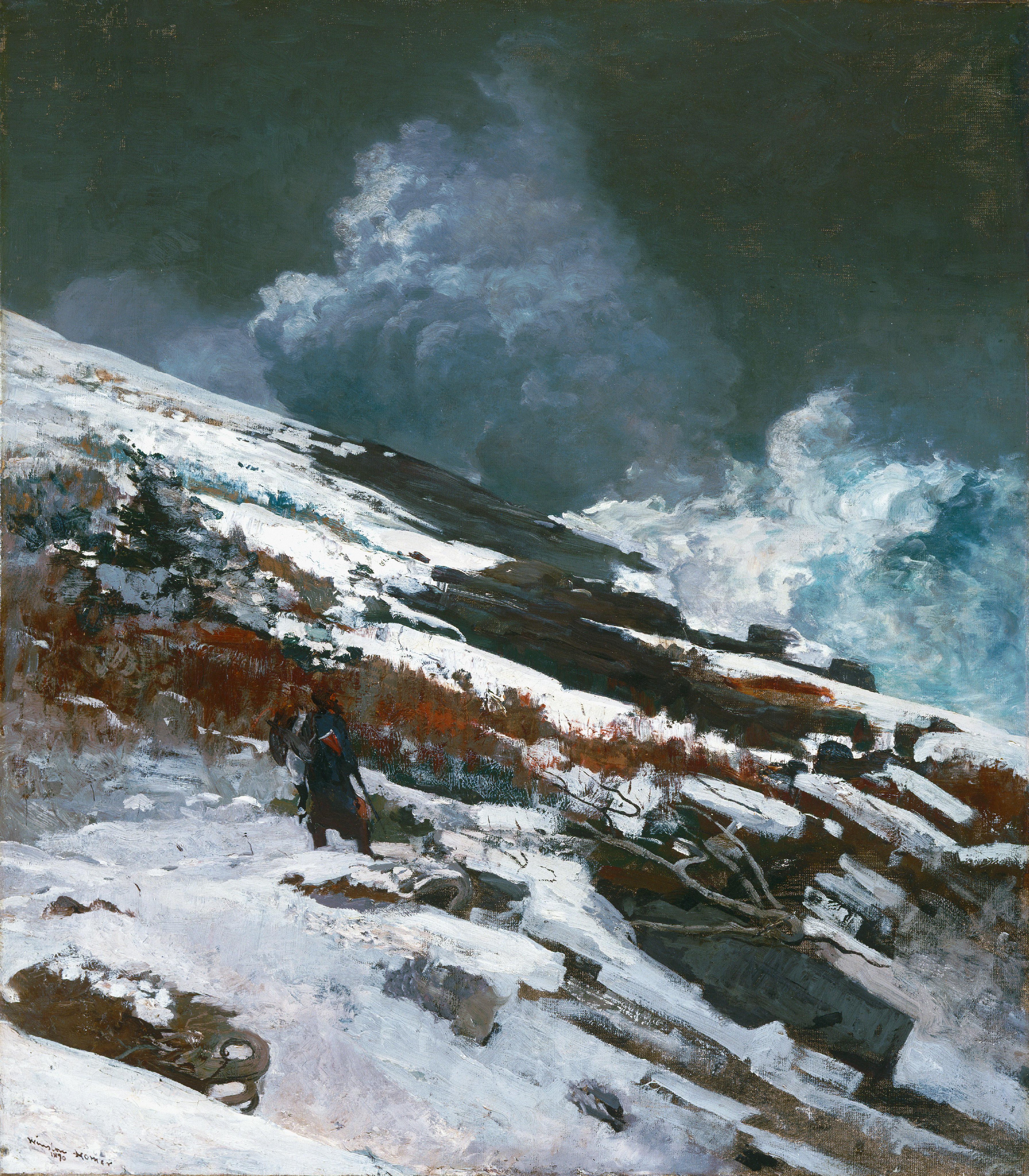
There is a rocky Maine coastline in this painting. Above the coast, there is what looks like clouds. But these are actually waves from the Atlantic Ocean crashing into the coast.
1
Winslow Homer (1836-1910) Homer was born in Boston, Massachusetts. Though he was an average student, he always had an exceptional talent in art. His mother was a gifted watercolorist and was his first art teacher until he was an adult. Homer never had any formal art instruction because he claimed he wanted his style to be original, not a copy of other artists. His main job was as an illustrator for Harper’s Magazine where he drew mostly Boston life and other New England scenes. After opening a studio in New York City, he took a course in the basics of oil painting, but he taught himself in only one year’s time. Harper’s sent him to the front lines during the Civil War, where he painted the loneliness of the soldiers and the horrors of the war.
2
MUSIC APPRECIATION
“Rule of the Valkyries” from Die Walküre by Richard Wagner
This scene from the opera Die Walküre has become so popular a piece. It shows the Valkyries, eight sisters, making preparations to carry heroes to Valhalla, the equivalent of heaven in Norse mythology.
3
Richard Wagner (1813-1883) was a German dramatic composer and theorist whose operas and music had a revolutionary influence on the course of Western music, either by extension of his discoveries or reaction against them. Among his major works are The Flying Dutchman (1843), Tannhäuser (1845), Lohengrin (1850), Tristan und Isolde (1865), Parsifal (1882), and his great tetralogy, The Ring of the Nibelung (1869–76). 4
- Lange, Krista, and Leigh Lowe. First Grade Enrichment: Classical Core Curriculum. Teacher Guide. Memoria Press, 2017. ↩︎
- Ibid. ↩︎
- “Music Appreciation I: Memoria Press – Classical Christian Curriculum.” Memoria Press: Classical Education, 12 Aug. 2024, http://www.memoriapress.com/curriculum/art-and-music/music-appreciation-book/.
↩︎ - “Richard Wagner.” Encyclopædia Britannica, Encyclopædia Britannica, inc., 22 Oct. 2024, http://www.britannica.com/biography/Richard-Wagner-German-composer. ↩︎
 Providence School of Tifton