
“Our work goes wrong when we lose touch with the God who works ‘his salvation in the midst of the earth.’ It goes wrong both when we work anxiously and when we don’t work at all, when we become frantic and compulsive in our work and when we become indolent and lethargic in our work. The foundational truth is that work is good. If God does it, it must be all right. Work has dignity: there can be nothing degrading about work if God works. Work has purpose: there can be nothing futile about work if God works…Relentless, compulsive work habits which our society rewards and admires are seen by the psalmist as a sign of weak faith and assertive pride, as if God could not be trusted to accomplish his will, as if we could rearrange the universe by our own effort.”
― Eugene Peterson, A Long Obedience in the Same Direction
ROMANS 13:1-10
1 Let every person be subject to the governing authorities. For there is no authority except from God, and those that exist have been instituted by God. 2 Therefore whoever resists the authorities resists what God has appointed, and those who resist will incur judgment. 3 For rulers are not a terror to good conduct, but to bad. Would you have no fear of the one who is in authority? Then do what is good, and you will receive his approval, 4 for he is God’s servant for your good. But if you do wrong, be afraid, for he does not bear the sword in vain. For he is the servant of God, an avenger who carries out God’s wrath on the wrongdoer. 5 Therefore one must be in subjection, not only to avoid God’s wrath but also for the sake of conscience. 6 For because of this you also pay taxes, for the authorities are ministers of God, attending to this very thing. 7 Pay to all what is owed to them: taxes to whom taxes are owed, revenue to whom revenue is owed, respect to whom respect is owed, honor to whom honor is owed. 8 Owe no one anything, except to love each other, for the one who loves another has fulfilled the law. 9 For the commandments, “You shall not commit adultery, You shall not murder, You shall not steal, You shall not covet,” and any other commandment, are summed up in this word: “You shall love your neighbor as yourself. 10 Love does no wrong to a neighbor; therefore love is the fulfilling of the law.
COLLECT FOR ADVENT
Blessed Lord, who has caused all Holy Scriptures to be written for our learning; grant that we may in such wise hear them, read, mark, learn, and inwardly digest them, that by patience, and comfort of the holy word, we may embrace, and ever hold fast the Blessed hope of everlasting life, which thou Hast given us in our Savior Jesus Christ. Amen.
ART APPRECIATION
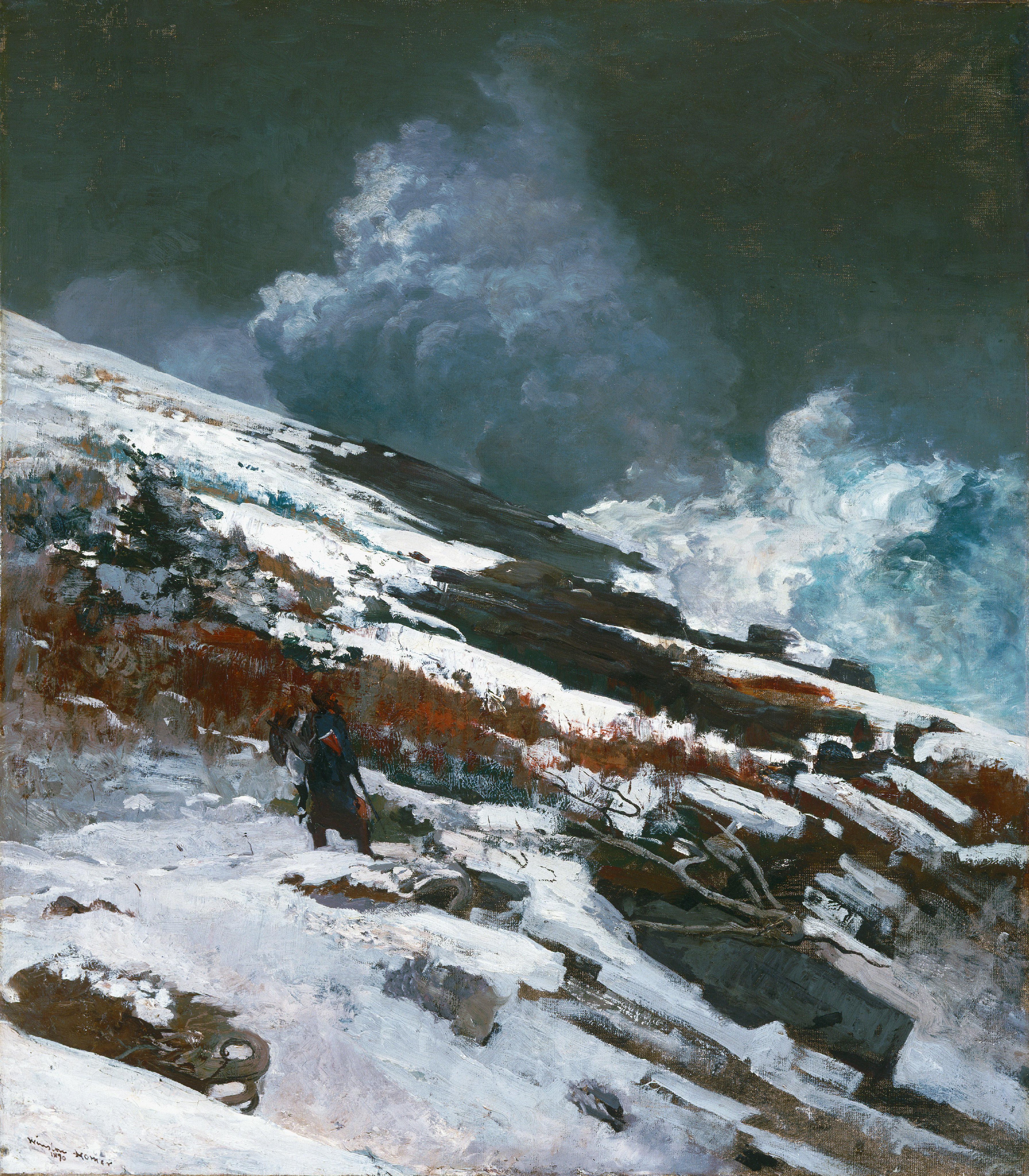
There is a rocky Maine coastline in this painting. Above the coast, there is what looks like clouds. But these are actually waves from the Atlantic Ocean crashing into the coast.
1
Winslow Homer (1836-1910) Homer was born in Boston, Massachusetts. Though he was an average student, he always had an exceptional talent in art. His mother was a gifted watercolorist and was his first art teacher until he was an adult. Homer never had any formal art instruction because he claimed he wanted his style to be original, not a copy of other artists. His main job was as an illustrator for Harper’s Magazine where he drew mostly Boston life and other New England scenes. After opening a studio in New York City, he took a course in the basics of oil painting, but he taught himself in only one year’s time. Harper’s sent him to the front lines during the Civil War, where he painted the loneliness of the soldiers and the horrors of the war.
2
MUSIC APPRECIATION
“Rule of the Valkyries” from Die Walküre by Richard Wagner
This scene from the opera Die Walküre has become so popular a piece. It shows the Valkyries, eight sisters, making preparations to carry heroes to Valhalla, the equivalent of heaven in Norse mythology.
3
Richard Wagner (1813-1883) was a German dramatic composer and theorist whose operas and music had a revolutionary influence on the course of Western music, either by extension of his discoveries or reaction against them. Among his major works are The Flying Dutchman (1843), Tannhäuser (1845), Lohengrin (1850), Tristan und Isolde (1865), Parsifal (1882), and his great tetralogy, The Ring of the Nibelung (1869–76). 4
- Lange, Krista, and Leigh Lowe. First Grade Enrichment: Classical Core Curriculum. Teacher Guide. Memoria Press, 2017. ↩︎
- Ibid. ↩︎
- “Music Appreciation I: Memoria Press – Classical Christian Curriculum.” Memoria Press: Classical Education, 12 Aug. 2024, http://www.memoriapress.com/curriculum/art-and-music/music-appreciation-book/.
↩︎ - “Richard Wagner.” Encyclopædia Britannica, Encyclopædia Britannica, inc., 22 Oct. 2024, http://www.britannica.com/biography/Richard-Wagner-German-composer. ↩︎
 Providence School of Tifton