
Angelic minds, they say, by simple intelligence
Behold the Forms of nature. They discern
Unerringly the Archtypes, all the verities
Which mortals lack or indirectly learn.
Transparent in primordial truth, unvarying,
Pure Earthness and right Stonehood from their clear,
High eminence are seen; unveiled, the seminal
Huge Principles appear.
The Tree-ness of the tree they know-the meaning of
Arboreal life, how from earth’s salty lap
The solar beam uplifts it; all the holiness
Enacted by leaves’ fall and rising sap;
But never an angel knows the knife-edged severance
Of sun from shadow where the trees begin,
The blessed cool at every pore caressing us
An angel has no skin.
They see the Form of Air; but mortals breathing it
Drink the whole summer down into the breast.
The lavish pinks, the field new-mown, the ravishing
Sea-smells, the wood-fire smoke that whispers Rest.
The tremor on the rippled pool of memory
That from each smell in widening circles goes,
The pleasure and the pang –can angels measure it?
An angel has no nose.
The nourishing of life, and how it flourishes
On death, and why, they utterly know; but not
The hill-born, earthy spring, the dark cold bilberries.
The ripe peach from the southern wall still hot
Full-bellied tankards foamy-topped, the delicate
Half-lyric lamb, a new loaf’s billowy curves,
Nor porridge, nor the tingling taste of oranges.
An angel has no nerves.
Far richer they! I know the senses’ witchery
Guards us like air, from heavens too big to see;
Imminent death to man that barb’d sublimity
And dazzling edge of beauty unsheathed would be.
Yet here, within this tiny, charmed interior,
This parlour of the brain, their Maker shares
With living men some secrets in a privacy
Forever ours, not theirs.
― C.S. Lewis, On Being Human
ECCLESIASTES 12:13-14
13 The end of the matter; all has been heard. Fear God and keep his commandments, for this is the whole duty of man. 14 For God will bring every deed into judgment, with every secret thing, whether good or evil.
ST. THOMAS’S PRAYER BEFORE STUDY
Creator of all things, true source of light and wisdom, origin of all being, graciously let a ray of your light penetrate the darkness of our understanding. Take from us the double darkness in which we have been born, an obscurity of sin and ignorance. Give us keen understanding, retentive memories, and the ability to grasp things correctly and fundamentally. Grant us the talent of being exact in our explanations and the ability to express ourselves with thoroughness and charm. Point out the beginning, direct the progress, and help in the completion. We ask this through Christ our Lord. Amen.
ART APPRECIATION
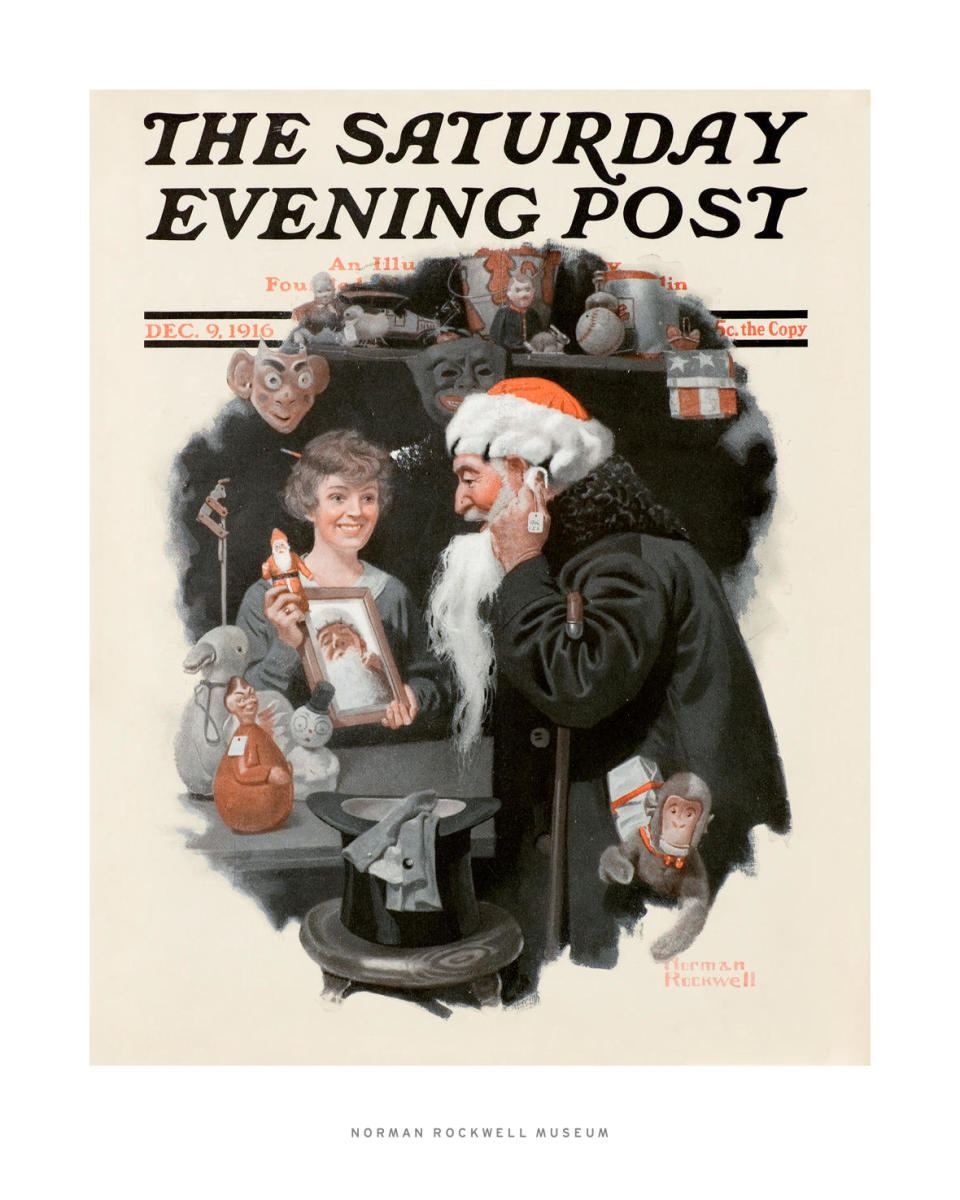
This painting appeared in the December 9, 1916, cover of The Saturday Evening Post. This was only the sixth of Rockwell’s covers for the magazine, and his first Christmas-themed cover. Rockwell’s original picture of Man Playing Santa was an oil painting, and its location is unknown today.
1
Norman Rockwell (1894-1978) was a beloved American artist best known for his portrayal of idealistic American small town culture. In his teens, Rockwell was hired as art director of Boy’s Life, the official publication of the Boy Scouts of America. At age twenty-two, he began a forty-seven-year relationship with the Saturday Evening Post. Rockwell would produce 322 covers for this popular magazine. During World War II, Rockwell painted the popular Four Freedoms paintings, based on his interpretations of Freedom of Speech, Freedom to Worship, Freedom from Want, and Freedom from Fear.
2
MUSIC APPRECIATION
“Minuet in F Major” by Leopold Mozart
Mozart composed this Minuet when he was 6. Its beautifully crafted melody woos the listener from the very first measure with a curvaceous broken chord springing into graceful quarter notes.
3
Leopold Motzart (1719-1787) matriculated at the Salzburg Benedictine University in 1737 but was expelled in September 1739 for poor attendance and a failure to show proper deference to his professors and the university establishment. He then became a valet and musician to Johann Baptist, Count of Thurn-Valsassina and Taxis, Salzburg canon and president of the consistory. In 1743, Leopold joined the Salzburg court orchestra as fourth violinist; by 1758 he had advanced to the post of second violinist and in 1763 he was promoted to deputy Kapellmeister. During these years he composed prolifically; a contemporaneous account of the Salzburg court music, possibly written by Leopold himself ‘(Nachricht von dem gegenwärtigen Zustande der Musik Sr. Hochfürstl. Gnaden des Erzbischoffs zu Salzburg’), mentions a large number of symphonies, more than serenades, concertos for flute, oboe, bassoon, horn and trumpet, ‘countless’ trios and divertimentos for various instruments, ‘hundreds’ of minuets, opera dances and similar works, a dozen oratorios and ‘many contrapuntal and other church items’. References in the family letters show that Leopold Mozart considered himself a ‘modern’ composer and his extant works, both early and late, bear this out.4
- Lange, Krista, and Leigh Lowe. First Grade Enrichment: Classical Core Curriculum. Teacher Guide. Memoria Press, 2017. ↩︎
- Ibid. ↩︎
- Kirsten, arioso7: Shirley. “Piano Instruction: Mozart Minuet in F Major, K. 2 (a Rolling Forward Wrist Motion Aids Phrase-Shaping) Video.” Arioso7’s Blog (Shirley Kirsten), 16 Apr. 2012, arioso7.wordpress.com/2012/04/16/piano-instruction-mozart-minuet-in-f-major-k-2-a-rolling-forward-wrist-motion-aids-phrase-shaping-video/.
↩︎ - “Mozart &Material Culture.” Mozart, Leopold (1719-1787) | Mozart & Material Culture, mmc.kdl.kcl.ac.uk/entities/person/mozart-leopold/. Accessed 24 Nov. 2024. ↩︎
 Providence School of Tifton