
“O flower of warriors, beware of that trap.
Choose, dear Beowulf, the better part,
Eternal rewards. Do not give way to pride.
For a brief while your strength is in bloom
But it fades quickly; and soon there will follow
Illness or the sword to lay you low,
Ora sudden fire or surge of water
Or jabbing blad or javelin from the air
Or repellent age. Your piercing eye
will dim and darken; and death will arrive,
Dear warrior, to sweep you away.
― “Hrothgar’s Sermon”, Beowulf
LUKE 12:13-21
13 Someone in the crowd said to him, “Teacher, tell my brother to divide the inheritance with me.” 14 But he said to him, “Man, who made me a judge or arbitrator over you?” 15 And he said to them, “Take care, and be on your guard against all covetousness, for one’s life does not consist in the abundance of his possessions.” 16 And he told them a parable, saying, “The land of a rich man produced plentifully, 17 and he thought to himself, ‘What shall I do, for I have nowhere to store my crops?’ 18 And he said, ‘I will do this: I will tear down my barns and build larger ones, and there I will store all my grain and my goods. 19 And I will say to my soul, “Soul, you have ample goods laid up for many years; relax, eat, drink, be merry.”’ 20 But God said to him, ‘Fool! This night your soul is required of you, and the things you have prepared, whose will they be?’ 21 So is the one who lays up treasure for himself and is not rich toward God.”
ST. FRANCIS’S PRAYER OF DESIRE
Creator of all things, true source of light and wisdom, origin of all being, graciously let a ray of your light penetrate the darkness of our understanding. Take from us the double darkness in which we have been born, an obscurity of sin and ignorance. Give us keen understanding, retentive memories, and the ability to grasp things correctly and fundamentally. Grant us the talent of being exact in our explanations and the ability to express ourselves with thoroughness and charm. Point out the beginning, direct the progress, and help in the completion. We ask this through Christ our Lord. Amen.
ART APPRECIATION
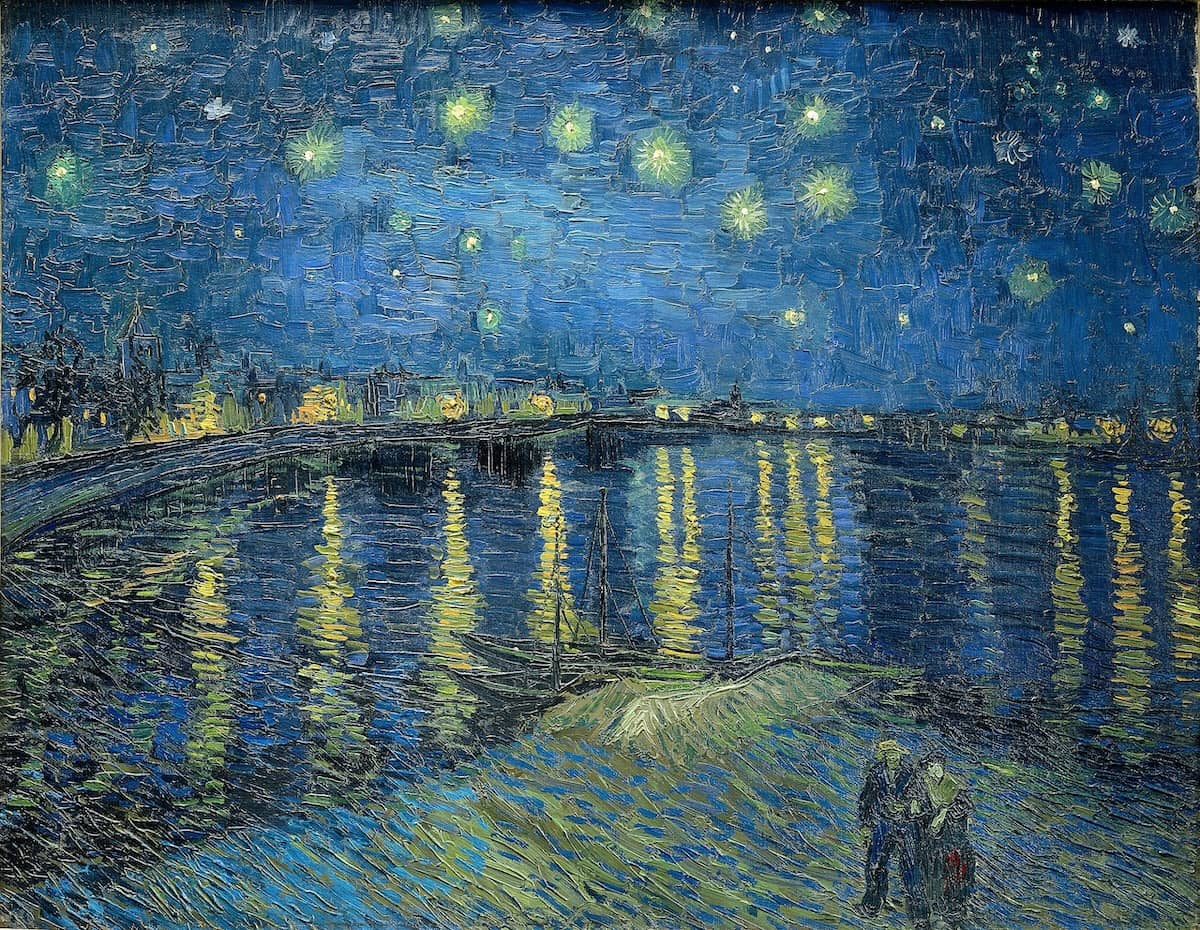
This painting is one of van Gogh’s paintings of the night sky and the effects of light at night. In this painting, we see a more realistic nighttime sky. We see a contrast between the two different types of light: starlight and light coming from the gas lamps, reflected on the river.1
Vincent van Gogh (1853-1890) was born the son of a preacher in 1853 in Holland. He pursued a career in art for most of his life; he was never considered successful, though he worked tirelessly for days, sometimes without stopping to eat! Even though he painted over 800 works, only one painting sold during his lifetime. Van Gogh’s works are characterized by large, sweeping brush strokes using paints in a very thick amount. Sometimes he would store the paint on with a knife, almost like working with clay. Van Gogh also painted still lifes of fruits (lemons and pears) and of flowers (irises and sunflowers). Today, several of his paintings rank among the most expensive in the world! Other painters that lived during van Gogh’s lifetime were Jean-Francois millet, Paul Gaugin, Camille Pissarro, and Claude Monet. 2
MUSIC APPRECIATION
“Lullaby,” op. 49, No. 4 by Johannes Brahms
Johannes Brahms may have written the world’s most famous lullaby. Wiegenlied, Op. 49, No.4 was dedicated to Brahms’ former lover, Bertha Faber, after the birth of her son. The melody found its way into the first movement of Brahms’ Second Symphony in a slightly altered form.
3
Johannesburg Brahms (1833-1897) was one of the big “Three B’s” of the classical music world and is most widely known by modern audiences for his melodic lullaby, but his influence goes much further afield than simple children’s tunes.
The son of a lower middle class family, Brahms was born in Hamburg of the early 19th century; a scruffy port city filled with exotic traders and seedy traffickers alike. Although in an earlier era, it had been home to a number of fine musicians, it was, at the midpoint of the 19th century, a unseemly and unlikely a place for a future legend to arise as one might imagine. Although admittedly he was no child prodigy, he occasionally dislikened himself to the young Mozart, Brahms would tell listeners on later occasions that his father, a trained musician himself, often arranged Brahms’ early concerts in the public bars of the town. Bars of that place and era doubled as houses of ill-repute; it was an entirely shocking inverse portrait of Brahms’ life overlaid by evoking the measure of natural and wholesome adoration Wolfgang’s father’s evidenced for his child in securing him appointments to all the finest courts of Europe.4
- Lange, Krista, and Leigh Lowe. First Grade Enrichment: Classical Core Curriculum. Teacher Guide. Memoria Press, 2017. ↩︎
- Ibid. ↩︎
- Judd, Timothy. “Brahms’ Wiegenlied, Op. 49, No. 4.” Timothy Judd, Suzuki Violin Lessons, 7 Oct. 2015, timothyjuddviolin.com/tag/carnegie-hall/. ↩︎
- “Johannes Brahms: Kennedy Center.” The Kennedy Center, http://www.kennedy-center.org/artists/b/bo-bz/johannes-brahms/. Accessed 10 Oct. 2024. ↩︎
 Providence School of Tifton