
Six days of work are spent
To make a Sunday quiet
That Sabbath may return.
It comes in unconcern;
We cannot earn or buy it.
Suppose rest is not sent
Or comes and goes unknown,
The light, unseen, unshown.
Suppose the day begins
In wrath at circumstance,
Or anger at one’s friends
In vain self-innocence
False to the very light,
Breaking the sun in half,
Or anger at oneself
Whose controverting will
Would have the sun stand still.
The world is lost in loss
Of patience; the old curse
Returns, and is made worse
As newly justified.
In hopeless fret and fuss,
In rage at worldly plight
Creation is defied,
All order is unpropped,
All light and singing stopped.
― Wendell Berry, “Sabbath Poem V”
ECCLESIASTES 3:9-13
9 What gain has the worker from his toil? 10 I have seen the business that God has given to the children of man to be busy with. 11 He has made everything beautiful in its time. Also, he has put eternity into man’s heart, yet so that he cannot find out what God has done from the beginning to the end. 12 I perceived that there is nothing better for them than to be joyful and to do good as long as they live; 13 also that everyone should eat and drink and take pleasure in all his toil—this is God’s gift to man.
THE LORD’S PRAYER
Our Father, who art in heaven, Hallowed be thy Name; Thy kingdom come; Thy will be done on earth, as it is in heaven: Give us this day our daily bread; And forgive us our trespasses, as we forgive those that trespass against us; And lead us not into temptation, But deliver us from evil: For thine is the kingdom, the power, and the glory, For ever and ever. Amen.
ART APPRECIATION
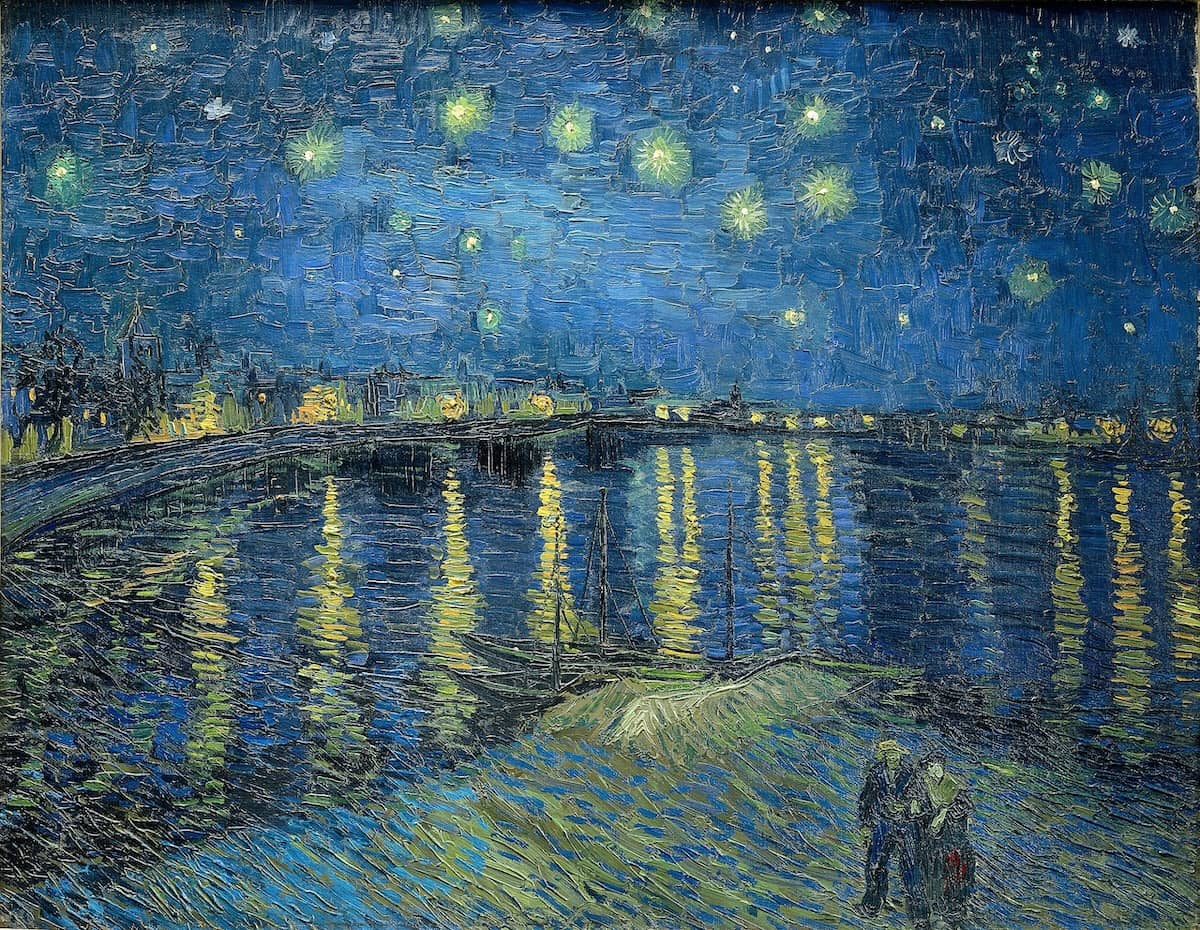
This painting is one of van Gogh’s paintings of the night sky and the effects of light at night. In this painting, we see a more realistic nighttime sky. We see a contrast between the two different types of light: starlight and light coming from the gas lamps, reflected on the river.1
Vincent van Gogh (1853-1890) was born the son of a preacher in 1853 in Holland. He pursued a career in art for most of his life; he was never considered successful, though he worked tirelessly for days, sometimes without stopping to eat! Even though he painted over 800 works, only one painting sold during his lifetime. Van Gogh’s works are characterized by large, sweeping brush strokes using paints in a very thick amount. Sometimes he would store the paint on with a knife, almost like working with clay. Van Gogh also painted still lifes of fruits (lemons and pears) and of flowers (irises and sunflowers). Today, several of his paintings rank among the most expensive in the world! Other painters that lived during van Gogh’s lifetime were Jean-Francois millet, Paul Gaugin, Camille Pissarro, and Claude Monet. 2
MUSIC APPRECIATION
“Lullaby,” op. 49, No. 4 by Johannes Brahms
Johannes Brahms may have written the world’s most famous lullaby. Wiegenlied, Op. 49, No.4 was dedicated to Brahms’ former lover, Bertha Faber, after the birth of her son. The melody found its way into the first movement of Brahms’ Second Symphony in a slightly altered form.
3
Johannesburg Brahms (1833-1897) was one of the big “Three B’s” of the classical music world and is most widely known by modern audiences for his melodic lullaby, but his influence goes much further afield than simple children’s tunes.
The son of a lower middle class family, Brahms was born in Hamburg of the early 19th century; a scruffy port city filled with exotic traders and seedy traffickers alike. Although in an earlier era, it had been home to a number of fine musicians, it was, at the midpoint of the 19th century, a unseemly and unlikely a place for a future legend to arise as one might imagine. Although admittedly he was no child prodigy, he occasionally dislikened himself to the young Mozart, Brahms would tell listeners on later occasions that his father, a trained musician himself, often arranged Brahms’ early concerts in the public bars of the town. Bars of that place and era doubled as houses of ill-repute; it was an entirely shocking inverse portrait of Brahms’ life overlaid by evoking the measure of natural and wholesome adoration Wolfgang’s father’s evidenced for his child in securing him appointments to all the finest courts of Europe.4
- Lange, Krista, and Leigh Lowe. First Grade Enrichment: Classical Core Curriculum. Teacher Guide. Memoria Press, 2017. ↩︎
- Ibid. ↩︎
- Judd, Timothy. “Brahms’ Wiegenlied, Op. 49, No. 4.” Timothy Judd, Suzuki Violin Lessons, 7 Oct. 2015, timothyjuddviolin.com/tag/carnegie-hall/. ↩︎
- “Johannes Brahms: Kennedy Center.” The Kennedy Center, http://www.kennedy-center.org/artists/b/bo-bz/johannes-brahms/. Accessed 10 Oct. 2024. ↩︎
 Providence School of Tifton