“To integrate subjects means to remove barriers between areas of study and to make connections among subjects, because all truth ultimately belongs to God. ‘Subjects’ are a hallmark of modern education: algebra for an hour, then literature, then physics, then Bible if it’s a Christian school. But when subjects are isolated from each other, students make fewer connections, even between subjects that fit well together such as history and literature. They learn not to use all their skills in every class, and never develop the habit of taking everything in life from a Christian perspective. Classical Christian education strives to integrate material both laterally — every subject with every other subject — and vertically — every subject as it belongs to God.”
― Association of Classical Christian Schools (ACCS)
ROMANS 5:6-8
6 For while we were still weak, at the right time Christ died for the ungodly. 7 For one will scarcely die for a righteous person—though perhaps for a good person one would dare even to die— 8 but God shows his love for us in that while we were still sinners, Christ died for us.
ST. THOMAS’S PRAYER BEFORE STUDY
Creator of all things, true source of light and wisdom, origin of all being, graciously let a ray of your light penetrate the darkness of our understanding. Take from us the double darkness in which we have been born, an obscurity of sin and ignorance. Give us keen understanding, retentive memories, and the ability to grasp things correctly and fundamentally. Grant us the talent of being exact in our explanations and the ability to express ourselves with thoroughness and charm. Point out the beginning, direct the progress, and help in the completion. We ask this through Christ our Lord. Amen.
ART APPRECIATION
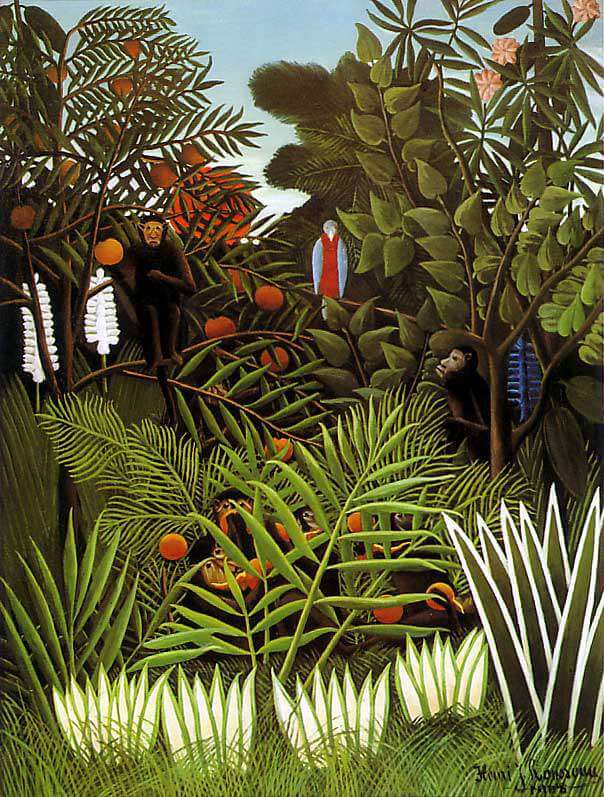
Many of Rousseau’s best-known pictures are jungle scenes. Though he portrayed them beautifully, Rousseau never visited any jungles. All his inspirations came from books, of which Exotic Landscape is an example. Notice the different shades of green in this jungle scene. Rousseau applied color very carefully and was considered a master colorist.1
Henri Rousseau (1844-1910) was born in France. He went to school as any normal child would. He was not a standout student in any subjects, but he did win prizes for drawing and music. Rousseau married, had children, and worked as a tax collector on goods entering Paris. It was not until he retired that he focused on painting full-time. Since he never had any formal art instruction, he was considered naive or primitive. 2
MUSIC APPRECIATION
“Sheherazade,” op. 35 by Nikolai Rimsky-Korsakov
Risky-Korsakov wrote this piece, which has four different parts, to remind the listener of fairy tales of the Middle East. It is based on the story of Scheherazade, the queen who told 1,000 stories for 1,001 nights to the Sultan, who finally fell in love with her.
3
Nikolai Rimsky-Korsakov (1844-1908) was born into an aristocratic family who, despite realizing their son had musical ability, did not take it seriously because being a composer was not considered suitable for someone of their social standing. Based on his parents’ wishes, he studied for a career in the Imperial Russian Navy.
While at school, he took piano lessons. Rimsky-Korsakov became convinced as his studies progressed that he could make a career in music, even though he lacked the formal music training of a conservatory. He began composing his first symphony while at sea in the Russian navy.
As his naval duties lessened, he found more time to compose. In 1871, he was invited to become a professor at the St. Petersburg Conservatory. He resigned his naval commission in 1873, devoting himself to teaching and composing. Ironically, the more he taught, the more he realized his need for more professional training. He began to study harmony, counterpoint, and orchestration in earnest.
He is considered a highly skilled orchestrator. He is also known for orchestrating, revising, and finishing the works of other Russian composers.4
- “Tree of Life Window.” The Charles Hosmer Morse Museum of American Art, 26 Aug. 2022, morsemuseum.org/collection-highlights/windows/window-tree-of-life-2/. ↩︎
- Lange, Krista, and Leigh Lowe. First Grade Enrichment: Classical Core Curriculum. Teacher Guide. Memoria Press, 2017. ↩︎
- Fata, Patrick. Music Appreciation I. Memoria Press, 2017. ↩︎
- “Nicolai Rimsky-Korsakov.” The Kennedy Center, http://www.kennedy-center.org/education/resources-for-educators/classroom-resources/media-and-interactives/artists/rimsky-korsakov-nicolai/. Accessed 30 Sept. 2024. ↩︎
 Providence School of Tifton