
“The seven liberal arts are skills that free a person to learn for themselves, direct themselves, and lead others well. They cultivate one’s reasoning skills and provide one with the tools of learning through seven arts split into the trivium and the quadrivium.
The term ‘liberal arts’ has some unfortunate connotations. But considering the liberal arts are possibly the most influential element in classical education, understanding what they are is paramount. Classically understood, the liberal arts are skills that a person needs to direct themselves and lead others well. Once, the term ‘art’ simply meant that skill which produced something new. On one hand, a person can build a rocking chair by imitating or copying someone else, but mere imitation is not art. On the other hand, if he had read many books about building rocking chairs but did not build them himself, his knowledge would be considered ‘science’ rather than art. ‘Science’ in this sense comes from the Latin word scientia meaning knowledge. Rather, an art is a skill. Someone may learn a skill through imitation and knowledge, but in order to really have a skill he needs to add his own mind to the equation. An art, or skill, requires a mind that can think and reason.
So what is a liberal art, then? The liberal arts tower above the other arts because they produce the works of reason which are needed for every art. While fine arts produce beautiful music and art, and mechanical arts produce solid rocking chairs and car engines, liberal arts train the mind to think. They train the human mind in logic, language, mathematics. In doing so, they strengthen one’s mind, which benefits the other arts and gives one the tools of learning needed to find knowledge (i.e. science). They are called “liberal,” because they make for free-thinking people, people who don’t need others to direct them but can direct themselves, people who can lead others.”
― Association of Classical Christian Schools (ACCS)
ISAIAH 5:1-3
1 Who has believed what he has heard from us?
And to whom has the arm of the Lord been revealed?
2 For he grew up before him like a young plant, and like a root out of dry ground;
he had no form or majesty that we should look at him, and no beauty that we should desire him.
3 He was despised and rejected by men,
a man of sorrows and acquainted with grief;
and as one from whom men hide their faces he was despised, and we esteemed him not.
A PRAYER OF THANKSGIVING
Almighty God, Father of all mercies, we your unworthy servants give you humble thanks for all your goodness and loving-kindness to us and to all whom you have made. We bless you for our creation, preservation, and all the blessings of this life; but above all for your immeasurable love in the redemption of the world by our Lord Jesus Christ; for the means of grace, and for the hope of glory. And, we pray, give us such an awareness of your mercies, that with truly thankful hearts we may show forth your praise, not only with our lips, but in our lives, by giving up ourselves to your service, and by walking before you in holiness and righteousness all our days; through Jesus Christ our Lord, to whom, with you and the Holy Spirit, be honor and glory throughout all ages. Amen.
ART APPRECIATION
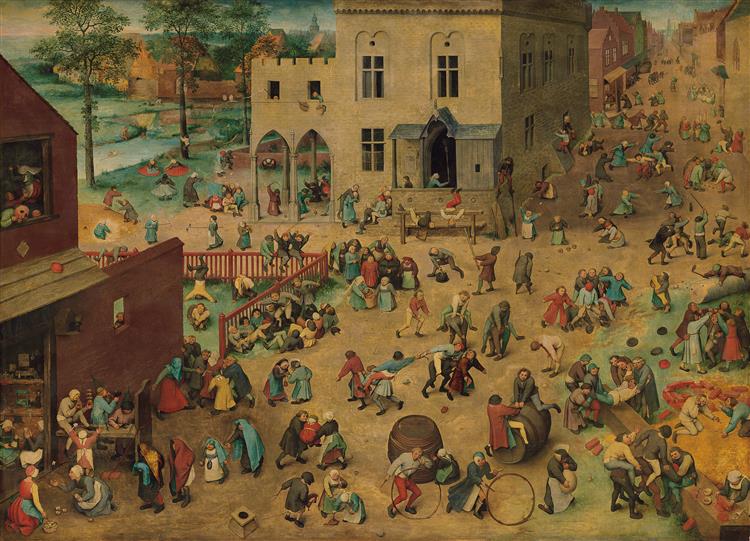
Bruegel loved to paint common people doing common things. Look closely at the children in this European town. There are more than 230 children playing about 90 different games.1
Pieter Bruegel the Elder (c. 1525-1530 to 1569) was known as the greatest Netherlandish (Flemish) painter of the 16th century. Bruegel painted proverbs, landscapes, views of peasant life, and panoramic biblical scenes. Early in his career he studied art in Italy.2
MUSIC APPRECIATION
“In the Hall of the Mountain King” from Peer Gynt by Edvard Grieg
This is the scene of the opera when Peer Gynt is dreaming that he is standing in front of throne of a troll king. The description of the scene by the author says: There is a great crowd of troll couriers, gnomes and goblins. Dovregubben [The Troll King] sits on his throne, with crown and scepter, surrounded by his children and relatives. Peer Gynt stands before him. there is a tremendous uproar in the hall.3
Edvard Grieg (1810-1849) was a Norwegian composer and pianist. He is widely considered one of the leading Romantic era composers, and his music is part of the standard classical repertoire worldwide. His use and development of Norwegian folk music in his own compositions put the music of Norway in the international spectrum, as well as helping to develop a national identity, much as Jean Sibelius and Antonín Dvořák did in Finland and Bohemia, respectively.4
- “Tree of Life Window.” The Charles Hosmer Morse Museum of American Art, 26 Aug. 2022, morsemuseum.org/collection-highlights/windows/window-tree-of-life-2/. ↩︎
- Lange, Krista, and Leigh Lowe. First Grade Enrichment: Classical Core Curriculum. Teacher Guide. Memoria Press, 2017. ↩︎
- Fata, Patrick. Music Appreciation I. Memoria Press, 2017. ↩︎
- “Edvard Grieg.” Edvard Grieg – Steinway & Sons, http://www.steinway.com/artists/edvard-grieg. Accessed 13 Sept. 2024. ↩︎
 Providence School of Tifton