
“Lord Jesus, teach me to be generous.
Teach me to serve as you deserve,
To give and not count the cost,
To fight and not heed the wounds,
To labor and not to seek to rest,
To give of myself and not ask for a reward,
Except the reward of knowing that I am doing your will.”
― St. Ignatius of Loyola
MATTHEW 5:2-10
2 And he opened his mouth and taught them, saying: 3 “Blessed are the poor in spirit, for theirs is the kingdom of heaven. 4 “Blessed are those who mourn, for they shall be comforted. 5 “Blessed are the meek, for they shall inherit the earth.
6 “Blessed are those who hunger and thirst for righteousness, for they shall be satisfied. 7 “Blessed are the merciful, for they shall receive mercy. 8 “Blessed are the pure in heart, for they shall see God. 9 “Blessed are the peacemakers, for they shall be called sons of God. 10 “Blessed are those who are persecuted for righteousness’ sake, for theirs is the kingdom of heaven.
ST. FRANCIS’S PRAYER OF DESIRE
Therefore, let us desire nothing else, let us want nothing else, let nothing else please us and cause us delight except you our Creator, Redeemer and Savior, the only true God, Who is the fullness of good, all good, every good, the true and supreme good, Who alone is good, merciful, gentle, delightful, and sweet, Who alone is holy, just, true, holy, and upright, Who alone is kind, innocent, clean, from Whom, through Whom and in Whom is all pardon, all grace, all glory of all penitents and just ones, of all the blessed rejoicing together in heaven. Amen.
ART APPRECIATION
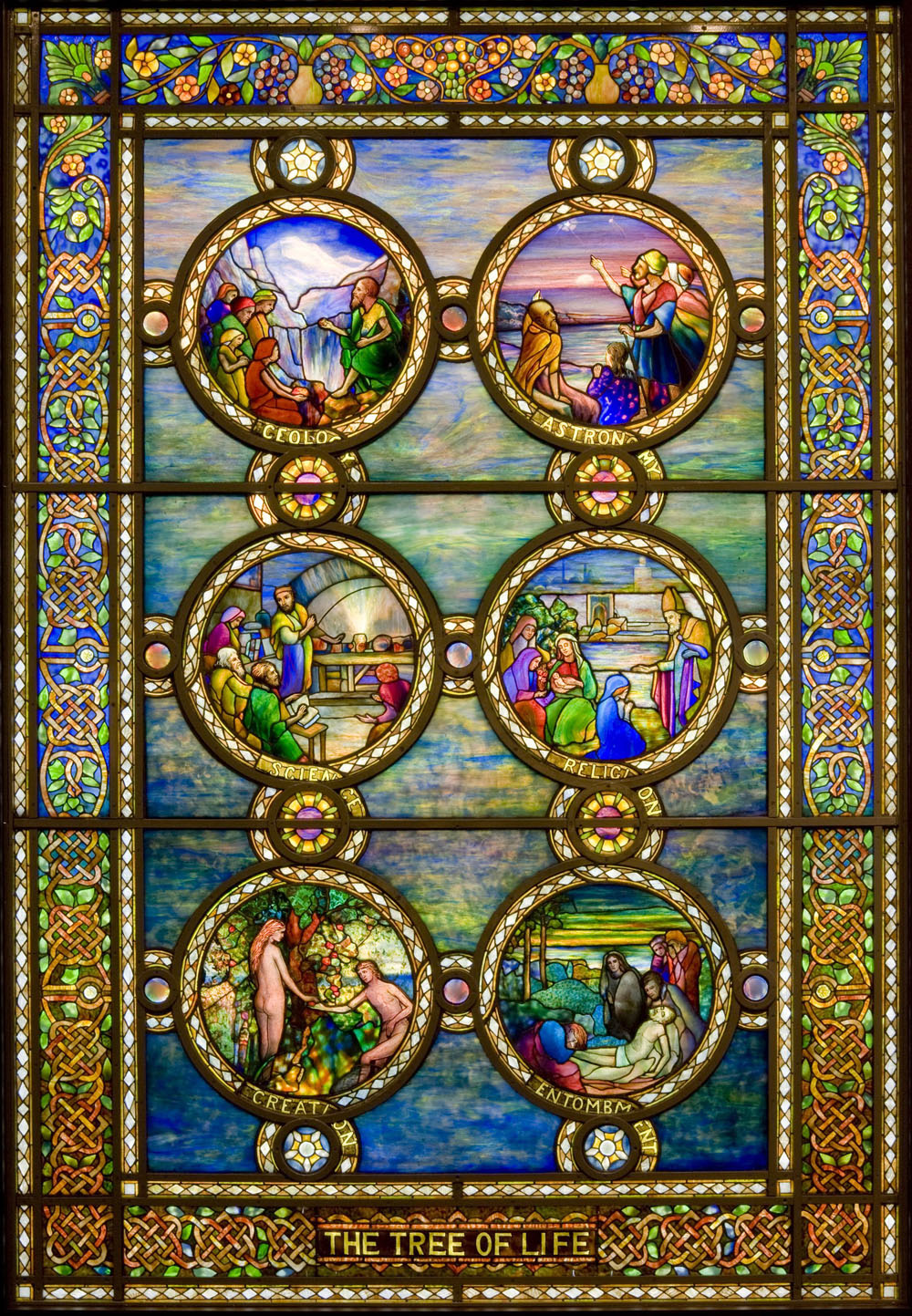
The Tree of Life window is significant as the last window designed by Louis Comfort Tiffany (1848–1933) and for the meaning the artist assigned the window’s themes in his legacy. It is also the only known window that Tiffany designed in Florida. First conceived in 1929, the window was designed over the course of three winters at the artist’s winter home, Comfort Lodge, in Miami and completed in New York in 1931. Tiffany designed this finale to his window-making career to “be an everlasting inspiration to each successive group” of fellows studying at the Louis Comfort Tiffany Foundation he had organized at his Long Island estate to preserve his artistic vision and influence generations of artists to come. The completed Tree of Life window was unveiled May 29, 1932, on the north wall of the “large studio room” in the fellows section at the foundation. The composition of the window reflects a traditional medieval medallion format. The source is believed to be a twelfth-century psalter cover. The window’s six rondels are devoted to subjects Tiffany personally believed to be important in the instruction of art students. The left column medallions, Geology, Science, and Creation, dwell on earthly subjects. The right column rondels, Astronomy, Religion, and Entombment, represent heavenly and spiritual pursuits.1
Louis Comfort Tiffany (1848-1933) was born in New York, the son of Charles Lewis Tiffany, the founder of a jewelry store called Tiffany & Company. Tiffany attended two military academies and began his artistic pursuits as a painter. He became interested in glassmaking, and today is best known for his work in stained glass. Tiffany began to make his own colored glass and was a pioneer in his stained glass works. Before this time, stained glass was clear glass that was painted. Tiffany was a leader in the American Art Nouveau movement, where art was applied to glassware, ironworks, and posters.2
MUSIC APPRECIATION
Etude op. 10, No. 12 in C Minor, “Revolutionary” by Frédéric Chopin
Chopin transformed the études, originally meant to be technical exercises, into concert pieces, though he still wrote them with the goal of improving piano technique. This étude, his 12th, was written at the same time as the November Uprising of 1831 in his native Poland.3
Frédéric Chopin (1810-1849) was born in Zelazowa-Wola, in a village six miles from Warsaw, Poland in 1810, to a French father and a Polish mother. His father had moved to Poland to be a tutor for the son of a countess. He was an extremely rare child prodigy, who started playing the piano at age 4. By the time he was 8 years old he was giving private concerts in Warsaw. He published his first composition “a rondo” at age 15. From 1823 to 1826, Chopin attended the Warsaw Lyceum, where his father was a professor. In the autumn of 1826, Chopin began studying music theory, at the Warsaw Conservatory. He later moved to Paris where he taught piano lessons. He often played the piano in private homes preferring this to public concerts. While in Paris, he became a noted pianist, teacher, and composer. He developed a relationship with and fell deeply in love with French female novelist George Sand (born Aurore Dudevant). At the time she came into his life, he was a virtuoso and a favorite in Parisian salons, he was only twenty-seven years of age. Chopin had begun to suffer from tuberculosis when their relationship ended in 1847, thereafter his musical activity was limited; he scarcely composed. He made several last requests on his deathbed, one request for his funeral, was for Mozart’s Requiem be sung at his funeral, and for it to be held at the Church of the Madeleine. His funeral was delayed for almost 2 weeks while the church considered his wish. Although Chopin is buried in the Père Lachaise cemetery in Paris, his heart is entombed in a pillar in the Church of the Holy Cross in Warsaw. He had a fear of being buried alive and asked to be “cut open” to make sure he was dead before burial. He died in Paris of tuberculosis in 1849, at the age of 39.4
- “Tree of Life Window.” The Charles Hosmer Morse Museum of American Art, 26 Aug. 2022, morsemuseum.org/collection-highlights/windows/window-tree-of-life-2/. ↩︎
- Lange, Krista, and Leigh Lowe. First Grade Enrichment: Classical Core Curriculum. Teacher Guide. Memoria Press, 2017. ↩︎
- Fata, Patrick. Music Appreciation I. Memoria Press, 2017. ↩︎
- “Frédéric Chopin: Kennedy Center.” The Kennedy Center, http://www.kennedy-center.org/artists/c/ca-cn/frederic-chopin2/. Accessed 13 Sept. 2024. ↩︎
 Providence School of Tifton