
“He is happy who lives in accordance with complete virtue and is sufficiently equipped with external goods, not for some chance period but throughout a complete life.”
― Aristotle, The Nicomachean Ethics
2 PETER 3:14-18
14 Therefore, beloved, since you are waiting for these, be diligent to be found by him without spot or blemish, and at peace. 15 And count the patience of our Lord as salvation, just as our beloved brother Paul also wrote to you according to the wisdom given him, 16 as he does in all his letters when he speaks in them of these matters. There are some things in them that are hard to understand, which the ignorant and unstable twist to their own destruction, as they do the other Scriptures. 17 You therefore, beloved, knowing this beforehand, take care that you are not carried away with the error of lawless people and lose your own stability. 18 But grow in the grace and knowledge of our Lord and Savior Jesus Christ. To him be the glory both now and to the day of eternity. Amen.
COLLECT FOR PURITY
Almighty God, unto whom all hearts are open, all desires known, and from whom no secrets are hid; cleanse the thoughts of our hearts by the inspiration of your Holy Spirit, that we may perfectly love You, and worthily magnify your holy Name, through Christ our Lord. Amen.
ART APPRECIATION
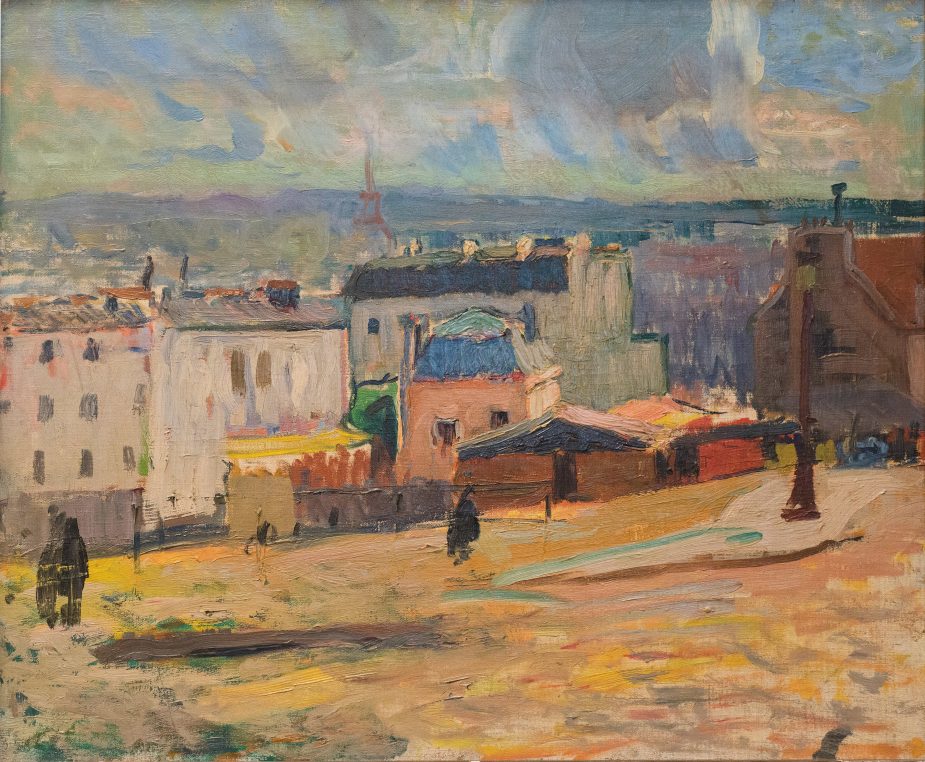
By the early 1900s, Dufy had developed a style in line with the Fauves. The Fauves, meaning “wild beasts,” received this name because they used such bright and unrealistic colors in their works.1
Raoul Duffy (1877-1953) was a Modern artist best known for his colorful paintings of luxury and pleasure. In 1900, Dufy attended the Ecole des Beaux-Arts in Paris, and he painted in an Impressionist style in his early works.2
MUSIC APPRECIATION
Intermezzo from Cavalleria Rusticana by Pietro Mascagni
This is the Intermezzo from the middle of the opera Cavalleria Rusticana, which Mascagni wrote in just two months so he could enter it in a competition to have it performed as his first opera. He won the competition, and the opera, as well as this intermezzo, went on to be performed 14,000 times during his lifetime, and many more times since then.3
Pietro Mascagni (1863-1945) was an Italian composer most noted for his operas. His 1890 masterpiece Cavalleria rusticana caused one of the greatest sensations in opera history and single-handedly ushered in the Verismo movement in Italian dramatic music. However, though it has been stated that Mascagni, like Leoncavallo, was a “one-opera man” who could never repeat his first success, this is inaccurate. L’amico Fritz and Iris have been popular in Europe since their respective premieres. In fact, Mascagni himself claimed that at one point Iris was performed in Italy more often than Cavalleria (cf. Stivender). 4
- Lange, Krista, and Leigh Lowe. First Grade Enrichment: Classical Core Curriculum. Teacher Guide. Memoria Press, 2017. ↩︎
- Ibid. ↩︎
- Fata, Patrick. Music Appreciation I. Memoria Press, 2017. ↩︎
- “Pietro Mascagni: Kennedy Center.” The Kennedy Center, http://www.kennedy-center.org/artists/m/ma-mn/pietro-mascagni2/. Accessed 8 Sept. 2024. ↩︎
 Providence School of Tifton