
“But what, you ask, about love? Is this not the first and great Commandment, that we should love God above all? And is not the second commandment like it — that we should love our neighbor as ourselves? Yes, indeed. But to love God above all is to struggle and pray for the coming of God’s Reign of shalom, to savor its presence and mourn its absence. And if we must say, in a word, how those who act in the Messianic light will treat their fellows, that word is love. In particular, Justice flows forth from Love: loving one’s neighbor requires and includes respecting his or her rights. In Kant, the center of the picture is always me and the moral law — this moral law being the Deliverance of my own Transcendent self. In the prophets the center of attention is not the moral law but persons — the widow, the alien, and the orphan, the little ones, the voiceless ones, the oppressed ones, the poor ones — the hundredth one, the one left outside. Of course there is law. But the law is grounded in God’s love for the little ones.”
― Nicholas Wolterstorff, Educating For Shalom
JOHN 14:25-31
25 “These things I have spoken to you while I am still with you. 26 But the Helper, the Holy Spirit, whom the Father will send in my name, he will teach you all things and bring to your remembrance all that I have said to you. 27 Peace I leave with you; my peace I give to you. Not as the world gives do I give to you. Let not your hearts be troubled, neither let them be afraid. 28 You heard me say to you, ‘I am going away, and I will come to you.’ If you loved me, you would have rejoiced, because I am going to the Father, for the Father is greater than I. 29 And now I have told you before it takes place, so that when it does take place you may believe. 30 I will no longer talk much with you, for the ruler of this world is coming. He has no claim on me, 31 but I do as the Father has commanded me, so that the world may know that I love the Father. Rise, let us go from here.”
ST. THOMAS’S PRAYER BEFORE STUDY
Creator of all things, true source of light and wisdom, origin of all being, graciously let a ray of your light penetrate the darkness of our understanding. Take from us the double darkness in which we have been born, an obscurity of sin and ignorance. Give us keen understanding, retentive memories, and the ability to grasp things correctly and fundamentally. Grant us the talent of being exact in our explanations and the ability to express ourselves with thoroughness and charm. Point out the beginning, direct the progress, and help in the completion. We ask this through Christ our Lord. Amen.
ART APPRECIATION
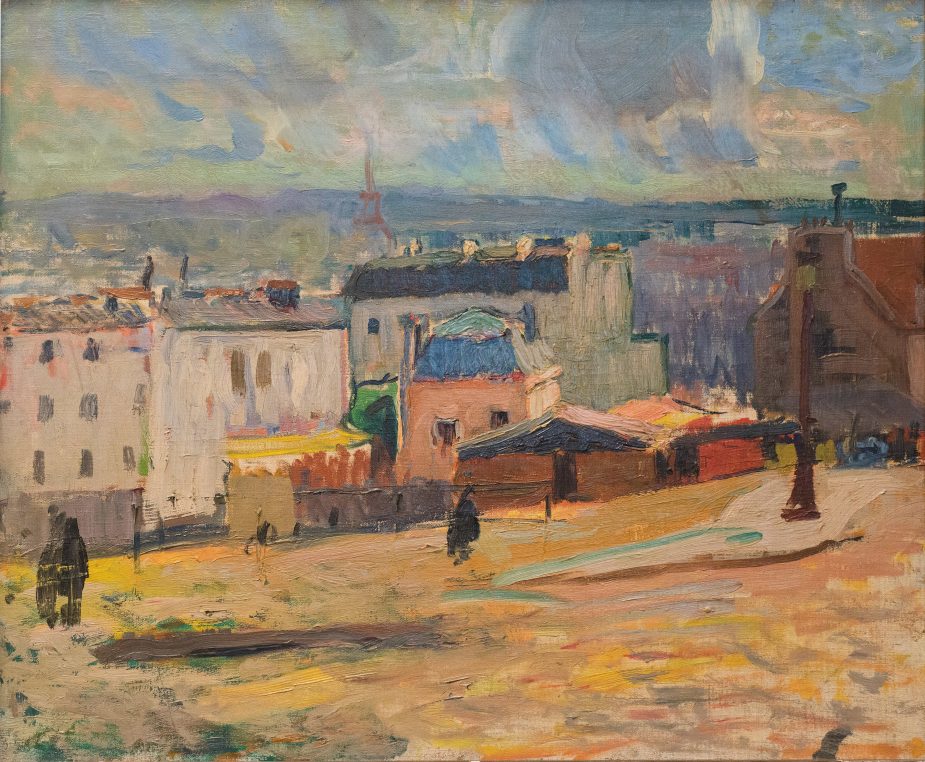
By the early 1900s, Dufy had developed a style in line with the Fauves. The Fauves, meaning “wild beasts,” received this name because they used such bright and unrealistic colors in their works.1
Raoul Duffy (1877-1953) was a Modern artist best known for his colorful paintings of luxury and pleasure. In 1900, Dufy attended the Ecole des Beaux-Arts in Paris, and he painted in an Impressionist style in his early works.2
MUSIC APPRECIATION
Intermezzo from Cavalleria Rusticana by Pietro Mascagni
This is the Intermezzo from the middle of the opera Cavalleria Rusticana, which Mascagni wrote in just two months so he could enter it in a competition to have it performed as his first opera. He won the competition, and the opera, as well as this intermezzo, went on to be performed 14,000 times during his lifetime, and many more times since then.3
Pietro Mascagni (1863-1945) was an Italian composer most noted for his operas. His 1890 masterpiece Cavalleria rusticana caused one of the greatest sensations in opera history and single-handedly ushered in the Verismo movement in Italian dramatic music. However, though it has been stated that Mascagni, like Leoncavallo, was a “one-opera man” who could never repeat his first success, this is inaccurate. L’amico Fritz and Iris have been popular in Europe since their respective premieres. In fact, Mascagni himself claimed that at one point Iris was performed in Italy more often than Cavalleria (cf. Stivender). 4
- Lange, Krista, and Leigh Lowe. First Grade Enrichment: Classical Core Curriculum. Teacher Guide. Memoria Press, 2017. ↩︎
- Ibid. ↩︎
- Fata, Patrick. Music Appreciation I. Memoria Press, 2017. ↩︎
- “Pietro Mascagni: Kennedy Center.” The Kennedy Center, http://www.kennedy-center.org/artists/m/ma-mn/pietro-mascagni2/. Accessed 8 Sept. 2024. ↩︎
 Providence School of Tifton